Which is better: tile, shingle, or metal roofing in South Florida?
Shingle is the value pick and looks right on most Miami-Dade homes. Tile is what most neighborhoods here expect, and it lasts the longest. Metal earns its price near the water and on low-slope or modern roofs. All three can be built to full HVHZ code. What separates them is fit, look, lifespan and budget.
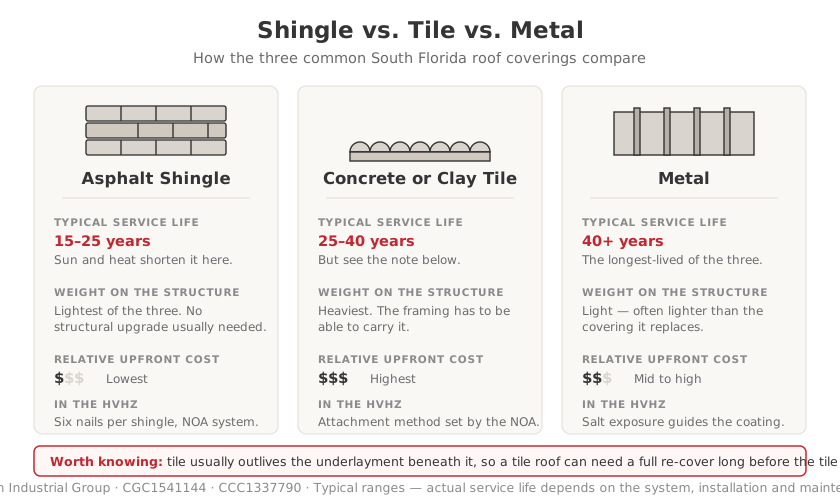
| System | Typical FL lifespan | Relative cost | Best fit |
|---|---|---|---|
| Asphalt shingle | 18–25 years | $ | Budget-conscious; broad style range |
| Concrete / clay tile | 30–50+ years | $$–$$$ | Longevity, curb appeal, HOA neighborhoods |
| Standing-seam metal | 40–50+ years | $$$ | Coastal / salt-air, modern & lower-slope roofs |
Is asphalt shingle a good roofing choice in South Florida?
Shingle is the cheapest way to get a code-compliant HVHZ roof, and there is nothing wrong with that. We install GAF and TAMKO architectural shingles over synthetic underlayment, with a sealed water barrier and the wind-rated nailing pattern the HVHZ requires.
Plan on 18 to 25 years here. That is shorter than the number printed on the wrapper, and the reason is sun. Asphalt bakes in Miami-Dade. On tear-off we see the same thing over and over: the south and west slopes are brittle and shedding granules while the north slope still looks almost new. Your gutters tell you before your ceiling does.
Where shingle is the wrong call: if your HOA mandates tile, or if you want the longest life you can buy, it is not this.
Is concrete or clay tile the right roofing choice in South Florida?
Tile is the South Florida default and it earns it. It handles the sun, it lasts, and it is the look most local neighborhoods and HOA boards expect. We install Westlake Royal (Newpoint) tile over the two-ply Polyglass underlayment system.
Here is the part homeowners rarely get told. On a tile roof, the tile is not what keeps the water out. The underlayment is. The tile is the wear layer and the wind layer. When we tear off a 30-year-old tile roof, the tile is usually still perfectly good; what failed is the felt underneath it. That is why the two-ply system matters more than the brand stamped on the tile, and why a bid that names the tile but says nothing about the underlayment is a bid to read twice.
The tradeoffs are real: tile costs more than shingle, it is heavier, and a proper tile re-roof is a bigger job with more days on your driveway. A house originally built for tile is engineered for the weight. If you are going from shingle up to tile, we check the structure before we put a number on it. In return you get 30 to 50-plus years and the best curb appeal of the three.
Is standing-seam metal roofing right for South Florida?
We install painted standing-seam aluminum and painted standing-seam Galvalume, both in the Englert Series 1300 profile with a factory Kynar/PVDF finish, rated 40 to 50-plus years.
Near the water, aluminum. It does not rust, and that is the whole argument. Galvalume is the value option for inland homes. On a standing-seam roof the fasteners are hidden under the seam, which does two things worth paying for: there is no exposed rubber washer to dry out and start leaking around year ten, and there is no screw head sitting out in salt air.
We do not install stone-coated steel, bare unpainted metal, or exposed-fastener panels. Exposed-fastener panels are what we get called out to repair. The washers harden, the screws back out, and by the time anyone notices the stain on the ceiling the holes are wallowed out and you cannot simply re-torque them.
How do you choose between tile, shingle, and metal roofing?
Work through it in this order:
- HOA or architectural rules. If tile is required, that decides it. Check this before you price anything.
- How close you are to salt water. Inside about a mile, aluminum standing-seam or tile beats shingle.
- How long you are staying. Twenty more years in the house? Tile or metal pays it back. Selling in five? Shingle is the rational answer and we will tell you so.
- Budget. Shingle, then tile, then metal. Price the lifespan, not just the install.
Frequently asked questions
Which roof lasts the longest?
Is metal roofing loud in the rain?
Will tile crack or is it too heavy for my house?
Can I put metal or tile on any house?
What do you recommend for a coastal/waterfront home?
Ask us to price two of them. Seeing your own roof quoted in shingle and in tile tells you more than any comparison chart, including this one.