Are concrete and clay tile both good roofing choices?
Concrete tile is the cost-effective workhorse with huge style range. Clay is the premium choice for color permanence and the longest life. But on either one, the two-ply self-adhered underlayment beneath the tile is what actually keeps water out, and it’s the same critical system on both.
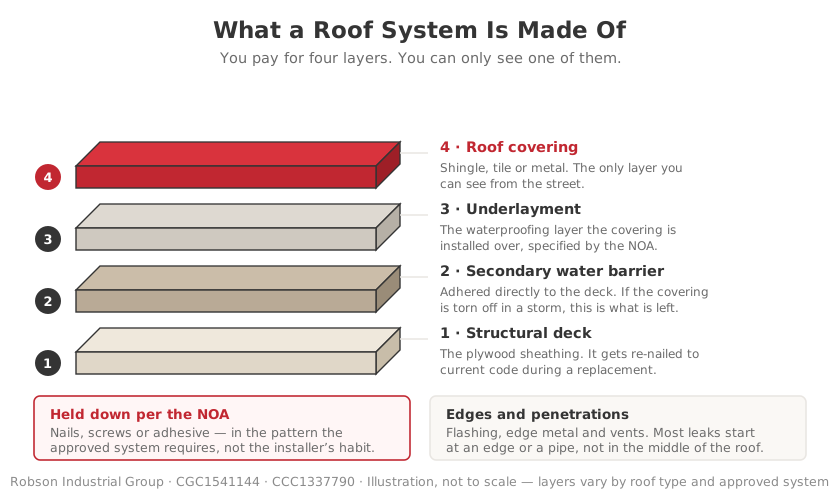
Here’s the thing most homeowners don’t realize: tile roofs don’t keep water out with the tile alone. The tile sheds the bulk of the water and protects the layers beneath it from sun, but the waterproofing is the underlayment. We install both concrete and clay over a two-ply Polyglass system: an anchor sheet that resists nail pull-through far better than felt, plus a self-adhered cap that seals around every fastener. Whatever tile you pick, that system is what determines how long the roof lasts. Choose the tile for looks and budget; trust the underlayment for performance.
What are the pros and cons of concrete tile?
Concrete tile is the most common tile in South Florida, and for good reason. We install Westlake Royal (Newpoint) concrete tile. Strengths:
- Cost-effective — less expensive than clay while still delivering 30–50+ years.
- Huge range of profiles and colors — flat, low, and high profiles; nearly any color, including blends that mimic clay or slate.
- Durable and proven in our climate.
The main tradeoff is color: many concrete tiles are surface-colored, so over decades the color can soften compared to clay’s through-body color. Modern concrete tiles have improved a lot on this, but it’s the classic difference.
What are the pros and cons of clay tile?
Clay is the premium, traditional choice (true terracotta, fired to its color). Strengths:
- Color permanence — the color is the material, not a coating, so it holds for the life of the tile.
- Longest life — quality clay can outlast concrete, often the longest-lived roof you can buy.
- The classic look — the Mediterranean/Spanish profile many South-Florida neighborhoods and HOAs were designed around.
The tradeoff is cost: clay generally costs more than concrete, both for the material and sometimes the installation. For a high-end home, an HOA that requires it, or an owner who wants the longest life and truest color, it’s worth it.
How do you choose between concrete and clay tile?
| Concrete | Clay | |
|---|---|---|
| Cost | Lower | Higher |
| Color | Often surface-applied | Through-body, permanent |
| Lifespan | 30–50+ years | Often the longest |
| Style range | Very broad | Classic terracotta profiles |
| Best for | Value + flexibility | Premium homes, color permanence, HOA mandates |
Two things to check either way: your HOA’s architectural rules (some specify tile type or color), and your roof structure (homes built for tile handle either; if you’re switching from a lighter system we verify the structure first). And on a re-roof of an existing tile roof, ask about lift-and-relay: reusing sound tile over a fresh underlayment, which can save material cost when the tile is in good shape.
Frequently asked questions
Is clay or concrete tile better?
Does tile color fade?
Is clay tile too heavy for my roof?
What is lift-and-relay?
Will my HOA care which tile I choose?
Concrete or clay, the roof lives or dies on the underlayment beneath it. We build both over a verified two-ply system, so you can pick the tile you love and trust the part you can’t see.