What is the HVHZ?
The High-Velocity Hurricane Zone covers Miami-Dade and Broward counties. It enforces the toughest wind and product-approval rules in the Florida Building Code, so a roof that’s legal in Orlando is not automatically legal here.
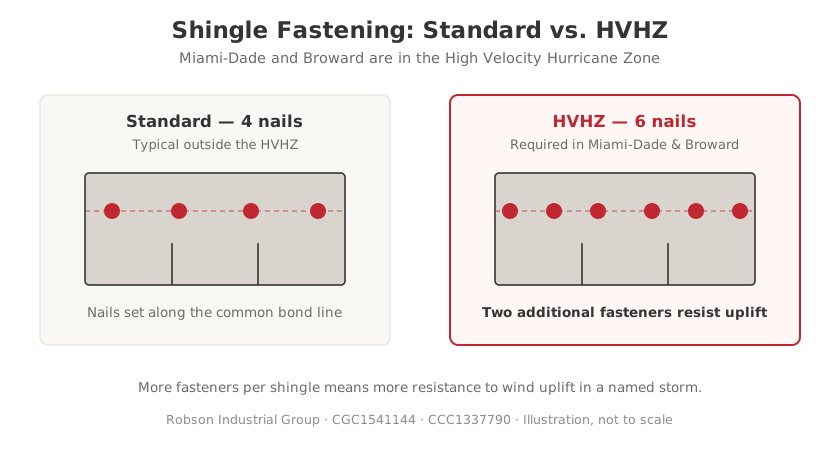
The High-Velocity Hurricane Zone (HVHZ) is a special section of the Florida Building Code that applies only to Miami-Dade and Broward counties. It exists because this is where the strongest hurricanes have historically made landfall, and where a roof failure puts the most lives and property at risk.
In practical terms, the HVHZ raises the bar on three things: the products you’re allowed to install, how those products are fastened down, and how the work is inspected. A contractor who works mostly outside South Florida often doesn’t carry these requirements in muscle memory, which is exactly why local experience matters here.
What products are approved for HVHZ roofs?
Every component that ends up on your roof has to be an approved product for the HVHZ: the underlayment, the shingles or tile or metal panels, the fasteners, the flashing. There are two approval systems you’ll see:
- a Miami-Dade Notice of Acceptance (NOA), issued by Miami-Dade County’s Product Control section; and
- a Florida Product Approval (FL number), issued at the state level.
A legitimate roof in Miami-Dade uses products that hold current approvals for this zone. If a quote can’t tell you which approved system it’s using, that’s a problem.
Why does HVHZ require a full tear-off?
Outside the HVHZ, some jurisdictions still allow a second layer of shingles over the first. Not here. The Florida Building Code requires a full tear-off down to the deck for a re-roof in the HVHZ. There’s a good reason: the inspector and the crew have to be able to see and re-nail the wood deck, install a proper secondary water barrier, and verify there’s no hidden rot. You can’t do any of that through an old roof.
Why is a secondary water barrier required in the HVHZ?
HVHZ roofs are built with a secondary water barrier: a sealed layer that keeps water out even if the primary covering is torn off in a storm. On tile and metal roofs, we use a two-ply self-adhered underlayment system. The anchor sheet alone resists nail pull-through far better than old-style felt, and the self-adhered cap seals around every fastener. It’s one of the most important, and least visible, parts of a code-correct roof.
What inspections are required for HVHZ roofing?
An HVHZ re-roof isn’t inspected once at the end. It’s inspected in stages, and the next stage can’t legally start until the previous one passes:
- Deck / sheathing nailing — the wood deck is re-nailed to current code and inspected before anything covers it.
- Dry-in & flashing — the underlayment and flashings are inspected after they go down and before the covering goes on.
- In-progress — an inspection during installation of the covering itself.
- Tile uplift (TAS 106) — for adhesive- or mortar-set tile, a pull test verifies the tiles are actually bonded.
- Final — the completed roof.
If a contractor offers to skip the permit or “handle inspections later,” walk away. The staged inspections are the homeowner’s protection.
Frequently asked questions
Does the HVHZ apply to my home?
Can I just repair my roof instead of meeting all of this?
Why is a roof more expensive here than in other parts of Florida?
How do I know a contractor is actually following HVHZ rules?
Robson is a Blue Lagoon-based, Florida-licensed roofing contractor that works in the HVHZ every day. If you want a roof built to code, and documented so you can prove it, we’d be glad to take a look.