Roofing · Miami-Dade & Broward
What Is the Miami-Dade HVHZ and Why Does It Matter for Your Roof?
Sign a roofing contract in Orlando and you can pick from almost anything on a manufacturer's catalog. Sign one in Kendall, Pinecrest, or Fort Lauderdale, and roughly half that catalog doesn't exist for you. That's the part most homeowners don't find out until they're already mid-quote: the High-Velocity Hurricane Zone doesn't just add paperwork to a re-roof. It changes what you're allowed to buy, how it has to go on your house, what your insurer and lender will say about it, and what a buyer's inspector will find if you sell in five years. If you're weighing bids right now, this is the version of HVHZ that actually affects your decision, not the regulatory backstory.
First, the boundary that matters
Florida has one statewide building code, but only two counties sit inside the full High-Velocity Hurricane Zone: Miami-Dade and Broward. Every other Florida county builds to the standard Florida Building Code wind provisions, which are already stricter than most of the country. HVHZ is a separate, tougher chapter layered on top, written specifically for the wind and wind-driven-rain exposure this corner of the state sees. If your property is anywhere in Miami-Dade or Broward, this code applies to your roof, full stop, regardless of how close or far you are from the water. If a contractor quoting your job doesn't mention HVHZ by name, that's worth asking about directly before you sign anything.
It restricts your material choices before you ever pick a color
In a lot of the country, a roofing product just needs a manufacturer warranty and a local permit sign-off. Here, every component of your roofing system, the shingle or tile itself, the underlayment, the fasteners, the flashing details, has to carry a Miami-Dade Notice of Acceptance (NOA) or an equivalent Florida Product Approval (FL number) that specifically covers HVHZ use. That NOA isn't a rubber stamp; it's the result of the product being physically tested for uplift resistance and wind-driven rain intrusion at the assembly level, not just the shingle in isolation, at wind loads engineered for 140-plus mph design conditions.
Practically, this means your options narrow the moment you start shopping. A shingle line that's sold nationally may have an HVHZ-rated version and a non-rated version, and they are not interchangeable here. The rated version usually has a different fastening spec, sometimes a different width or sealant strip, engineered to pass the uplift testing. On our jobs we spec GAF Timberline HDZ HVHZ-rated shingles for asphalt re-roofs specifically because the assembly, shingle, starter strip, cap, and approved underlayment together, holds a current NOA as a system. Swap in a cheaper underlayment that isn't part of that tested assembly, and the whole roof's compliance is void even though the shingle on top is the "right" one. This is where a lot of non-compliant re-roofs actually go wrong: not the visible product, but a component buried underneath that was never tested with it.
Tile and metal aren't exempt
The same logic applies to concrete tile and metal roofing. Tile profiles need an NOA covering the specific fastening or foam-adhesive method used, and that method is often dictated by your roof's slope and deck type. It isn't a free choice, and switching a tile line mid-project because a distributor is out of stock can mean switching the entire tested fastening system with it. Standing-seam metal systems need panel-and-clip assemblies tested together as a unit, including the clip spacing and the specific screw type at each panel run. A metal roof that performs beautifully in a low-wind market can fail HVHZ testing in a configuration that looks identical to the eye. This is a big part of why HVHZ quotes vary more than homeowners expect between contractors: they're not always quoting the same tested assembly, even when the surface material looks the same in a brochure or a sample board.
It changes how the roof physically goes on — and what that does to cost and timeline
Three installation requirements are non-negotiable under HVHZ, and each one shows up on your invoice and your calendar.
Full tear-off, every time
You cannot install a new HVHZ-compliant roofing system over an existing one. In markets without HVHZ, a "roof-over" on asphalt shingles is sometimes legal and common as a budget move. Here, every re-roof strips down to the deck. That's more labor, more dump-trailer trips, and, importantly, it's also when we find the deck problems a roof-over would have hidden: rotted sheathing, undersized nailing patterns from a prior decade's code, old flashing that was never right. Expect that discovery, and expect a contractor who flags it honestly with photos rather than quietly re-covering it and letting you find out during the next storm.
Enhanced fastening patterns
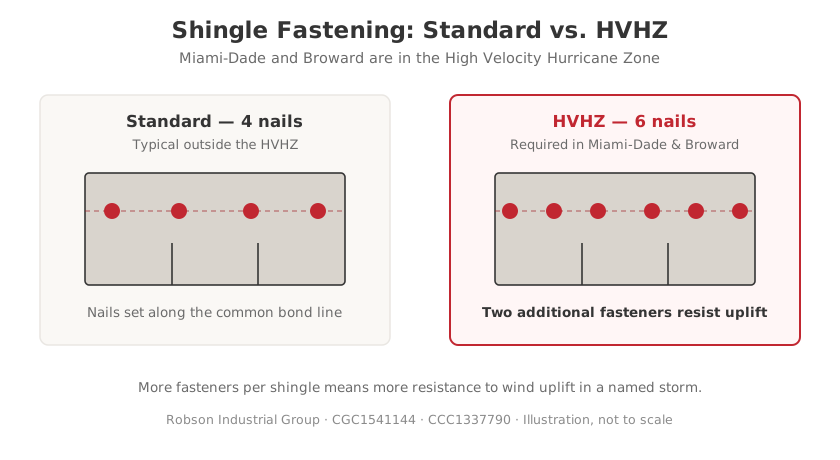
HVHZ fastening schedules call for more nails or screws per shingle or panel, placed in tighter, tested patterns, often with ring-shank fasteners instead of smooth-shank. This is invisible once the roof is finished. You will never see it from the ground, but it's the single biggest factor in whether a roof stays attached to the deck in a Cat 3-plus event instead of peeling off in sheets. It's also one of the easiest places for a corner-cutting crew to save labor time without you ever knowing, which is exactly why the staged inspections below exist.
Secondary water barrier
Beyond the standard underlayment, HVHZ requires a sealed secondary water barrier, typically a self-adhering membrane at the deck level, or taped/sealed seams on the underlayment itself, so that if the outer roofing surface is damaged mid-storm, water still can't reach the deck and the interior of your home. This is the layer that determines whether a roof that loses some shingles in a hurricane means a cosmetic repair or a full interior remediation, drywall and all.
Add these three requirements together and you get the honest answer to "why does a Miami-Dade re-roof cost more and take longer than my cousin's in Ocala": it's not markup, it's a materially different, more heavily tested scope of work, done by crews certified to install it and inspected multiple times to confirm it. As a Florida Certified General Contractor (CGC1541144) and licensed roofing contractor (CCC1337790), we're required to pull permits and schedule those inspections as part of the job. It isn't optional add-on service. It's the baseline for legal work in this zone. Budget for staged inspection scheduling to add days, not weeks, to a well-run project, but don't be surprised when it isn't a same-week turnaround the way a roof-over might be elsewhere.
What HVHZ compliance does to your insurance and financing
Florida property insurers have gotten aggressive about roof age and roof condition, and HVHZ compliance sits right in the middle of that underwriting conversation. A documented, permitted, NOA-compliant re-roof is one of the clearest ways to improve your wind-mitigation profile. Insurers recognize the enhanced fastening and secondary water barrier as measurable risk reduction, and that can move you into better rate tiers or unlock coverage that was harder to get on an older roof.
The flip side matters more at claim time than at binding time. If a roof was re-covered without pulling a permit, without the required inspections, or with products that were never tested as a system, an insurer investigating a storm claim can identify that during adjustment, and a non-compliant installation gives them grounds to deny or reduce a claim precisely when you need it most. We've seen this play out on inherited houses where a prior owner's "handyman special" roof job looked fine for years and then became a real problem the first time it needed to prove itself under a policy.
Financing follows the same logic. If you're rolling a re-roof into a home equity line, a renovation loan, or a cash-out refinance, the lender's appraisal and any wind-mitigation documentation will reference the same permit record insurers rely on. An open or missing permit on a "completed" roof is a common reason a refinance or purchase-money loan stalls at underwriting. The file doesn't match what's on the ground, and lenders in this market have learned to check. A clean, closed HVHZ permit removes that friction entirely and, on some programs, supports better terms tied to storm-hardening improvements.
What it does to resale and disclosure
When you sell in Miami-Dade or Broward, your roof's permit history is public record, and it's one of the first things a buyer's inspector and a buyer's insurance agent will pull. A roof with a closed, compliant permit and passed final inspection is a selling point you can put in the listing. A roof with no permit on file, or an open/expired permit, is a flag that stalls closings. Buyers' lenders and insurers increasingly ask for it directly, and "the roof looks new" doesn't answer the question if the county record doesn't back it up. If you're re-roofing with resale in mind at all, insist on a fully permitted, inspected job and keep the closeout paperwork; it's worth real money at the closing table later, and it's a five-minute conversation now versus a delayed closing later.
What to ask your contractor — HVHZ-specific checklist
Before you sign anything, get straight answers on these five questions:
1. Can you show me the NOA number for the exact assembly you're installing, not just the shingle or tile, but the underlayment and fastening pattern it's tested with? A contractor who can produce this on request, in writing, is doing the job correctly.
2. Is this a full tear-off, and is that reflected in the written scope, not a verbal promise, but a line item on the contract with the deck inspection called out separately?
3. What secondary water barrier product are you using, and is it part of the same tested assembly as the rest of the system, or a substitute swapped in to save cost?
4. Who is pulling the permit, and are you scheduling the required staged inspections (deck/dry-in, in-progress, and final) rather than just a final walkthrough after the fact?
5. Will I receive the closed permit and inspection record for my files, so I have it for insurance renewal, refinancing, and eventual resale?
If a contractor is vague on any of these, that's the moment to walk, not the moment to hope it works out.
FAQ
Does HVHZ apply to my entire county, or just coastal areas?
It applies to the entire county. Miami-Dade and Broward are the only two counties in Florida under full HVHZ jurisdiction, and the code applies uniformly whether your property is oceanfront or well inland. There is no distance-from-coast exemption written into the code itself.
Can I install a non-HVHZ-rated roofing product if I just want something cheaper?
No. Local building departments will not approve a permit for a roofing assembly that lacks a valid NOA or Florida Product Approval covering HVHZ use, and installing without a valid permit exposes you to code enforcement issues, insurance claim denial, and resale complications. The upfront savings are rarely worth what it costs later.
Does HVHZ compliance actually lower my insurance premium?
It can. Insurers weigh a documented, permitted HVHZ-compliant roof favorably in wind-mitigation underwriting because the enhanced fastening and secondary water barrier are measurable risk reducers. The exact discount depends on your carrier and overall wind-mitigation inspection, but a compliant, well-documented roof is consistently one of the strongest levers homeowners have.
What happens if I skip the permit on a re-roof to save time?
You take on the risk yourself. An unpermitted roof has no inspection record proving it meets HVHZ fastening and water-barrier requirements, which can lead to claim denial after storm damage, code enforcement penalties, and a documented gap that surfaces during any future home sale, refinance, or insurance renewal.
How much longer does an HVHZ re-roof take compared to a standard re-roof?
Expect it to run longer than a comparable job in a non-HVHZ county, primarily due to mandatory full tear-off and multiple staged inspections rather than a single final one. Exact timelines depend on roof size and material, but building in extra time for deck repairs discovered during tear-off and for inspection scheduling is realistic planning, not a worst-case estimate.