What happened to South Florida roofs in Hurricane Andrew?
Hurricane Andrew (1992) was a Category 5 storm that devastated southern Miami-Dade, especially Homestead. The catastrophic, widespread destruction, much of it from buildings that should have performed better, led directly to the High-Velocity Hurricane Zone and the modern Florida Building Code. The rules that make a Miami-Dade roof expensive are the rules written in Andrew’s aftermath.
On August 24, 1992, Hurricane Andrew made landfall in southern Miami-Dade County as a Category 5 hurricane. It was one of the most destructive storms in U.S. history. Homestead and the surrounding communities were hit hardest: entire neighborhoods were leveled, and tens of thousands of homes were destroyed or made uninhabitable.
What weaknesses did Hurricane Andrew expose in roofing?
The damage wasn’t random. Investigators found that a great deal of the destruction came from building failures that shouldn’t have happened: roofs that peeled off, gable ends that collapsed, and a chain reaction that started, again and again, when wind got inside a building through a failed window or door and then blew the roof off from underneath.
Two lessons stood out: enforcement of existing codes had been inconsistent, and the codes themselves weren’t demanding enough for the wind this region actually faces. The way roofs were attached, the products that were allowed, and the lack of protection on openings all contributed.
What changed in Florida’s building code after Andrew?
Florida responded with the most significant overhaul of building regulation in its history. Out of it came:
- the High-Velocity Hurricane Zone for Miami-Dade and Broward, with the strictest standards in the state;
- a rigorous product-approval system — the Miami-Dade NOA — so that products on a roof or in a window opening had to be tested for hurricane forces, including large-missile impact;
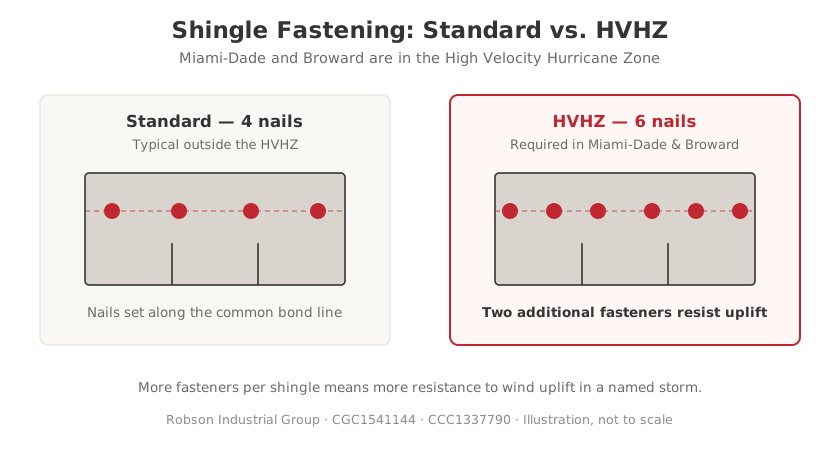
- enhanced roof-attachment and secondary-water-barrier requirements; and
- eventually, the statewide Florida Building Code (first edition 2002), which unified and raised standards across the state.
Why does Hurricane Andrew still matter to your roof today?
Full tear-offs, NOA-approved products, staged inspections, the all-or-nothing rule on opening protection: everything we’ve written about elsewhere traces back to Andrew. When a roof here costs more than the same roof in a milder climate, that difference is the cost of building to standards written in the wreckage of a Category 5. It’s also why local experience matters: the contractors who work the HVHZ every day carry these rules as second nature.
Frequently asked questions
When was Hurricane Andrew?
Why did Andrew lead to new building codes?
Is my home safer because of these codes?
Does the HVHZ apply outside Miami-Dade?
We’re based in Blue Lagoon, Miami and work the HVHZ every day, including Homestead, where Andrew came ashore. The history isn’t abstract to us; it’s the code we build to.