Roofing · Windows & Doors · Miami-Dade County, FL
How to Read a Miami-Dade NOA: A Homeowner's Guide
Pull up any Miami-Dade NOA and you'll see the same thing most homeowners see: a dense, multi-page PDF full of code citations, product codes, and engineering language that looks like it was written for someone else. It was: it was written for permit reviewers and product control engineers, not for the person paying for the windows. But that document is the single piece of paper that tells you whether what's going on your roof or in your window openings is actually rated for a Miami-Dade hurricane, or just rated to look like it on a spec sheet. If you've already read our primer on what a Miami-Dade NOA is and how to check one, this is the next step: learning to actually read the document itself, section by section, so you know what you're looking at before you sign a contract or close on a house.
A quick refresher, then we go deeper
A Miami-Dade Notice of Acceptance (NOA) is a product-specific approval issued by Miami-Dade County's Product Control Division, confirming that a specific manufacturer's specific product (a particular window series, roofing shingle, or door system) has been tested and approved for use in the High-Velocity Hurricane Zone (HVHZ), which covers Miami-Dade and Broward counties. It's a stricter standard than the statewide Florida Product Approval, because HVHZ testing accounts for large-missile impact and wind loads that inland Florida code doesn't require. That's the short version; for the full breakdown of NOA versus Florida Product Approval and why the distinction matters, see the learn page. What we're covering here is different: once you have an NOA number in hand, how do you actually read the document behind it?
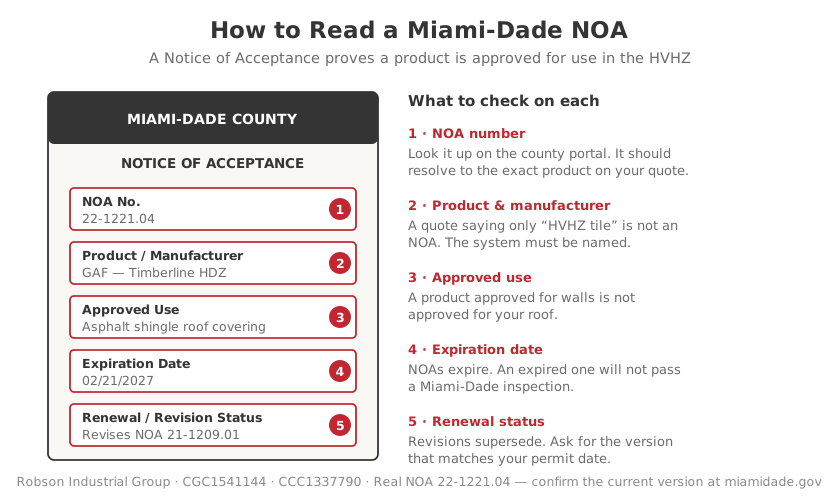
Where you'll actually find your NOA number
Before you can read an NOA, you need the number, and there are three places it should show up on a real job:
Your permit application. Any roofing, window, or door permit filed with Miami-Dade or a local municipality requires the NOA number for every product being installed. It's listed on the permit set or the product approval form submitted with the application. If a contractor pulls a permit for your job, that number is public record. You can request it from the building department if it wasn't shared with you directly.
Your contract or proposal. A reputable contractor lists the NOA number for each product line on the proposal itself, not just "impact windows" or "GAF shingles" as a category. At Robson Industrial Group (CGC1541144, CCC1337790), every proposal we write specifies the exact product series and its current NOA number, because that's the number the permit reviewer, the inspector, and eventually your insurance adjuster will all be checking against.
The product label or spec sheet. Impact-rated windows and doors typically carry a permanent label on the frame or glass referencing the NOA number, and manufacturer spec sheets and installation instructions list it as well. If you're standing in front of an installed window, that label is your fastest way to verify what's actually there.
The structure of an NOA document, section by section
Miami-Dade NOAs follow a fairly standard format regardless of product type, which means once you know the layout, you can read any NOA (roofing, windows, doors, skylights) the same way.
The approval number itself
You'll see something formatted like 23-0707.12. That's not arbitrary. The first two digits are the year the approval was issued or renewed, the next four digits are the month and day it was processed, and the number after the decimal is a sequence number distinguishing it from other approvals processed that same day. Knowing the format matters because it tells you at a glance roughly how old the current approval cycle is: a number starting with "13-" attached to a product being sold to you in 2026 should raise an immediate question, even before you check the expiration date.
Issue date and expiration date
Every NOA has a validity term, typically issued for a period of years before it must be renewed. The document states both the issue date and the expiration date clearly, usually near the top. This is not a formality. An NOA that has expired doesn't necessarily mean the product itself is unsafe, but it means the approval on file with the county is no longer active, and a permit reviewer can reject a permit application that cites an expired number. Manufacturers renew NOAs regularly for active product lines; a current, in-production product should have a current NOA. If the number your contractor gave you has lapsed, that's your first red flag, not a technicality to wave off.
The scope and description section
This is where the document specifies exactly what's covered: manufacturer name, product category, and the specific model or series number. This is the part most homeowners assume is broader than it actually is. An NOA does not approve a manufacturer's entire product catalog. It approves one specific configuration. A manufacturer can have one series that's HVHZ-approved and a nearly identical-looking series sold elsewhere in the country that has no Miami-Dade NOA at all. When you're comparing what's written on your contract to what's on the NOA, the series name and model number need to match exactly, not just the brand name.
The limitations section — the part homeowners skip and shouldn't
Buried a few pages into most NOAs is a section labeled "LIMITATIONS" or "APPROVED FOR USE," and it's the most consequential part of the document for a homeowner, because it's where the approval stops being about the product in isolation and starts being about how it has to be installed. This section typically specifies:
• Maximum panel or unit size the approval covers
• Minimum substrate or deck thickness required beneath the product
• Required fastener type, spacing, and pattern
• The wind zone or design pressure rating the product is approved for
• The specific installation method it must follow
Here's the part that trips people up: a product only stays compliant with its NOA if both the product and the installation match what's written in this section. You can install a genuinely NOA-approved window and still be out of compliance if the crew used the wrong fastener spacing or skipped a required shim detail, because the wind and impact testing that earned the approval was performed under those exact installation conditions. Change the installation and you've effectively voided the tested performance, even though the product itself is the correct one. This is why licensing and installation experience matter as much as the product spec sheet. It's also why every crew working under Robson Industrial Group's CGC1541144 and CCC1337790 licenses installs to the fastening pattern and details specified in the governing NOA, not a generalized "best practice."
Referenced test standards and reports
Further into the document, you'll find citations to the specific test standards and test reports the product passed. Things like large-missile impact testing and wind uplift or water infiltration testing performed by an accredited testing lab. You don't need to pull the underlying test reports or interpret raw data; that's the engineering backup the county's reviewers already evaluated before issuing the approval. What matters for you as a homeowner is simply confirming that section exists and cites real, specific test standards rather than vague language. Its presence is part of what separates a legitimate NOA from a document that's been altered or misrepresented.
Manufacturer and applicant information
The final identifying section lists the manufacturer of record and the applicant who submitted the approval (sometimes the manufacturer directly, sometimes a distributor). Cross-check this against the brand name on your contract. It's a simple check, but it's the fastest way to catch a mismatch if a product substitution happened somewhere between the sale and the install.
Red flags to watch for when you're reading an NOA
Once you know the structure, spotting a problem is mostly pattern matching. Watch for:
An expired date. Check the expiration against today's date every time, not just when the product was purchased.
A description that doesn't match what's being installed. If your contract says one series and the NOA describes a different model number, that's not a paperwork error to shrug off. It means the product on your house may not carry the approval you were told it has.
A missing or thin limitations section. A legitimate NOA always has installation limitations spelled out. If a document you're handed skips straight from the product description to the test citations, treat that as a reason to verify the document against the county's own record rather than the copy you were given.
A contractor who can't produce the number at all. Before work starts, not after. Any licensed contractor working in the HVHZ should be able to hand you the NOA number for every product on the job without having to look it up under pressure.
Pulling the document yourself
You don't have to take anyone's word for it. Miami-Dade County's Product Control Division maintains a public NOA search portal where you can look up an approval directly, either by entering the NOA number itself or by searching the manufacturer and product name if you don't have the number yet. The search returns the current, official version of the document, which is the version that matters: not a PDF that's been forwarded around, screenshotted, or excerpted. If a number a contractor gave you doesn't return a match, or returns a match for a different product than what's being proposed, that's worth a direct conversation before any contract gets signed.
Why this actually matters, practically
This isn't a paperwork exercise. When a hurricane comes through and a claims adjuster is evaluating storm damage, one of the first things they check is whether the products installed on the home match their approved NOAs and whether the installation followed the specified method. A mismatch can complicate or reduce a claim even when the underlying damage is legitimate. The same NOA record follows the house into resale: buyers and their inspectors increasingly ask for NOA documentation on windows, doors, and roofing as part of due diligence, especially on higher-value coastal and near-coastal properties. And most fundamentally, the NOA is the paper trail behind the actual physical performance of your home in a storm: it's the difference between a product that was engineered and tested for a 150+ mph wind event with large-missile impact, installed the way the testing assumed it would be, and a product that merely resembles one.
Frequently Asked Questions
Can an NOA number be reused for a different product?
No. Each NOA number is tied to one specific product configuration from one manufacturer. If a contractor cites the same number for two different products or series, that's a mismatch worth investigating directly through the county's search portal before proceeding.
Does an expired NOA mean the product is unsafe?
Not automatically: the physical product hasn't changed. But an expired NOA means the county no longer has an active approval on file for it, which can cause permit rejections and complicates insurance and resale documentation. A current product line should carry a current, renewed approval.
Who is responsible for confirming the NOA matches the installed product — me or my contractor?
Your licensed contractor is responsible for pulling permits with the correct NOA and installing to its specifications. As the homeowner, verifying it yourself is a safeguard, not a substitute for hiring a properly licensed contractor in the first place.
Is a Florida Product Approval the same as a Miami-Dade NOA?
No, and this distinction matters if you're comparing quotes. A statewide Florida Product Approval does not automatically meet Miami-Dade's HVHZ testing requirements. Our NOA basics page covers the difference in detail.
What should I do if the NOA number on my contract doesn't return a result in the county's database?
Stop and ask the contractor to clarify before signing anything or allowing work to begin. It could be a typo, but it could also mean the product cited isn't actually HVHZ-approved. A licensed, established contractor should be able to resolve this immediately.