What is a Miami-Dade NOA?
A Notice of Acceptance (NOA) is Miami-Dade County’s product-approval document certifying that a specific product, such as a window, a roof tile, or an underlayment, has been tested and approved for use in the High-Velocity Hurricane Zone. If a product is going on your home here, it should hold a current NOA or an equivalent Florida Product Approval.
The NOA is issued by Miami-Dade County’s Product Control section. It documents that a named product, made by a named manufacturer, has passed the testing required for our hurricane zone, including large-missile impact and design-pressure testing for windows and doors, and wind-uplift testing for roofing systems. Each NOA has a number, an issue and expiration date, and a description of exactly what was approved and how it must be installed.
What’s the difference between an NOA and Florida Product Approval?
There are two approval systems you’ll encounter, and they overlap:
- The Miami-Dade NOA is the county system — the original, and the one most associated with HVHZ-grade products.
- The Florida Product Approval (FL number) is the statewide system.
For the HVHZ, a product needs approval valid for this zone, most commonly demonstrated by a current Miami-Dade NOA, sometimes by a statewide FL approval that includes HVHZ. The practical point for a homeowner: the product on your home should carry a current approval that explicitly covers the High-Velocity Hurricane Zone.
What should you verify on an NOA?
If a quote references an NOA, you can confirm three things:
- It’s current. NOAs expire and get renewed. An expired NOA number doesn’t protect you.
- It matches your product. The NOA describes a specific product and configuration. The window or tile being installed should be the one the NOA covers.
- It’s the right rating. For openings, you want large-missile impact rating and a design pressure suited to your home’s exposure.
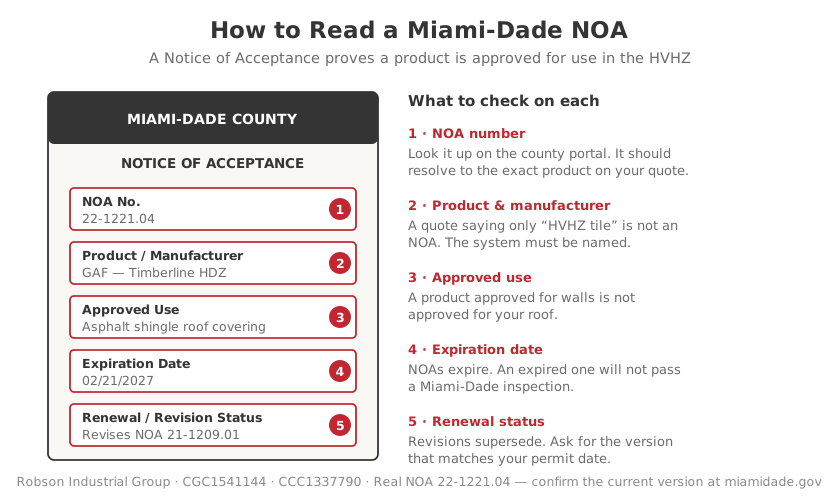
The example on this page is a real, current Miami-Dade approval: NOA 22-1221.04: GAF Timberline HDZ asphalt shingles, approved 09/07/23 and expiring 02/21/2027. Download the full NOA (PDF, Miami-Dade County), or search any NOA number yourself.
How do you verify an NOA yourself?
Miami-Dade publishes its approved-product records online, searchable by NOA number or by manufacturer and product. You don’t have to take a contractor’s word for it. You can look up the number on the quote and confirm it’s real, current, and matches what’s being installed. We name the NOA-approved systems we use on purpose, precisely so you can check them.
How do you look up a specific NOA number? (Example: 23-0707.12)
Homeowners searching for a specific number off a quote, for example 23-0707.12, can verify it directly with Miami-Dade County in a couple of minutes:
- Go to the Miami-Dade Product Control search: miamidade.gov/building/pc-search_app.asp.
- Enter the NOA number exactly as it appears on your quote — e.g. 23-0707.12 — into the NOA Number field, and run the search.
- Open the matching record and check the expiration date and product description against what’s actually being installed.
- If it doesn’t return a result, or it’s expired, ask your contractor for the current NOA before you sign anything.
Robson installs Miami-Dade NOA-approved impact windows and doors in Miami-Dade and Broward, and we name the exact NOA on every proposal so you can run this same check before work starts.
Frequently asked questions
Does every product on my roof need an NOA?
Can I look up an NOA myself?
What if an NOA is expired?
Is an NOA the same as a warranty?
What is NOA 23-0707.12?
NOA 23-0707.12 is Miami-Dade County’s approval for the PGT Industries Series “SH-5500” PVC single-hung window: High-Velocity Hurricane Zone, Large and Small Missile Impact, design pressure +65/-70 psf. It expired on July 30, 2025 and was superseded by NOA 25-0520.01.
So if you are looking at 23-0707.12 on a quote or a spec sheet, that approval is no longer current. Ask whoever gave it to you for the NOA that replaced it. An expired NOA will not clear permitting in Miami-Dade, and the number on your paperwork should match the product actually being installed.
You can confirm any of this yourself in about a minute at the county’s Product Control search: miamidade.gov/building/pc-search_app.asp , then enter the number in the “Search by File” box. Checked against the county record on August 9, 2026; NOAs change, so re-check before you rely on it.
We use NOA-approved systems and we’ll put the product names on your proposal, so you can verify every approval yourself before anything goes on your home.