Roofing · Miami-Dade & Broward
Miami-Dade vs Broward Roofing Codes: What Every Homeowner Needs to Know
Both Miami-Dade and Broward County sit inside the High-Velocity Hurricane Zone: the strictest wind-load territory in the continental United States. A contractor who has spent a career in one county and just crossed the line into the other may not know the differences that matter for your project. Those differences are small but consequential: a material approval that clears Miami-Dade may not cover Broward, the permit process runs through different offices with different timelines, and the inspection cadence can vary by municipality.
This guide covers what is actually different between the two counties for residential and light-commercial roofing, and what is the same, because a few misconceptions are common on both sides of the line.
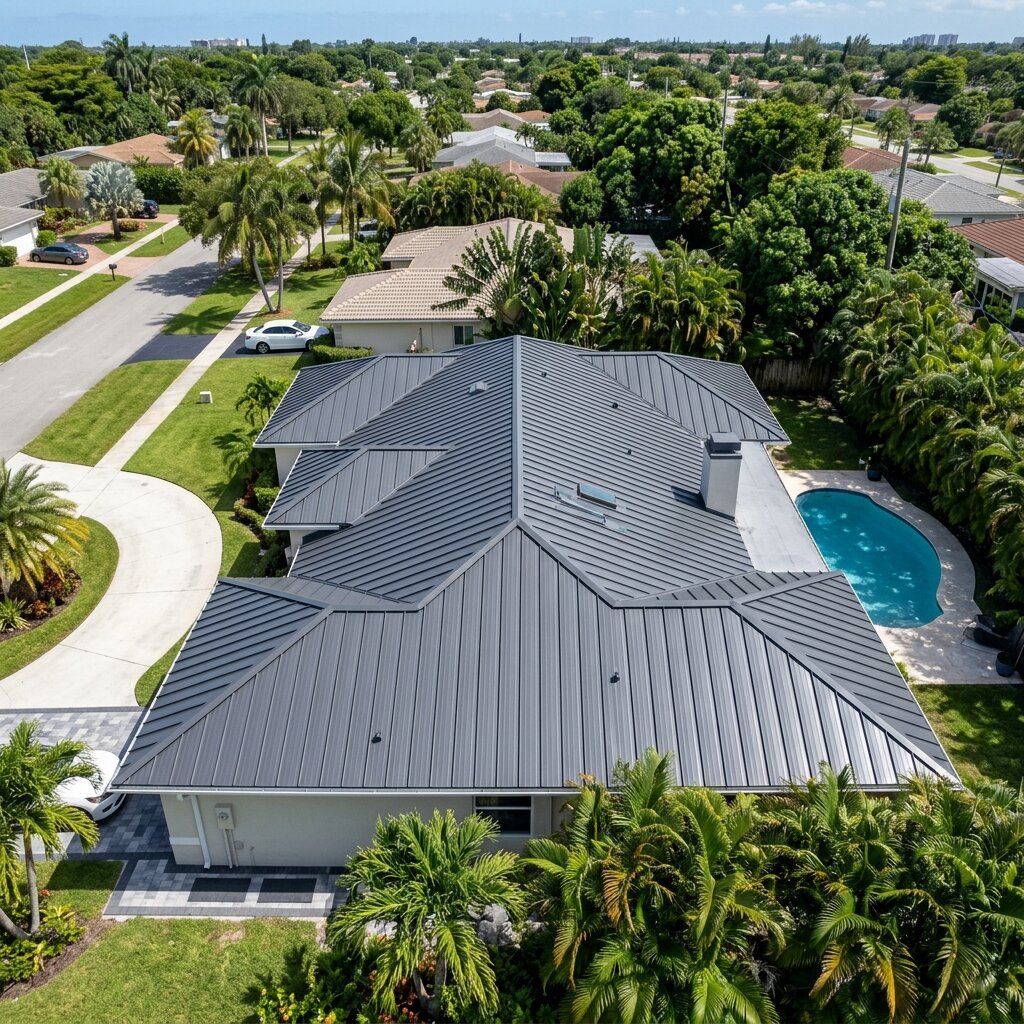
What the Two Counties Share: The HVHZ Baseline
Before getting to the differences, it helps to understand the shared foundation. Miami-Dade and Broward are the only two counties in Florida designated as High-Velocity Hurricane Zones under the Florida Building Code (Chapter 44). This designation means:
- All roofing materials must meet HVHZ product approval — not just standard ASTM ratings used elsewhere in Florida.
- Every roofing project requires a building permit — no exceptions for “minor” work the way some other Florida jurisdictions allow.
- Florida-licensed Roofing Contractors (CCC) must pull permits — the license must be in the contractor’s name, not a subcontractor’s.
- Inspections are mandatory at minimum at the dry-in stage and final stage.
Any contractor who does not know these basics is operating outside their depth in either county.
Where They Differ: Product Approval (NOA vs Florida Product Approval)
This is the most significant practical difference between the two counties.
Miami-Dade operates its own product approval system: the Miami-Dade Notice of Acceptance (NOA). The NOA is issued by the Miami-Dade Product Control Division and represents testing conducted specifically for Miami-Dade’s wind speed and pressure requirements. An NOA number covers a specific product, a specific installation method, and a specific application, and the NOA must be valid before a permit is issued.
Broward County accepts the Florida Product Approval (FPA) system administered by the state’s BCIS (Building Code Information System), with one important nuance: products must carry the HVHZ-specific approval flag within the FPA database. A product approved for “all of Florida” but without the HVHZ flag will not pass a Broward permit review for roofing in the wind-borne debris zone.
The practical implication: a contractor who learned the trade in Miami-Dade will correctly ask “what’s the NOA number?” before specifying a product. In Broward, the question becomes “does the FPA listing include HVHZ?”: a different lookup on a different database. Both require the contractor to know the product approval system, not just the product brand.
Permit Processes: Different Departments, Different Timelines
Both counties are large enough that most municipalities run their own building departments, not a single county-wide office. In practice:
- Miami-Dade unincorporated areas go through Miami-Dade County Building Department (MDBD). Incorporated cities (Miami, Coral Gables, Homestead, etc.) have their own departments that typically incorporate Miami-Dade’s standards but may have additional local requirements.
- Broward County unincorporated areas go through Broward County Building Division. Incorporated cities (Fort Lauderdale, Hollywood, Pembroke Pines, etc.) similarly have their own departments with local overlays.
Permit timelines differ by municipality and by season. In hurricane season (June–November), both counties typically see slower turnaround as storm-related applications spike. A contractor who is familiar with the local municipality will know which permitting portal is used, what the typical review timeline looks like, and which inspector notes to anticipate, all of which affects your project schedule.
Robson Industrial Group operates across both counties. We pull permits in the relevant jurisdiction before any work begins, and we know the process for each municipality we work in: Kendall (unincorporated Miami-Dade), Hollywood (Broward), Pembroke Pines (Broward), and others.
Inspection Requirements: What to Expect in Each County
Both counties require at minimum a dry-in inspection and a final inspection for roofing projects. The differences are in the details:
- Miami-Dade typically requires a nailing pattern inspection (deck attachment) and a dry-in inspection (secondary water resistance membrane) before shingles or tile are installed. The sequence is: permit issuance → deck inspection → dry-in inspection → material installation → final inspection.
- Broward varies by municipality, but generally aligns with the Miami-Dade sequence for HVHZ projects. Some Broward municipalities have adopted additional energy code inspection requirements that verify roof deck ventilation and insulation values in addition to structural wind resistance.
What matters for homeowners: failing an inspection at any stage adds time and cost. Contractors who know the local inspection sequence will schedule work in the correct order and call in inspections at the right stages. Contractors who don’t, particularly those crossing county lines for the first time, often fail the first inspection and then need an additional reinspection, adding days or weeks to your project.
Wind Speed Requirements: Closer Than You Think
One misconception we encounter regularly: homeowners in Broward sometimes assume their wind requirements are meaningfully lower than Miami-Dade’s. In practice, the difference is small and both counties require a far higher standard than the rest of Florida.
Under ASCE 7-22 (the current wind load standard), design wind speeds in both counties are in the 175–185 mph range for most residential applications: the highest design speeds outside of dedicated hurricane research facilities. The difference between, say, Fort Lauderdale and Miami is a few mph, not a meaningful change in material specification for most roof systems.
What does vary: properties within 1 mile of the coast in either county have additional requirements for impact-resistance and product approval that properties further inland do not face. A contractor should be asking about your property’s exact location and running the correct wind speed lookup (via ATC Hazards by Location or the Florida Building Code wind speed maps) before specifying materials.
License Requirements: The Same on Both Sides of the Line
A Florida Certified Roofing Contractor license (CCC) is valid statewide. It does not need to be reissued or modified for work in Broward versus Miami-Dade. The same applies to a Florida Certified General Contractor license (CGC). Both licenses allow work throughout Florida and can pull permits in any Florida jurisdiction.
The confusion arises with local business tax receipts (formerly called occupational licenses). Some municipalities in both counties require contractors to register with the local business tax office before pulling permits. This is administrative, not a licensing issue, but it can delay a first-time contractor in that municipality.
Robson Industrial Group holds CCC1337790 (Certified Roofing Contractor) and CGC1541144 (Certified General Contractor), both active statewide under qualifier Francisco Rijo, and we are a GAF Certified™ Residential Roofing Contractor (GAF ID: 1164276).
Insurance Discount Mechanics: Similar Programs, Local Variations
Both Miami-Dade and Broward homeowners are eligible for wind mitigation credits under Florida’s My Safe Florida Home (MSFH) framework. Though the actual discount depends on your specific insurer and their filed rate tables, which vary.
The mitigation inspection report (OIR-B1-1802) is the same form in both counties. What changes is the insurer’s rate table, which determines what each mitigation feature is actually worth. A hip roof with secondary water resistance in Miami-Dade may generate a larger premium reduction than the same setup in Broward if the homeowner’s insurer has different rate tables for the two counties.
Practical takeaway: get the mitigation inspection done after any new roof installation regardless of which county you are in. The report is inexpensive, the potential premium reduction is not, and the report remains valid for five years.
What to Ask a Contractor Who Works Both Counties
If you are in Broward and considering a contractor who primarily works in Miami-Dade (or vice versa), ask these questions directly:
- “Have you pulled a permit in [my municipality] before?” — First-time permitters in a municipality sometimes face administrative delays that experienced local contractors don’t.
- “What product approval database are you using for this project?” — In Miami-Dade: the answer should reference NOA. In Broward: it should reference FPA with HVHZ.
- “How many inspections should I expect, and what is the typical timeline between permit issuance and final inspection?” — A contractor who has worked in your municipality knows the answer.
- “Will the warranty I receive be affected by which county the property is in?” — For manufacturer warranties like GAF System Plus, the county doesn’t matter; the contractor’s certification status does.
Why Robson Works Across Both Counties
Robson Industrial Group is based in Blue Lagoon, Miami (7290 NW 7th St, Unit 105, Miami, FL 33126) and regularly works across both Miami-Dade and Broward. From Coral Gables and Homestead in the south to Pembroke Pines and Hollywood in the north. We carry CCC1337790 and CGC1541144, and as a GAF Certified™ Residential Roofing Contractor (GAF ID: 1164276), we can offer the GAF System Plus Limited Warranty across both counties.
Every project starts with a permit in the correct jurisdiction. We know both the NOA system (Miami-Dade) and the FPA/HVHZ system (Broward), and we don’t confuse them.
Frequently Asked Questions
Is a Florida roofing license valid in both Miami-Dade and Broward?
Yes. A Florida Certified Roofing Contractor (CCC) license is statewide and valid in all Florida counties, including Miami-Dade and Broward. The contractor does not need a separate license for each county. Some municipalities require a local business tax receipt before permitting, which is an administrative registration, not a separate license. Always verify that the CCC license is active by searching myfloridalicense.com.
Do Miami-Dade and Broward use the same product approval system for roofing?
No. Miami-Dade uses its own Notice of Acceptance (NOA) system, administered by the Miami-Dade Product Control Division. Broward accepts the Florida Product Approval (FPA) system, but products must carry the HVHZ approval flag. A contractor crossing from one county to the other needs to know which system applies and how to look up approvals in each. Using a product with only standard Florida approval (no HVHZ flag) in Broward will fail permit review for HVHZ applications.
Are building permits required for all roofing work in both counties?
Yes. Both Miami-Dade and Broward require a building permit for roof replacements and most significant repairs under the HVHZ provisions of the Florida Building Code. There is no meaningful “minor repair” exemption for structural roofing work in either county. A contractor who proposes cash-only work without a permit is exposing the homeowner to insurance claim denial and title issues when the property is sold.
Does a GAF System Plus warranty work the same in both counties?
Yes. The GAF System Plus Limited Warranty is a manufacturer warranty that applies to the installed roofing system regardless of which Florida county the property is in. What matters is that the contractor is GAF Certified and that the correct qualifying products are installed. County location does not affect warranty eligibility or coverage. The contractor’s certification status, not the county, determines whether the System Plus warranty is available.
Do wind mitigation discounts work the same in Miami-Dade and Broward?
The mitigation inspection process and report form (OIR-B1-1802) are the same in both counties. However, the actual premium discount depends on your specific insurer’s filed rate tables, which can vary by county. Both counties are high-value mitigation markets: a new roof with a hip geometry, secondary water resistance, and proper deck attachment will generate meaningful premium reductions in either county. Get the inspection done after any new roof installation; the report is valid for five years.