Do you need an “MSFH-approved contractor”?
No. The My Safe Florida Home Authorized Contractor Program ended June 30, 2024, and no state-issued approved-contractor list exists anymore. Per the MSFH 2025–2026 Homeowner’s Guide (Florida Department of Financial Services), it is the homeowner’s sole responsibility to find and manage an eligible contractor and oversee the contractor relationship. The only requirement is that the contractor’s license is certified or registered with the Florida DBPR and authorizes the specific improvements recommended in your Initial Inspection Report.
This matters because many Florida contractors still advertise themselves as “MSFH Approved” or “an authorized My Safe Florida Home contractor.” That designation has not existed in over two years. It is not a credential anyone can hold today, and a company claiming it is either working from old information or hoping you won’t check.
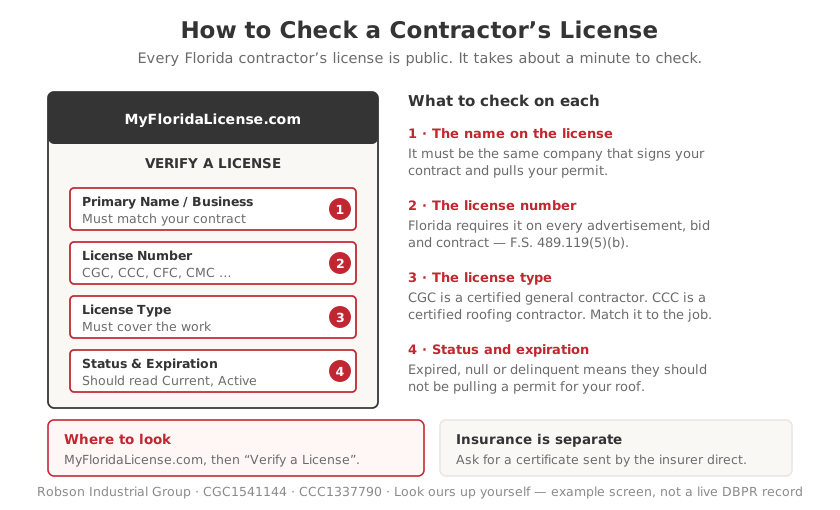
What you should check instead is simpler and more useful: is the contractor’s license current with the Florida Department of Business and Professional Regulation, and does that license actually authorize the work your report recommends? Roofing and general contracting are two different licenses in Florida. A general contractor license does not by itself authorize a roofing scope.
You can verify any Florida contractor yourself in about thirty seconds at myfloridalicense.com by searching the license number.
Who qualifies for a My Safe Florida Home grant?
The Program requires all of the following:
- Single-family detached home or townhouse
- Site-built construction
- Owner-occupied
- Homestead exemption granted
- Insured value of $700,000 or less under Coverage A (Dwelling)
- Initial building permit applied for before January 1, 2008
- A completed MSFH Initial Inspection
The insured-value figure is the Coverage A (Dwelling) number on your homeowner’s policy declarations page, not your market value, and not your county assessed value. People talk themselves out of applying because their home is “worth more than $700,000” when the figure that actually governs is a different, usually lower number on a page in their insurance file.
How do you apply for a My Safe Florida Home grant?
You apply directly with the state. There is no contractor, broker, or middleman in that step, and nobody can apply on your behalf.
- Create an account and apply at the official program site, mysafeflhome.com. This is the Florida Department of Financial Services program site — the only place applications are accepted.
- Get your free wind mitigation inspection. The Program provides it at no cost. A licensed inspector visits the home and produces your Initial Inspection Report, which lists the improvements you may fund.
- Wait for your Grant Application approval email. Do not sign a contract, start work, or buy materials before it arrives.
- Choose your contractor and submit your Draw Request through the Applicant Portal.
Funding is subject to legislative appropriation, and the Program has opened and closed application windows in past cycles. Check mysafeflhome.com for current application status before you plan around it.
What does the My Safe Florida Home grant actually pay?
Matching Grant: the state contributes $2 for every $1 you contribute, reimbursing two-thirds of your project cost, up to a state contribution of $10,000. It works on a reimbursement basis: you pay, then submit a paid-in-full invoice with your Draw Request.
| Your project | State reimburses | Your share |
|---|---|---|
| $9,000 | $6,000 | $3,000 |
| $15,000 | $10,000 | $5,000 |
| $20,000 | $10,000 (max) | $10,000 |
Low-Income Grant: paid to the homeowner directly for the actual cost of the recommended improvements. No homeowner match is required, and no paid-in-full invoice is needed at Draw Request. Eligibility is measured against HUD income limits.
Be realistic about the ceiling. On a full-home impact window package in Miami-Dade, $10,000 is a meaningful contribution toward the job, not the whole job. Any contractor implying the grant covers everything is setting up a bad conversation later. It is also worth checking whether Florida’s home-hardening sales tax refund applies to your project.
What improvements does the grant cover?
Two broad categories:
- Opening protection — impact windows, impact entry doors, French doors, sliding glass doors, and garage doors.
- Roof strengthening — roof-to-deck attachment, roof-to-wall connections (clips and wraps), and secondary water resistance.
Only improvements recommended in your Initial Inspection Report are fundable. The inspection comes first and it sets the menu. You cannot decide what you want and then ask the grant to pay for it, and a contractor who quotes you work outside the report is quoting you something the grant will not reimburse.
What sequencing rule disqualifies homeowners from the grant?
This is the part that costs people the money, and it is stricter than most homeowners assume. From the MSFH 2025–2026 Homeowner’s Guide:
“To be eligible for Disbursement, you must not perform any work, sign with a Contractor, or purchase make any materials purchases prior to receiving an email from the MSFH Program informing you to proceed with work. Performing work, signing a contract with a Contractor, or purchasing materials before Grant approval will result in a denial.”
Source: MSFH 2025–2026 Homeowner’s Guide, Florida Department of Financial Services. (Quoted exactly as published, including the Program’s own typo.)
Note what is on that list. Not just starting work: signing the contract is itself disqualifying if it happens before your approval email. So is buying materials. A contractor who wants your signature early to “hold your spot” is asking you to do the one thing that voids the grant, and you only get one grant, ever.
Do not let a contractor pull your building permit before your approval email arrives. Beginning the permitting process can look like work has begun, and your grant is not worth the argument. If a contractor offers to pull the permit early to “get you moving,” ask why the hurry. To be precise about what is whose rule: the Guide names work, contracts, and materials explicitly. The permit caution is ours, applied because we are not willing to gamble your one grant on a technicality.
Program rules can change between funding cycles. Always confirm your project’s status directly with My Safe Florida Home before taking any action.
What is the one-year deadline for using the grant?
Once your Grant Application is approved you have one year to request your MSFH Final Inspection, or to request a single additional 6-month extension. Miss it and the application is administratively closed and the funds are reallocated.
In Miami-Dade and Broward, permitting is the variable that eats that year. Plan review, revisions, inspection scheduling, and closeout all sit between your approval and your final inspection request, and none of them move faster because your deadline is close. If your approval is already a few months old, you are further along the clock than it feels.
How do you choose a contractor for MSFH-funded work?
Since no state list exists, the vetting is yours to do. A short, practical checklist:
- Verify the license number yourself at myfloridalicense.com — don’t accept a screenshot or a number on a truck.
- Confirm the license covers the scope. Roofing work requires a roofing license. Ask which license number covers which part of your job.
- Ask when they want you to sign. The correct answer is: after your approval email. Anyone pushing for an earlier signature is risking your grant.
- Ask who pulls the permit and whose name it goes in. It should be pulled by the contractor, under their license, after approval.
- Check the public permit record. County permit records are public and searchable by property address at miamidade.gov and broward.org.
- Ask whether they perform their own wind mitigation inspection. A contractor certifying that his own installation earns your insurance discount is on both sides of that document.
If you have an approved grant and want to talk to a licensed contractor about scoping strictly to your Initial Inspection Report, that is what our MSFH grant contractor page covers, including how to change a contractor you’ve already named. We work across Miami-Dade and Broward as a licensed MSFH contractor in Miami-Dade, and we install grant-eligible impact windows and roofing improvements under CGC1541144 and CCC1337790.
My Safe Florida Home FAQ
Do I need to use an MSFH-approved contractor?
No. The MSFH Authorized Contractor Program ended June 30, 2024, and no state-issued approved-contractor list exists anymore. The homeowner is solely responsible for finding and managing an eligible contractor. The only requirement is that the contractor’s license is certified or registered with the Florida DBPR and authorizes the improvements recommended in the Initial Inspection Report.
Can a contractor start work before my grant is approved?
No. Performing work, signing a contract with a contractor, or purchasing materials before Grant approval will result in a denial, per the MSFH Homeowner’s Guide.
I already named a different contractor. Can I switch?
Yes. Homeowners can change their listed contractor at the Draw Request stage in the MSFH Applicant Portal after the Grant Application is approved.
How much does My Safe Florida Home pay?
Up to $10,000. The Matching Grant contributes $2 in state funds for every $1 the homeowner contributes, reimbursing two-thirds of project cost up to that $10,000 cap. Low-Income Grants are paid directly to the homeowner with no match required.
What is the deadline after approval?
One year from Grant Application approval to request the MSFH Final Inspection, with one additional 6-month extension available on request. After that the application is administratively closed and funds are reallocated.
Does MSFH pay for a wind mitigation inspection?
My Safe Florida Home provides a free wind mitigation inspection as part of the program.
This guide is general information for Florida homeowners, not legal or financial advice, and it summarizes the MSFH 2025–2026 Homeowner’s Guide published by the Florida Department of Financial Services. Program parameters are subject to legislative appropriation and change between funding cycles: confirm current requirements directly with My Safe Florida Home at mysafeflhome.com before acting. Robson Industrial Group LLC is an independent licensed contractor and is not affiliated with, endorsed by, or acting on behalf of the My Safe Florida Home Program, the Florida Department of Financial Services, or the State of Florida.