Miami Gardens is the largest predominantly African American city in Florida and the third-largest city in Miami-Dade County: a community of roughly 115,000 residents whose housing stock spans postwar concrete block homes from the 1950s and 1960s, mid-century tile roofs, and newer construction from the 1980s through 2000s. Like the rest of Miami-Dade County, every property sits inside the High Velocity Hurricane Zone (HVHZ), the most demanding roofing code environment in the continental United States.
That combination (large, dense residential base, aging housing stock, and strict code requirements) makes Miami Gardens a target for unlicensed roofing operators who move through the area after storm events, offer cut-rate prices, and disappear before inspections are complete. This guide gives you the verification steps, the code requirements, and the contract questions you need to protect your investment. Robson Industrial Group (Lic. CGC1541144 · CCC1337790) serves Miami Gardens and all of Miami-Dade County.
Miami Gardens by Neighborhood: What Different Roof Ages Mean for You
Miami Gardens is not one uniform housing stock: the city was assembled from several older unincorporated communities when it incorporated in 2003, and each carries a distinct roofing profile.
- Bunche Park, on the city's east side, was founded between 1946 and 1951 as one of South Florida's first postwar suburbs built for Black World War II veterans. Its tree-lined streets are lined with ranch-style homes from the 1950s and 1960s — many still on their original or first-replacement roof deck. On a roof this age, the deck itself (not just the shingles) is frequently undersized by current HVHZ standards, which is why a full tear-off inspection matters more here than a simple reroof quote.
- Andover, a golf-course community between I-95 and the Florida Turnpike centered on the Andover Golf Club, mixes townhomes, patio homes, and larger custom estates built across several decades. Roof age varies block to block, and larger estate homes often carry more complex hip-and-valley rooflines that add labor cost regardless of material choice.
- Norland, a middle-class area of tree-lined streets, is built out almost entirely in ranch homes from the 1960s. Like Bunche Park, Norland's housing stock is now well past the 30–40 year service life of most tile and shingle systems, which is part of why storm-chaser activity concentrates in these two neighborhoods after named storms — older roofs are the easiest sales pitch for a fast, unlicensed job.
If your home is in one of these older sections of the city, budget time for a full deck inspection as part of your estimate, not just a materials quote. See the "What a Robson Estimate Includes" section below.
Why Miami Gardens Roofs Fail Differently Than Coastal Miami-Dade
Miami Gardens sits well inland, away from direct storm surge exposure, but that does not mean its roofs face less risk. It means they face a different kind of risk. The city is flat, with limited natural elevation change, and several neighborhoods drain toward the Biscayne Canal and Snake Creek Canal systems that run through northern Miami-Dade. During tropical downpours, that flat topography means water sits on roof surfaces and in gutters longer before it clears, which accelerates deterioration at flashing points, fascia boards, and any spot where a prior repair was not properly sealed.
Combine that drainage profile with the age of the housing stock described above, and you get a specific failure pattern local roofers see repeatedly in Miami Gardens: soffit and fascia rot at the roof edge well before the field of the roof shows visible damage. A contractor who only inspects the visible shingle or tile field (and skips the eaves, valleys, and deck underneath) will miss the damage that actually determines whether your roof passes a wind mitigation inspection.
Florida Roofing License Types — What They Mean for Miami Gardens Homeowners
Florida has three contractor license types that authorize roofing work. They are not equivalent, and knowing the difference protects you.
| License Type | Who Holds It | Valid Where | What to Check |
|---|---|---|---|
| Certified General Contractor (CGC) | Statewide general contractors — includes roofing scope | All 67 Florida counties | DBPR: active, same name as company |
| Certified Roofing Contractor (CCC) | Roofing specialists with statewide certification | All 67 Florida counties | DBPR: active, same name as company |
| Registered Contractor | Local license only — must register with each county | County-by-county; must show Miami-Dade registration | DBPR + Miami-Dade CITT registration |
Robson Industrial Group holds CGC1541144 (Certified General Contractor) and CCC1337790 (Certified Roofing Contractor). Both statewide certifications that are valid without any county-level registration requirement.
The 7-Step Contractor Verification Process
These steps take less than 15 minutes and will eliminate most bad actors before you sign anything.
- DBPR license lookup. Go to myfloridalicense.com → Verify a License → Contractor. Search by the contractor's name or license number. Confirm the license is Active and the qualifying agent's name matches who you spoke to.
- Verify the qualifying contractor is the one doing your job. Some companies have a licensed qualifier on paper but run crews under unlicensed supervisors. Ask directly: "Is [license holder's name] going to pull the permit for my job?"
- Workers' compensation certificate of insurance. Request a current COI naming you as certificate holder for the duration of the project. Call the insurer to confirm it hasn't been cancelled — this takes 2 minutes and eliminates your liability if a worker is injured on your property.
- General liability insurance. Minimum $1M per occurrence. Same COI process as workers' comp.
- Miami-Dade NOA for proposed materials. Ask for the Notice of Acceptance number for the shingle or tile system they plan to install. Verify it is still valid at miamidade.gov/building. NOAs expire every five years — an expired NOA means non-compliant installation.
- Permit pull confirmation. Confirm they will pull the Miami Gardens building permit before any work begins. Get this in writing. If they ask you to pull the permit yourself, walk away.
- Sunbiz entity verification. Look up the company at search.sunbiz.org to confirm it is an active Florida business entity. A dissolved or inactive company cannot legally hold a license as its qualifier.
HVHZ Requirements That Apply to Every Miami Gardens Roof
Every roof replacement in Miami Gardens must comply with Miami-Dade's High Velocity Hurricane Zone standards. These are stricter than the Florida Building Code that applies to the rest of the state.
| Requirement | HVHZ Standard | Why It Matters |
|---|---|---|
| Roofing material approval | Miami-Dade NOA required (not just FL Product Approval) | FPA-only products are illegal in Miami-Dade |
| Shingle fastening | Minimum 6 nails per shingle (not 4) | 4-nail patterns fail wind uplift tests at 110+ mph |
| Deck attachment | Ring-shank nails, 6" field / 12" field on center | Smooth shanks pull out in high winds |
| Underlayment | Modified bitumen SBS required below shingles | Felt underlayment not permitted as primary layer |
| Decking | Minimum 19/32" plywood or OSB | Thinner decks fail under HVHZ nail load |
| Contractor license | CGC or CCC (statewide) or Registered with Miami-Dade CITT | Unregistered contractors cannot pull permits |
Ask your contractor to walk you through the NOA number for the specific shingle system they are proposing. If they cannot immediately tell you the NOA number, that is a signal they may be sourcing materials without verifying compliance.
Miami Gardens Permit Process — What to Expect
Roof replacements in Miami Gardens are permitted through the City of Miami Gardens Building Services Division (18605 NW 27th Avenue, Miami Gardens, FL 33056 · (305) 622-8027), which enforces Miami-Dade County's HVHZ standards on top of city-level review. The division publishes its own permit application on the city website under Building & Code > Building Services > Documents & Forms, and by ordinance the city must issue a permit or a written list of required corrections within 15 working days of a complete submittal. Here is the typical sequence:
- Contractor submits permit application with scope of work, NOA documentation, and contractor license number. Processing time is typically 5–15 business days depending on workload.
- Permit issued. The permit placard must be posted at the property during work.
- Decking inspection. Inspector verifies fastener type and pattern on the deck before underlayment goes down. This is the most commonly failed inspection for HVHZ work.
- Underlayment and metal inspection. SBS underlayment installed, drip edge and valley metal set — inspector verifies before shingles.
- Final inspection. Completed roof inspected for finish shingle installation, ridge cap, flashing at penetrations, and overall compliance.
- Certificate of completion issued. This document is your proof of permitted, inspected work — keep it with your property records.
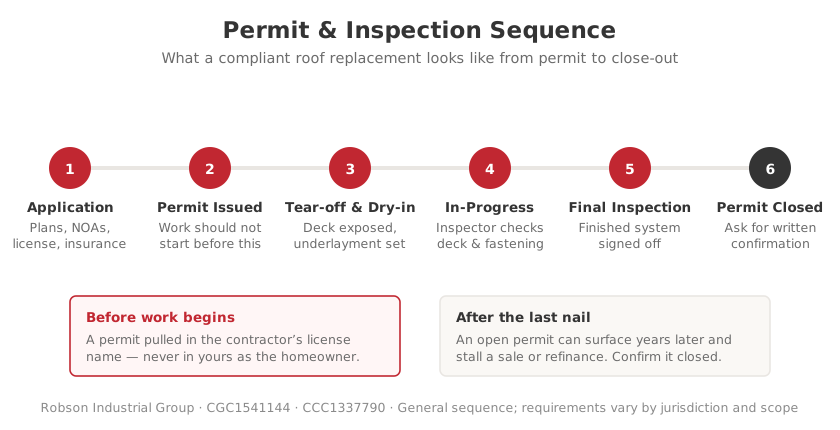
Any contractor who tells you permits are unnecessary, or asks you to handle the permit yourself, is either unlicensed or trying to avoid a failed inspection. Do not accept either.
Common Roofing Scams Targeting Miami Gardens Homeowners
Post-storm and post-hurricane-season, Miami Gardens sees an influx of contractors who are not licensed in Florida and in some cases not licensed anywhere. These are the patterns to recognize:
- No permit pulled. "We don't need one for a repair" or "permits slow things down" — both false for any roof replacement in Miami-Dade.
- Storm chasing. Showing up door-to-door immediately after a weather event with a clipboard and a pressure-signed contract. Reputable contractors are already booked after storms — the ones with instant availability are often unlicensed.
- Advance payment disappearance. Requesting 50–100% of project cost upfront, then not returning. Florida law (F.S. 489.126) does not cap deposits, but a contractor who takes more than 10% up front must apply for the permit within 30 days of that payment and start work within 90 days after the permit is issued.
- Substandard materials substitution. Bidding a named NOA-approved product but installing a cheaper uncertified substitute once work begins. Ask to inspect the product packaging on delivery.
- Fake NOA numbers. Providing a real NOA number that belongs to a different product or has expired. Always cross-reference on miamidade.gov yourself.
- Insurance assignment fraud. Pressuring you to sign an Assignment of Benefits (AOB) immediately. You retain the right to work with your own adjuster and get multiple estimates — signing an AOB transfers that control.
- Unlicensed qualifier. The name on the DBPR license belongs to someone who has not worked for the company in years and is unaware their name is being used.
- No workers' comp. If a worker is injured on your property without workers' comp, your homeowner's insurance becomes primary — and your policy may not cover it.
- Verbal-only contracts. Florida law requires home improvement contracts over $2,500 to be in writing with specific disclosures. Verbal agreements are unenforceable and a signal of an unlicensed operator.
⚠ Immediate Red Flags — Walk Away
- Cannot produce a DBPR license number on the spot
- License on DBPR shows a different company name than the one on their truck
- Requests a large deposit before work begins with no permit application in sight
- Cannot name the NOA number for the shingle system they are proposing
- Says they will "take care of permits after" or that permits are not required
- Pressures you to sign an Assignment of Benefits before work begins
- No certificate of insurance available within 24 hours of request
- Significantly lower bid than the other two estimates you received — materials cost roughly the same for everyone
What to Look for in a Roofing Proposal
A complete proposal from a reputable contractor should include every item on this checklist before you sign:
- Contractor's name, license number (CGC or CCC), and business address
- Specific shingle brand, series, and color — with the Miami-Dade NOA number
- Underlayment specification (SBS modified bitumen — product name and NOA)
- Decking specification (19/32" minimum) and whether full replacement or spot replacement is included
- Fastening pattern (6-nail minimum for shingles; ring-shank for deck)
- Flashing scope — chimney, pipe boots, valleys, drip edge included or excluded
- Permit cost itemized separately (a legitimate line item — not hidden in labor)
- Cleanup and haul-away scope
- Payment schedule (never 100% upfront)
- Warranty: manufacturer's product warranty (requires GAF Certified or equivalent installer), workmanship warranty duration and what it covers
- Start date and estimated completion timeline
Wind Mitigation and Insurance Discounts
A properly installed HVHZ-compliant roof in Miami Gardens can reduce your homeowner's insurance premium by 15–35%. The vehicle is a wind mitigation inspection report, completed by a licensed wind mitigation inspector after your roof is done and submitted directly to your carrier.
Key items inspectors verify that trigger premium credits:
- Roof covering: NOA-approved product (credit)
- Roof deck attachment: ring-shank nails at 6/12 pattern (higher credit than smooth-shank 6/6)
- Roof-to-wall connection: hurricane straps vs. toe-nails
- Roof shape: hip roof vs. gable — hip roofs earn higher credits
- Opening protection: impact windows and doors vs. shutters vs. nothing
Ask your contractor to confirm that all installation documentation will be ready for the inspector. Your permit certificate of completion and the inspector's wind mitigation report together are what you submit to your insurer. Robson Industrial Group (Lic. CGC1541144 · CCC1337790) provides complete post-installation documentation packages to all Miami Gardens clients.
What a Robson Estimate for a Miami Gardens Home Includes
Every written estimate Robson Industrial Group provides in Miami Gardens covers the same core scope, regardless of which neighborhood the home is in:
- A full deck inspection during tear-off — not just a visual from the ground. On Bunche Park and Norland homes built in the 1950s and 1960s, this is where hidden damage actually shows up.
- Itemized material specification with brand, series, color, and Miami-Dade NOA number for shingle or tile, underlayment, and flashing — not a generic "3-tab shingle" line item.
- Permit line item priced separately, with the Miami Gardens Building Services Division permit pulled in Robson's name as contractor of record before any work begins.
- Deck repair pricing per sheet disclosed up front, so a damaged-deck discovery during tear-off does not turn into a surprise change order.
- Permit and inspection records finalized after final inspection, so your documentation package is ready for your independent wind mitigation inspector and insurer without a separate scramble.
- Written manufacturer and workmanship warranty terms, including GAF System Plus eligibility where the installed system qualifies.
GAF Certified™ Roofing — What It Means
Robson Industrial Group is a GAF Certified™ Residential Roofing Contractor (GAF ID: 1164276). GAF certification is not a sticker you buy: it requires factory training, proof of licensing and insurance, and ongoing compliance verification. It unlocks the GAF System Plus Limited Warranty, an enhanced manufacturer warranty on the GAF materials for eligible installations that non-certified contractors cannot register; workmanship is covered separately by Robson's own written warranty, with the term stated in your contract.
In Miami Gardens, where shingle replacements following hurricane damage are common, the System Plus warranty provides meaningful protection: if the shingle system fails due to a materials or installation defect, GAF covers the repair cost: not just the materials.
Financing
Financing may be available through third-party providers, subject to their approval and terms. Ask us for details.
FL Certified Roofing Contractor · Lic. CCC1337790
Qualifying Agent: Francisco Rijo
7290 NW 7th St, Unit 105 · Miami, FL 33126 · (954) 546-4161
Free Estimate for Miami Gardens Homeowners
Licensed, insured, and GAF-certified. We pull permits and provide full NOA documentation, ready for your independent wind mitigation inspector.
Request a Free EstimateFrequently Asked Questions
How do I verify a roofing contractor's license in Miami Gardens?
Go to the Florida DBPR license verification portal at myfloridalicense.com. Under 'Verify a License,' select 'Contractor' and enter the contractor's name or license number. A CGC (Certified General Contractor) or CCC (Certified Roofing Contractor) license is valid statewide. A Registered Contractor license is county-restricted and requires additional Miami-Dade local licensing. Robson Industrial Group holds Lic. CGC1541144 and CCC1337790, both statewide certifications.
Does Miami Gardens require a separate city permit for roof replacement?
Yes. Miami Gardens is a municipality within Miami-Dade County and requires permits for roof replacements under Florida Statute §553.79. Work done without a permit creates issues at resale and can void your homeowner's insurance. Always confirm your contractor will pull the permit under their own license before work begins.
What is HVHZ and does it apply to Miami Gardens?
HVHZ stands for High Velocity Hurricane Zone. Miami-Dade County, including Miami Gardens, sits within the HVHZ, the highest wind-load construction zone in the continental United States. HVHZ requires Miami-Dade NOA-approved materials, a minimum 6-nail fastening pattern, ring-shank deck nails, and SBS modified bitumen underlayment. Materials that are Florida Product Approved but NOT Miami-Dade NOA-approved cannot be legally installed in Miami Gardens.
Can a new roof lower my homeowner's insurance in Miami Gardens?
Yes, significantly. A new HVHZ-compliant roof with SBS underlayment, 6-nail fastening, and proper deck attachment typically qualifies for a 15–35% premium reduction through a post-completion wind mitigation inspection, performed by your own independent, licensed inspector. Your contractor should provide complete post-installation permit and product-approval documentation for that inspector to use.
How many roofing contractors in Miami Gardens are actually licensed?
There is no precise public count, but South Florida consistently ranks among the highest concentrations of unlicensed contractor activity in the state. Florida DBPR enforcement actions list dozens of Miami-Dade violations each year for roofing specifically. The only reliable protection is running the DBPR lookup yourself, at myfloridalicense.com, before signing any contract.
Which Miami Gardens neighborhoods tend to need roof replacement soonest?
Bunche Park and Norland have the oldest housing stock in the city. Postwar ranch-style homes built in the 1950s and 1960s, many still on an original or first-replacement deck. Andover's golf-course community mixes older and newer construction more evenly. Age alone doesn't mean replacement is due, but a full deck inspection (not just a look at the visible shingles or tile) is the only way to know for sure on an older home.
What does a Robson roofing estimate for a Miami Gardens home include?
A full deck inspection during tear-off, itemized materials with NOA numbers, a separately priced permit line pulled through the Miami Gardens Building Services Division, disclosed per-sheet deck repair pricing, permit and inspection records for your independent wind mitigation inspector, and written manufacturer and workmanship warranty terms. All included at no charge on every estimate.
How long does it take to get a roofing permit in Miami Gardens?
The City of Miami Gardens Building Services Division (18605 NW 27th Avenue, Miami Gardens, FL 33056 · (305) 622-8027) is required to issue a permit, or a written list of required corrections, within 15 working days of a complete submittal. Missing NOA numbers or incomplete license documentation are the most common causes of delay beyond that window.
Related guides: Florida Roofing License Verification · HVHZ Compliance Guide · Miami Roof Replacement Cost 2026 · Kendall Roofing Contractor Guide · Hialeah Roofing Contractor Guide