Every year, Florida homeowners lose millions of dollars to unlicensed contractors. Some advertise heavily after hurricanes. Some are referred by neighbors with good intentions. Some carry business cards that look perfectly legitimate. The only way to know for certain is to look up the license yourself, before you sign anything.
This guide walks you through the Florida DBPR verification process step by step, explains what the license types mean, and gives you a checklist of red flags that should end the conversation immediately.
Robson Industrial Group LLC holds FL Certified General Contractor license CGC1541144 and FL Certified Roofing Contractor license CCC1337790, both verifiable on myfloridalicense.com.
Why License Verification Matters More in Florida Than Most States
Florida has some of the strictest contractor licensing requirements in the country, and for good reason. The state sits in a high-wind zone, homeowner's insurance rates are the highest in the nation, and South Florida's High-Velocity Hurricane Zone (HVHZ) demands code compliance that only properly credentialed contractors can legally perform.
Under Florida Statute §489.128, any contract entered with an unlicensed contractor is voidable at the homeowner's option. That means you may be able to get your money back, but it doesn't undo the unpermitted work, the failed inspection, or the insurance denial that follows.
The Florida Department of Business & Professional Regulation (DBPR) maintains a public license database. It costs nothing and takes under two minutes to use. There is no legitimate reason to skip this step.
Florida Contractor License Types: What You’re Looking For
| License Type | Code | Scope | Valid In |
|---|---|---|---|
| Certified General Contractor | CGC | All construction including roofing | Statewide |
| Certified Roofing Contractor | CCC | Roofing systems only | Statewide |
| Certified Building Contractor | CBC | Commercial & residential structures | Statewide |
| Registered Contractor (any type) | RC / RR | Same trades but jurisdiction-limited | One county or municipality only |
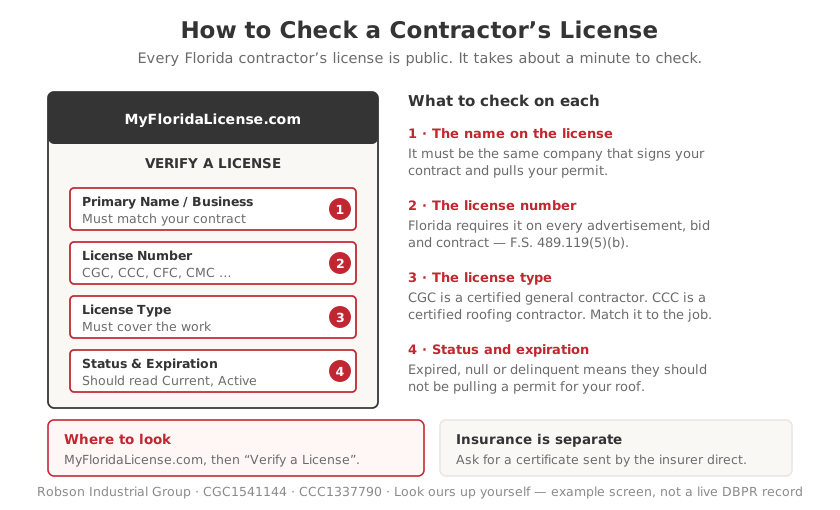
For roofing work, you want to see a CGC or CCC license, both statewide Certified credentials. A Registered Roofing contractor (RR) can legally work in the jurisdiction they registered in, but they cannot legally take on a project in an adjacent county without re-registering there. This matters if your project spans county lines or if you move.
Step-by-Step: How to Verify a Roofing Contractor License on DBPR
- Go to myfloridalicense.com. On the homepage, click “Verify a License.” No account or login is required — this is a public database.
- Select the profession. From the dropdown, choose “Contractor.” The system will show you sub-options for license type. You can leave it broad or filter to “Certified Roofing Contractor” specifically.
- Enter the contractor’s name or license number. If searching by name, use the business name as it appears on their contract or proposal. If you already have a license number (e.g., CGC1541144), enter it directly — this is faster and unambiguous.
- Review the status field. You want to see “Current, Active.” Any other status — Suspended, Revoked, Inactive, Expired — means the contractor cannot legally perform work. Do not accept explanations like “we’re in the renewal process” without a fresh Active record to back it up.
- Check the expiration date. Florida contractor licenses typically renew on a two-year cycle. A license expiring in the next 30 days is a yellow flag — ask for confirmation that renewal is submitted.
- Review the qualifier name. The “Qualifier” listed on the DBPR record is the licensed individual responsible for the work. Ask who the qualifier is and confirm they will be actively supervising your project. Some companies use a qualifier’s license without that person being present on any jobs.
- Check for complaints and discipline. The DBPR record shows administrative actions, citations, and active complaints. One dismissed complaint from years ago may be insignificant. Multiple complaints, a consent order, or a suspension history are serious red flags that warrant asking the contractor directly.
What the License Does — and Doesn’t — Guarantee
A valid Florida contractor license means the holder passed a state examination, met experience requirements, and is currently in good standing with the DBPR. It does not mean:
- The contractor is insured (you must verify that separately)
- The contractor will pull permits for your job (ask explicitly)
- The workmanship will meet HVHZ standards (verify they know the NOA requirements)
- The qualifier will actually be on your project site
Think of license verification as the floor, not the ceiling. It rules out the worst actors, but it doesn’t guarantee a quality outcome.
Insurance Verification: The Step Most Homeowners Skip
A licensed contractor without insurance is still a significant liability to you. Florida law requires contractors with employees to carry Workers’ Compensation. General Liability is not mandated by state law but is standard for any reputable contractor and typically required by project permits.
How to verify:
- Ask for a Certificate of Insurance (COI) naming you as an additional insured on the GL policy. This costs the contractor nothing and is standard procedure.
- Contact the insurance company listed on the certificate directly to confirm the policy is active. Certificates can be forged or show expired policies.
- For Workers’ Comp, you can verify the contractor’s coverage on the Florida Division of Workers’ Compensation Proof of Coverage database at myfloridacfo.com.
- Minimum GL coverage you should accept: $1,000,000 per occurrence. In Miami-Dade, $2M is becoming standard for full roof replacements.
Permit Requirements: The Third Pillar
In Florida, any roofing project that replaces or substantially alters a roof structure requires a permit. This is not optional and is not something you can waive. Under Florida Statute §553.79, unpermitted work:
- Cannot be inspected or certified by the county
- Becomes a disclosure obligation when you sell the property
- Can result in a stop-work order and fines
- May void your homeowner’s insurance coverage for that system
- Can result in a lien against your property if the contractor abandons the job
Ask every roofing contractor directly: “Will you be pulling the permit for this project in my name, as required by Florida law?” The answer should be an unambiguous yes. A contractor who suggests doing the work “without the hassle of permits” is offering to put you in legal jeopardy.
Miami-Dade HVHZ: Additional Requirements
If your home is in Miami-Dade or Broward County, it falls in the High-Velocity Hurricane Zone (HVHZ), the most stringent wind-load zone in the continental United States. HVHZ requirements include:
- All roofing products must carry a Miami-Dade Notice of Acceptance (NOA) — not just a Florida Product Approval, which does not satisfy HVHZ requirements
- Minimum 6 fasteners per shingle in the nailing zone, compared to 4 in standard zones
- Ring-shank nails for deck attachment (smooth-shank nails are not permitted)
- SBS-modified bitumen underlayment is required — standard felt (#30) is not sufficient as a standalone underlayment
- Every product assembly must be installed per the specific NOA instructions, not just “to code” generically
Ask any contractor bidding a Miami-Dade roof replacement: “What NOA do you use for the shingle/tile you’re proposing, and can I see the installation instructions?” If they can’t answer that question, they are not qualified to do HVHZ work.
🚨 8 Red Flags That Should End the Conversation
- Cannot or refuses to provide a license number immediately
- License shows as Suspended, Revoked, or Expired on DBPR
- Offers to do the work “without permits” or calls permits “unnecessary”
- Cannot provide a current Certificate of Insurance with your name as additional insured
- Asks for a large deposit with no permit application in sight (under F.S. 489.126, a contractor who takes more than 10% up front must apply for the permit within 30 days and start within 90 days of permit issuance)
- Pressures you to sign today with a discount that expires immediately (classic storm-chaser tactic)
- Does not know what a NOA is or which NOA applies to the materials they’re proposing
- The DBPR qualifier name does not match the company principal you are dealing with, and they cannot explain why
The Pre-Contract Checklist
Before signing any roofing contract, confirm the following in writing:
- □ Contractor’s license number (CGC or CCC) and DBPR status confirmed Active
- □ General Liability insurance (≥$1M) — COI received and verified
- □ Workers’ Compensation coverage confirmed active
- □ Contractor will pull the permit under their license
- □ NOA for all products confirmed for HVHZ compliance (Miami-Dade/Broward)
- □ Detailed written scope of work including materials, fastener specs, underlayment type
- □ Payment schedule tied to milestones, not arbitrary dates
- □ Deposit does not exceed 10% of contract value (for contracts over $2,500)
- □ Workmanship warranty in writing, separate from manufacturer warranty
- □ Lien waiver signed upon final payment
Robson Industrial Group: Our Credentials
Robson Industrial Group LLC is a Florida Certified General Contractor (CGC1541144) and Florida Certified Roofing Contractor (CCC1337790), both statewide credentials verified on myfloridalicense.com. We are a GAF Certified™ Residential Roofing Contractor (GAF ID: 1164276), which allows us to offer the GAF System Plus Limited Warranty, a warranty that requires installation by a GAF-credentialed contractor.
We pull permits on every project, carry General Liability and Workers’ Compensation, and provide a certificate of insurance with your name as an additional insured before work begins. Every Miami-Dade installation uses NOA-approved product assemblies installed per HVHZ specifications. We welcome homeowners who verify our credentials before signing. It’s the right thing to ask.
Frequently Asked Questions
What is the difference between a CGC and a CCC license in Florida?
A Certified General Contractor (CGC) license allows a contractor to perform any construction work statewide, including roofing as part of a broader project. A Certified Roofing Contractor (CCC) license is specifically for roofing work and is the primary credential for a company specializing in roofing. Both are statewide credentials issued by the Florida DBPR and searchable on myfloridalicense.com.
How do I look up a Florida roofing contractor license?
Go to myfloridalicense.com, click “Verify a License,” select “Contractor,” and enter the contractor’s name or license number. The record shows license type, status (Active/Suspended/Revoked), expiration date, and any complaints or discipline on file.
Can a roofing contractor legally work in Florida with only a Registered license?
Yes, but only in the county or municipality where they registered. A Registered license does not grant statewide authority. Many homeowners in Miami-Dade don’t realize their contractor may only hold a local registration that restricts where they can legally work.
What insurance should a roofing contractor carry?
At minimum: General Liability (≥$1M per occurrence) and Workers’ Compensation. Ask for a Certificate of Insurance naming you as an additional insured, and verify the policy is current directly with the insurer. Do not accept an expired certificate or a contractor’s verbal assurance.
What happens if an unlicensed contractor does work on my roof?
Under Florida law (F.S. §489.128), contracts with unlicensed contractors are voidable. You may be able to recover payments. More critically: the work won’t pass permit inspection, your homeowner’s insurance may deny claims, and in Miami-Dade HVHZ territory, non-code-compliant installation can create a life-safety issue. The workmanship warranty is unenforceable.
Can a roofing contractor legally work in Florida with only a Registered contractor license?
Yes, but a Registered license restricts the contractor to the county or municipality where they registered. It does not grant statewide authority. A Certified license (CGC or CCC) is statewide. Many homeowners in Miami-Dade don't realize their 'licensed contractor' may only hold a local registration that expires if they move across county lines.
Verify Robson’s Credentials — Then Call Us
CGC1541144 · CCC1337790 · GAF Certified™ · Lic. & Insured · Serving Miami-Dade, Broward, & West Palm Beach
Get a Free Roof Assessment