What should a real roofing estimate spell out?
A good estimate is specific. It names the system, includes a permit line, accounts for deck repair, separates workmanship warranty from manufacturer warranty, and lists what’s excluded. Vague is a warning sign.
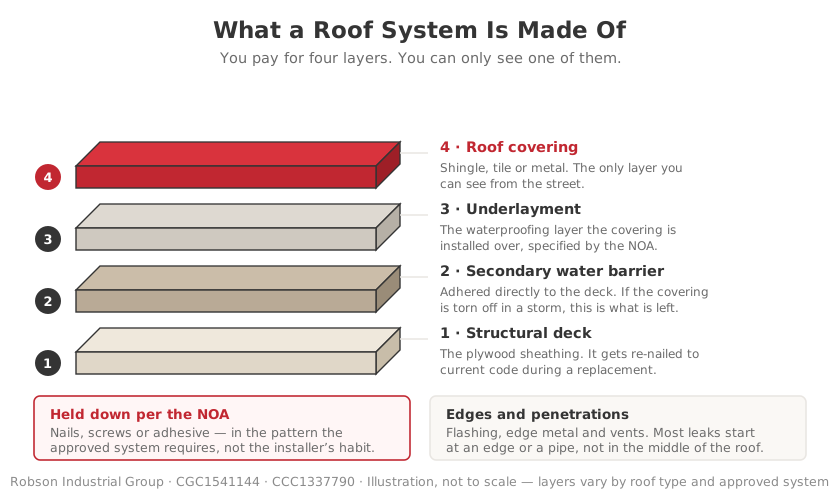
Look for these line items. A serious estimate has most or all of them. A bid that names the tile but says nothing about the underlayment is a bid you have to read twice.
- Tear-off scope — full removal to the deck (required in the HVHZ), and disposal.
- Deck repair allowance — a stated rate for replacing rotten sheathing found during tear-off, so a surprise doesn’t become a surprise bill.
- The underlayment / water-barrier system, named. For tile, that should be the two-ply self-adhered system — not just “felt.”
- The covering, by manufacturer and product. “Shingles” isn’t enough; which shingle?
- Fastening and flashing details — the wind-rated nailing and new flashing/edge metal, not reused flashing.
- Product approval — reference to NOA or Florida Product Approval for the system.
- Low-slope sections listed separately — a flat section is its own system with its own approval; a flat roofing contractor in Miami should name it (modified bitumen, TPO or BUR), not fold it into the shingle line.
- Permit and inspections — a line confirming the job is permitted and will pass the staged inspections.
- Warranties — clearly separating the contractor’s workmanship warranty from the manufacturer’s material warranty.
- Exclusions and allowances — what’s not included.
- Payment schedule — reasonable, milestone-based; not a huge up-front demand.
What are the two different roofing warranties?
People conflate these, and contractors sometimes blur them on purpose:
- The manufacturer warranty covers the materials — the shingles, tile, or panels. It’s only as good as the company behind it, and some are prorated.
- The workmanship warranty covers the installation — the labor. This is the one that protects you if the roof was put on wrong, and it’s only as good as the contractor still being in business.
A good estimate states both, in writing, with their terms. We put the workmanship-warranty term right on the proposal.
What are red flags in a roofing estimate?
Be cautious if you see:
- Vague scope — “re-roof, $X” with no detail. You can’t compare it to anything.
- No permit line, or an offer to skip the permit “to save money.” In the HVHZ, that’s skipping your inspections — your protection.
- “We’ll just go over the existing roof.” Not legal here; full tear-off is required.
- A large up-front deposit demanded before any work.
- “Free roof” or deductible waiving on an insurance job — illegal in Florida.
- No deck-repair allowance — almost guarantees a change-order surprise.
- Pressure to sign today for a “today only” price.
How do you compare two roofing estimates fairly?
Line them up item by item, not bottom line to bottom line. If one is cheaper, find out why: a thinner underlayment, an unnamed product, no deck allowance, or a skipped permit will all make a quote look cheaper while making the roof worse. The honest cheaper bid and the corner-cutting cheaper bid look identical until you read them.
Price spreads on the same roof can be wide and still both be legitimate. A 2,000 sq ft flat roof in Miami might land near $30,000 in shingle and closer to $52,000 in standing-seam metal, same footprint, different material tier. Even within one material, bids on a single job can range from roughly $11,500 to $24,000 depending on scope. Before comparing totals, check how much plywood the bid actually replaces: a common shortcut is quoting only half a sheathing sheet per spot, leaving the rest of the deck unaddressed. Ask for the sheathing allowance in writing, in full sheets, not a percentage.
Frequently asked questions
Why is one estimate so much cheaper than another?
Should the estimate include a permit?
What's a reasonable deposit?
Do I need the product names on the estimate?
We write estimates to be read, not just signed: named products, a deck allowance, permit and inspections, and the warranty terms in plain sight. Compare ours to anyone’s.