HVHZ Roofing Compliance in Miami: What Every Homeowner Should Know
If your home is in Miami-Dade or Broward County, every roofing job is subject to the strictest building standards in the continental United States, and the consequences of non-compliance follow the property, not the contractor.
What the HVHZ Actually Covers — and Why Miami-Dade Wind Requirements Are the Strictest in Florida
The High-Velocity Hurricane Zone, HVHZ, is a wind-exposure classification under the Florida Building Code that covers all of Miami-Dade County and all of Broward County, and nowhere else in the state. If you own a home in Kendall, Coral Gables, Hialeah, Pembroke Pines, Hollywood, or anywhere between, your roof, your windows, and your doors are all governed by Miami-Dade wind requirements that are materially stricter than the hurricane zone roofing codes used in Orlando, Tampa, or even Palm Beach County just north of the line. There is no partial-county exemption and no distance-from-the-coast carve-out: the code applies the same whether you're oceanfront or fifteen miles inland. This matters most for a question we hear constantly: homeowners assume that because a roof or a set of windows "looks fine" and passed a visual glance from the driveway, it must be up to code. It usually isn't that simple: compliance lives in the paperwork, the fastener count, and the NOA number on file, none of which are visible from the street.
The HVHZ classification was established in the wake of Hurricane Andrew in 1992. Andrew struck South Florida as a Category 5 storm and destroyed more than 125,000 homes: not primarily because the wind was unprecedented, but because a large share of those homes were built and reroofed without adequate oversight. Post-Andrew investigations found widespread violations: missing fasteners, wrong materials, jobs done without permits, and inspectors who signed off on work they never saw. The HVHZ framework, with its tighter product-approval and inspection requirements, was the legislative response.
Under HVHZ requirements, every roofing material, window, and door installed in Miami-Dade or Broward must carry a Miami-Dade County Notice of Acceptance (NOA) or an approved Florida Product Approval. This is not brand-level approval: it is product-number-level approval, and it applies to openings as much as it applies to roofs. The system exists to keep roofs, windows, and doors attached and intact at sustained wind loads of 140 miles per hour and above.
Not sure whether your current roof or windows are already HVHZ-compliant? Request a free compliance check and we'll verify your permits, NOA documentation, and inspection history before a storm or a sale forces the question.
What NOA Approval Actually Means for Your Roof, Windows, and Doors
Homeowners often hear "NOA-approved shingles" or "NOA-approved windows" and assume that means the brand is on some sort of approved list. That is not how it works. The NOA is issued to a specific product (a specific shingle series, underlayment line, window model, door assembly, or fastener specification) each with its own approval number. Every single component of a compliant HVHZ installation, whether it's on the roof or in a window opening, must carry its own NOA.
The contractor must have that documentation on the job site. The permit application requires listing the specific NOA numbers for each product being installed. When the county inspector arrives, they check that the materials on the roof or in the opening match what was listed on the permit. If an inspector finds a product with no NOA, or a product whose NOA number does not match the permit, the inspection fails and the permit remains open.
This is where homeowners get hurt by unscrupulous contractors. The permit may be pulled with compliant products listed, and then the contractor substitutes cheaper, non-NOA materials after the permit is approved. The homeowner sees shingles going on the roof, or a window going into the frame, and has no way to verify product numbers from the ground. The contractor collects payment, and the problem only surfaces when the inspector shows up, or when a storm hits and the assembly fails. Always ask for the specific product numbers and NOA documentation before installation begins. If you want a line-by-line walkthrough of how to actually read one of these documents, see our Miami-Dade NOA homeowner's guide.
TAS Testing: What Actually Gets Tested Before a Product Earns Its NOA
An NOA doesn't get issued on paperwork alone. Before a roofing product, window, or door can be approved for HVHZ use, it has to pass a battery of Testing Application Standards (TAS) at an accredited lab, and understanding what those tests actually measure is the difference between trusting a sticker and understanding what you're paying for.
TAS 201: Large Missile Impact Test. A 9-pound piece of lumber is fired at the product at 50 feet per second, simulating windborne debris in a hurricane. The product has to withstand the impact without creating an opening large enough to let wind pressure build up inside the structure.
TAS 202: Structural and Air/Water Infiltration Test. The product is subjected to uniform static air pressure loads that simulate sustained hurricane-force wind, along with water infiltration testing, to confirm it holds structurally and doesn't leak under load.
TAS 203: Cyclic Wind Pressure Loading Test. The product is subjected to thousands of repeated pressure cycles that simulate the sustained buffeting of a multi-hour hurricane, not just a single gust. This is what catches fatigue failures that a one-time pressure test would miss.
A product only earns its Notice of Acceptance after it clears this testing as a complete, as-tested assembly: the frame, the glazing, the anchoring, and the installation method all have to match what was tested. Change any one of those and you've effectively voided the tested approval, which is exactly why installation method matters as much as product selection.
| TAS Standard | What It Simulates | What It Confirms |
|---|---|---|
| TAS 201 | A 9-lb. 2x4 fired at 50 ft/sec — windborne debris impact | The product won't breach and let internal pressure build |
| TAS 202 | Sustained hurricane-force static air pressure, plus water infiltration | The product holds structurally and stays sealed under load |
| TAS 203 | Thousands of repeated pressure cycles over a simulated multi-hour storm | No fatigue failure from sustained buffeting, not just one gust |
How to Check Whether Your Own Roof or Windows Are Currently Compliant
You don't have to wait for a storm or a sale to find out where you stand. A few checks take less than an hour and tell you most of what you need to know:
- Search the county permit portal. Miami-Dade's and Broward's building department websites both let you search permit history by address. Look for your most recent roof, window, or door permit and confirm the status reads "closed" or "finaled," not "open" or "expired."
- Pull your paperwork. If you still have the closing documents, contract, or invoice from your last roofing or window job, check whether NOA numbers are listed for the specific products installed. If the paperwork only lists a brand name with no NOA number, that's a gap worth investigating.
- Check your wind-mitigation inspection report if you have one on file from a past insurance renewal. It typically documents roof covering type, opening protection, and secondary water barrier — all of which tie back to HVHZ compliance.
- If anything doesn't check out, get a professional inspection before you need one. A short inspection now is dramatically cheaper than a denied claim or a stalled closing later.
HVHZ Compliance Isn't Just a Roofing Rule — It Applies Equally to Windows and Doors
Most homeowners think of "hurricane code" as a roofing issue. It isn't. Every window and door installed in Miami-Dade or Broward, whether it's a full impact-glass replacement or a standard opening protected by code-compliant shutters, is held to the same HVHZ product-approval and permit standard as the roof over it. The NOA requirement, the TAS testing behind it, and the permit-and-inspection process are identical in structure whether the crew on your property is replacing shingles or setting a French door.
This matters because the two trades are often bought separately, at different times, from different contractors, and homeowners sometimes assume that because their roof is compliant, their windows automatically are too, or vice versa. They aren't linked. A fully HVHZ-compliant roof does nothing to protect you from an insurance dispute over uninspected impact windows, and a documented window installation doesn't cover an open roofing permit. Robson Industrial Group handles both under one license structure (roofing under CCC1337790 and general contracting, including impact window and door installation, under CGC1541144) specifically so a homeowner isn't managing two separate compliance trails with two separate contractors. For the step-by-step mechanics of a compliant window installation, from product selection through final inspection, see our permit-to-inspection guide for impact windows.
Doors carry the same requirement and the same risk of confusion. French doors, sliding glass doors, and entry doors all need product-specific NOAs, and the tested assembly rule applies just as strictly: a French door and a sliding glass door are not interchangeable under a single approval, even from the same manufacturer, because each is tested and anchored differently. Garage doors are frequently the weak point homeowners overlook entirely: an HVHZ-rated garage door is required by code because a garage door failure during a hurricane lets wind pressure into the structure and can contribute to catastrophic roof and wall failure from the inside out, not just water intrusion.
The Permit-and-Inspection Requirement — For Every Roof, Window, and Door
Every roofing, window, or door job in Miami-Dade and Broward requires a building permit. This is not a threshold that applies only to full replacements. Repairs above a certain scope also require permits, and that threshold is lower in the HVHZ than in most of Florida. A contractor who tells you that your job is "too small to need a permit" is either misinformed or trying to avoid the accountability that comes with the permit-and-inspection process.
The inspection process works like this: after installation is complete, a county inspector physically visits the property and verifies the nailing pattern or anchoring, the underlayment or flashing, and confirms the materials installed match the permitted products and their NOA numbers. Only after passing inspection does the permit close. A closed permit is the documentation that your roof, window, or door was installed to HVHZ code, and it's the only thing that will hold up when a carrier or a buyer asks for proof.
The homeowner, not the contractor, is ultimately responsible for ensuring permits are pulled and closed. This matters at resale. When a buyer's inspector or title search finds an open permit from a prior roofing or window job, that problem does not stay with the contractor who left it open. It transfers with the property. Buyers may demand that open permits be resolved before closing, or they may walk. Lenders may require permit closure as a condition of financing. An unpermitted roof or window replacement can cloud a title for years.
Free HVHZ Compliance Check — Roof, Windows & Doors
Robson Industrial Group will inspect your roof and openings, confirm your permits are closed, and verify the NOA documentation on file for every product. Free, no obligation. If something isn't compliant, you'll know before a storm or a sale forces the issue.
Request My Free Compliance Check →What Happens When HVHZ Work Isn't Done Right
The consequences of non-compliant roofing, window, or door work in the HVHZ are serious and tend to materialize at the worst possible time. After a storm, or when you are trying to sell the house.
Insurance claim denial. After a hurricane, your homeowner's insurance carrier will investigate whether your roof and openings were permitted and inspected. If the work was unpermitted, or if the inspection records show the permit was never closed, the carrier has grounds to deny or reduce your claim. Even if the storm damage itself is otherwise covered. This is not hypothetical; it happened to thousands of South Florida homeowners after prior hurricanes, and it applies to window and door claims just as often as roof claims.
Code violations and fines. Local building departments can issue code enforcement citations for unpermitted work discovered at any point: not just at the time of installation. A municipal inspector doing a routine neighborhood sweep, or responding to an unrelated complaint, can flag an open or missing permit years after the work was done, triggering fines that accrue until the issue is resolved.
Resale complications. Open permits are discoverable in public records. Title companies flag them. Buyers negotiate over them. If the original contractor cannot be located, which is common years after the fact, resolving an open permit may require hiring a new contractor to document, re-permit, or redo the work entirely before the sale can close.
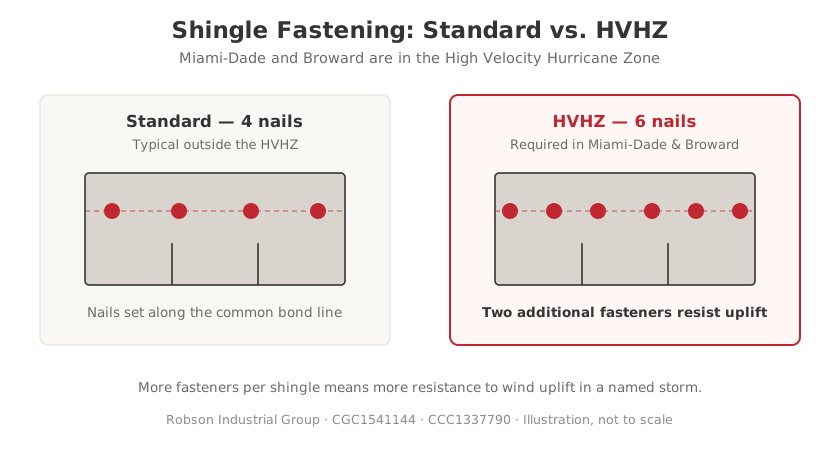
Structural failure. A roof installed with the wrong nailing pattern, four nails per shingle instead of the six required in the HVHZ, or a window installed with the wrong anchoring will not visibly fail under normal conditions. It will fail in a hurricane, when the consequences are severe and the damage compounds quickly once one opening is breached.
Legal exposure. Contractors who perform work without a license or permit in Florida can be prosecuted for unlicensed contracting. Homeowners who knowingly allow unpermitted work may face fines from the municipality. Both the contractor and the homeowner can be cited.
None of these outcomes require anything unusual to happen: they surface from completely ordinary events: a hurricane makes landfall, a homeowner decides to sell, or a mortgage gets refinanced. Compliance isn't a box you check once and forget; it's the difference between those ordinary events being routine and them becoming expensive.
What to Ask Before You Sign — Roofer, Window, or Door Installer
The easiest protection against HVHZ non-compliance is asking the right questions before you sign a contract. A licensed, compliant contractor, roofing or windows, will be able to answer all of these without hesitation:
- What is your Florida contractor license number? A Certified Roofing Contractor license begins with CCC; a Certified General Contractor license, which also covers window and door installation, begins with CGC. Verify it at myfloridalicense.com before signing. Confirm the license is active and shows no open complaints.
- Will you pull the permit? The answer should always be yes. If a contractor expects the homeowner to pull the permit, or says the job doesn't need one, walk away.
- What specific product numbers are on the NOA for this installation? Get the shingle series, underlayment product number, window model, door assembly, and anchoring specification in writing. Compare them to the permit application when it is submitted.
- What is the nailing pattern or anchoring spec? HVHZ code requires six nails per shingle in the approved nailing zone on roofs, and a specific anchor type and spacing for windows and doors that matches the tested assembly. Anything less does not meet HVHZ requirements.
- Is the installation method the same as what was tested? A window or door's NOA covers the product as tested — frame, glazing, and anchoring together. If the installer proposes a different anchoring method to save time, the installation may fall outside the tested approval even if the product itself carries a valid NOA.
- Will you provide the NOA documentation? A legitimate contractor will give you copies of the NOA for every product installed, roof or opening. This is not optional; it is required to close the permit.
Robson Industrial Group holds CGC1541144 (Certified General Contractor) and CCC1337790 (Certified Roofing Contractor). Both licenses verified active in Florida. We pull all permits, install to HVHZ specification with fully documented NOA-approved products across roofing, Eco Windows, and PGT impact window and door lines, and provide complete inspection records at job close. Our GAF Certified™ status (ID 1164276) lets us register the GAF System Plus Limited Warranty (enhanced coverage on GAF materials) on qualifying GAF roofing installations; workmanship is covered by Robson's own written warranty.
Robson Industrial Group · CGC1541144 · CCC1337790 · GAF Certified™ ID 1164276 · Miami-Dade, Broward, & West Palm Beach, FL · (954) 546-4161
Frequently Asked Questions
What areas does the HVHZ cover, and does it include Southeast Broward specifically?+
The High-Velocity Hurricane Zone covers all of Miami-Dade County and all of Broward County under the Florida Building Code. There is no partial-county carve-out. Homeowners in Pembroke Pines, Hollywood, Miramar, and other Southeast Broward cities are under the exact same HVHZ product-approval and permit requirements as homeowners in Miami-Dade. For a side-by-side look at how the two counties compare on roofing requirements, see our Miami-Dade vs. Broward roofing codes guide.
What's the difference between an NOA and TAS testing?+
TAS testing (TAS 201, 202, and 203) is the laboratory process a product goes through: simulated windborne debris impact, structural air pressure, and cyclic wind loading. The NOA (Notice of Acceptance) is the official Miami-Dade County document that certifies a specific product passed that testing and is approved for HVHZ installation. You can't get an NOA without the underlying TAS test reports, but the NOA number is what your contractor and the county inspector actually reference on the permit.
Do impact windows and doors need a permit in the HVHZ, even for a single opening?+
Yes. Miami-Dade and Broward require a permit for window and door replacement in the HVHZ regardless of how many openings are involved. There is no small-job exemption. The permit lists the NOA number for each product, and the installation must pass inspection before the permit closes.
Can a hurricane insurance claim actually be denied because of non-compliant HVHZ work?+
Yes, and it happens regularly after major storms. If a carrier's post-storm investigation finds the roof, window, or door work was unpermitted, uninspected, or installed with products lacking valid NOA documentation, the carrier has grounds to deny or reduce the claim. Even when the storm damage itself would otherwise be covered.
How do I verify a contractor's roofing and window/door licenses in Florida?+
Look up the license number at myfloridalicense.com. A Certified Roofing Contractor license begins with CCC; a Certified General Contractor license, which also covers window and door installation, begins with CGC. Confirm the license is active and check for open complaints before signing anything.
Does a small roof repair still need to meet HVHZ code, or only a full replacement?+
Both. The HVHZ permit threshold for repairs is lower than in the rest of Florida. Many repairs that would be permit-exempt elsewhere require a permit here. A contractor who tells you a repair is “too small” to need a permit is either misinformed or avoiding accountability.
Does HVHZ-compliant work cost more than a non-compliant job?+
The materials and labor cost more than an uninspected, non-NOA installation, yes, but that comparison is misleading. A non-compliant job isn't a cheaper version of the same product; it's a different, unapproved product with no tested wind or impact rating, installed without the inspection record that protects you later. The real comparison is compliant work now versus a denied insurance claim, a stalled sale, or a full redo after storm damage, and compliant work is dramatically cheaper on that comparison.
Do garage doors need HVHZ product approval too?+
Yes. An HVHZ-rated garage door needs its own NOA, just like roofing, windows, and other doors. It's one of the most commonly overlooked openings, but a garage door failure during a hurricane lets wind pressure into the structure and can contribute to roof and wall failure. Insurers and inspectors treat it as seriously as any other opening.
Related Resources
Material-by-material cost breakdown for Miami-Dade
What does a new roof actually cost in Miami-Dade? Ranges by material, permit fees, deck repair, and financing options. Updated for 2026.
Read the Cost Guide →Certification, warranty coverage, and verification
What GAF certification requires, what the System Plus warranty covers, and how to verify a contractor before you sign anything.
Read the Article →Licensed · Permitted · GAF Certified™
Serving Miami Beach, Kendall, Doral, Coral Gables, Hialeah, North Miami, and surrounding communities. CGC1541144 · CCC1337790.
See Service Areas →Get a Free HVHZ Compliance Estimate — Roofing, Windows & Doors
Robson Industrial Group pulls permits, installs to HVHZ code with fully documented NOA-approved products on every roof, window, and door, and closes every job with a passing inspection on file: no shortcuts, no exposure for you later. CGC1541144 · CCC1337790 · GAF Certified™ ID 1164276.
Get a Free Estimate →Call: (954) 546-4161 · CGC1541144 · CCC1337790 · GAF Certified™ · Miami-Dade, Broward, & West Palm Beach