Before Installation Begins: Product Selection and Approval
The first thing that happens after you sign a contract is product specification. In Miami-Dade, this step has a compliance dimension that doesn’t exist in most other places in the country. Every impact window and door installed in Miami-Dade must have a Miami-Dade Notice of Acceptance (NOA) or a Florida Product Approval (FL number) that covers the specific unit size and configuration being installed in your home.
The distinction between an NOA and an FL number matters. Miami-Dade NOA is the original, more stringent certification system. It was developed by Miami-Dade County after Hurricane Andrew and remains the gold standard for products installed in the High Velocity Hurricane Zone. An FL (Florida) approval is the statewide product approval system administered by the Florida Building Commission. Both are accepted in Miami-Dade for most impact window applications, but some specific applications, particularly in the highest-wind-speed zones within Miami-Dade, may require a NOA rather than an FL approval.
A reputable contractor will provide you with the NOA or FL number for every window and door being installed, along with the specific approval it covers. Approval documents specify: the maximum unit size the approval covers, the design pressure rating (a measure of wind resistance expressed in pounds per square foot), whether the product is approved for installation in masonry, wood-frame, or both, and the specific anchoring method the approval requires. Using an approved product with an unapproved anchor type or spacing is the same as using an unapproved product for purposes of inspection compliance.
Homeowners in communities governed by a homeowners association (HOA) or condo association have an additional step: HOA architectural review. Many Miami-Dade HOAs allow impact windows without prior approval because they’re code-required, but some, especially in communities with strong aesthetic standards or historic districts, require submittal of the window specifications, color, and grid pattern before work can begin. HOA approval timelines vary from a few days to several weeks. A contractor who doesn’t ask about HOA requirements before scheduling the permit is skipping a step that can result in stop-work orders after installation has already begun.
The Permit Application
In Miami-Dade, impact window replacement permits are pulled from Miami-Dade Building Department (for unincorporated Miami-Dade) or from the relevant municipality’s building department if the home is within city limits. Miami Beach, Coral Gables, Hialeah, and other incorporated municipalities each have their own building departments. The permit application requires a drawing package that includes the floor plan showing window locations with dimensions, the elevation drawings, and a product specification sheet for each unit type showing the NOA or FL approval information.
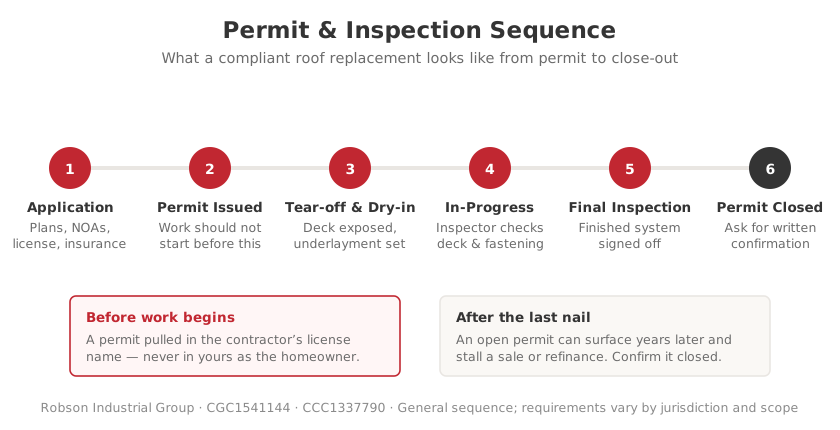
For impact window replacement specifically (as opposed to new construction), the permit also requires a signed contractor qualification page confirming the contractor holds the appropriate license. Under Florida Statute §489.119, this must be a Florida Certified General Contractor (CGC license) or a Florida Certified Building Contractor (CBC license). The work can be performed by the contractor’s employees or by subcontractors; what matters for the permit is that the qualifying licensee takes responsibility for the installation.
Permit processing time in Miami-Dade for a standard residential window replacement has historically ranged from 3 to 10 business days through the online portal (MDC ePermit). Jobs with unusual features, large unit counts, or properties in historic districts or special overlay zones may take longer. Your contractor should be able to give you a realistic permit timeline based on current processing volume. Work cannot legally begin until the permit is issued and the approved plans are on site.
One important note on over-the-counter vs. electronic permit submission: virtually all residential window permits in Miami-Dade are now submitted electronically. The approved plans are issued as a digital file. The contractor is required to have the approved plans accessible on site during inspection, typically on a tablet or laptop, not a printed set. If a contractor tells you they need to wait for “the plans to come back from the county” in physical form, they may be unfamiliar with the current process.
Pre-Installation: Ordering, Lead Times, and Site Prep
Impact windows and doors are manufactured to order. They are not stocked items that a contractor keeps in a warehouse. Once the permit is issued and the products are confirmed, the contractor places the manufacturing order. Lead times for impact windows in South Florida currently range from 8 to 16 weeks depending on the manufacturer, the product line, and current production volume. Peak season (spring and early summer, ahead of hurricane season) typically has longer lead times than off-season.
What should be happening during the lead time: the contractor should confirm the order has been placed and provide you with the order confirmation. They should notify you when the product ships from the factory to the local distribution point. Before the installation day, they should contact you to schedule the installation date and confirm any access requirements (furniture moved away from windows, pets secured, etc.).
The day before or morning of installation, the crew will typically verify the site: confirm window rough opening dimensions match what was measured and ordered, check that the approved plans are accessible, verify that the job site is ready. If there is a significant dimension discrepancy between the rough opening and the ordered unit, the installation may need to be rescheduled while the unit is remade or the opening is modified. This is rare but does happen, which is why accurate field measurement before ordering is critical.
The Installation Sequence
On installation day, or days (a typical whole-house window job in Miami-Dade takes 1 to 3 days depending on unit count and home size), the crew works through a defined sequence that the Miami-Dade building code and the product’s NOA or FL approval specify.
The typical sequence for a masonry opening (by far the most common in Miami-Dade concrete block construction):
- Remove existing windows. The old window unit is removed and the opening is inspected. Any deteriorated sill material, cracked block, or deteriorated caulk is identified and must be addressed before the new window goes in. If the existing sill has rot or structural damage, it must be repaired before installation proceeds. Installing a new window over a deteriorated substrate will fail inspection.
- Set the window in the opening. The unit is placed in the rough opening and checked for level, plumb, and square. This step is more critical than it seems: a window that is installed out of level or square will bind in operation, may not seal properly, and may fail the product’s specified installation requirements.
- Anchor the window. The NOA or FL approval specifies the anchor type (typically screws or expansion anchors into the masonry), the anchor diameter and embedment depth, and the maximum anchor spacing. In Miami-Dade, the required anchor spacing for HVHZ applications is typically tighter than standard — 6-inch maximum in some applications vs. the 12-inch spacing common elsewhere. The anchors are installed per the product’s approval document, not by the crew’s judgment.
- Rough-in inspection. Before the perimeter is sealed, a Miami-Dade building inspector must inspect the installation to verify that: the correct product (matching the NOA/FL approval) was installed, the anchors are the correct type and spacing, and the window is properly set in the opening. This inspection happens before sealant or interior trim is applied — because the inspector needs to see the anchors, the substrate condition, and the installation details that will be covered up once the job is finished.
- Perimeter sealing. After the rough-in inspection passes, the perimeter of the window is sealed with the sealant type specified in the NOA/FL approval. The sealant bridges the gap between the window frame and the masonry opening, providing the weather-tight seal. The sealant must fully bed and cure before it can be covered with interior trim or exterior stucco patch.
- Interior trim and exterior finishing. Interior trim (if any) is installed after the sealant cures. Exterior stucco patch around the window perimeter is applied and finished to match the existing exterior. On many Miami-Dade homes with exterior paint, the patched stucco area will need to be painted to match — this is typically the homeowner’s responsibility unless the contract specifies otherwise.
The Rough-In Inspection: What the Inspector Checks
The rough-in inspection is the critical compliance checkpoint in the impact window installation process. An inspector from the municipality’s building department arrives to verify the installation before it is covered up. What they look for:
- Product identity. The inspector verifies that the product on site matches the product specified on the permit. They may check the NOA or FL approval label on the window unit, or check the approval documentation against the product installed. A contractor who substitutes a different product than what was permitted — even a “similar” product — without amending the permit will fail this check.
- Anchor type and spacing. The inspector verifies that the anchors are the type and size specified in the product approval, and that the spacing meets the approval requirement. In Miami-Dade HVHZ applications, this is a hard check — insufficient anchor count or wrong anchor type is an automatic failure.
- Substrate condition. The inspector checks that the anchors are embedded in sound masonry. Anchors installed in deteriorated or hollow block do not provide the required withdrawal resistance and will fail.
- Installation per approval document. The inspector has access to the product’s approval document (or the contractor must have it on site). If the installation deviates from the approval in any way — different anchor spacing, different sill condition, different framing type than what the approval covers — it fails.
If the rough-in inspection fails, no sealant or covering work can proceed until the failure is corrected and re-inspected. This is why it is important to have the inspector come as quickly as possible after anchors are set, since the crew cannot move on to the next phase of work until the inspection passes.
Final Inspection and Certificate of Completion
After all windows are installed, sealed, and trimmed, the contractor requests a final inspection. The final inspector verifies that the installation is complete: all windows are installed and sealed, the perimeter is finished, and no rough-in discrepancies remain outstanding. They will also check operation: windows and doors open and close properly, locks engage, and there are no obvious installation defects.
A passed final inspection triggers the issuance of a Certificate of Completion (sometimes called a Certificate of Occupancy or simply a permit closeout). This document is important for multiple reasons:
- It proves the work was done legally and inspected, which is required if you sell the home.
- It is required to submit for wind mitigation credit with your insurance company. The OIR-B1-1802 wind mitigation inspection (done by a separate inspector) documents your opening protection status — the inspector will ask for the permit number to verify the work was permitted and completed.
- It protects you if there is a dispute with the contractor about whether the work was completed correctly — a passed inspection is evidence that the installation met code at the time of inspection.
You should request a copy of the Certificate of Completion from your contractor and keep it with your home records. If they cannot provide it, you can look it up directly at bldrecords.miamidade.gov using the permit number.
The Timeline: What a Typical Miami-Dade Impact Window Job Looks Like
A realistic timeline for a whole-house impact window replacement in Miami-Dade:
- Week 1–2: Site measurement, product specification, HOA submittal if required, permit application prepared.
- Week 2–4: Permit issued (typical range 3–10 business days from submission).
- Week 4–6: Manufacturing order placed; lead time begins.
- Week 12–20: Product arrives (8–16 weeks of manufacturing lead time).
- Week 13–21: Installation scheduled and completed (1–3 days on site for a typical home).
- Week 14–22: Rough-in inspection passes; sealant applied; trim and finishing.
- Week 15–23: Final inspection; Certificate of Completion issued.
From contract signing to final inspection sign-off, a total of 4 to 6 months is a realistic expectation for a whole-house job in Miami-Dade. Contractors who promise significantly shorter timelines are either carrying inventory from a prior job (possible but worth asking about) or underestimating lead times. The inspection schedule (rough-in and final) adds time that cannot be compressed. The inspector comes on their schedule, not yours.
How Robson Handles Impact Window Installations in Miami-Dade
Robson Industrial Group is a Florida Certified General Contractor (CGC1541144, verifiable at myfloridalicense.com). We pull the permit, provide the NOA or FL approval documentation for every unit we specify, coordinate the rough-in and final inspections, and deliver the Certificate of Completion to the homeowner at project close.
On product specification: we confirm the NOA or FL approval for every unit before the order is placed. If a product substitution becomes necessary due to a manufacturing or availability issue, we disclose it to the homeowner and re-verify approval compliance before installing. We do not install products that have not been verified against the permit approval.
On inspections: we schedule the rough-in inspection the same day anchors are set across the home, so the inspector can come and the job can move forward without a multi-day wait. We do not ask crews to apply sealant before the rough-in passes. Covering up the inspection point before it passes is a code violation and creates the kind of hidden compliance failure that surfaces later at resale.
Getting Impact Windows in Miami-Dade or Broward?
We handle the permit, supply the NOA documentation, manage both inspections, and deliver the closed permit at project completion. Call (954) 546-4161 or use the form below.
Get a Free Impact Window Estimate →Frequently Asked Questions
Do I need a permit to replace impact windows in Miami-Dade?
Yes, without exception. Replacing windows, including like-for-like replacements of existing impact windows, requires a permit in Miami-Dade County and all incorporated municipalities within it. This applies to single-window replacements as well as whole-house jobs. The permit requires approved drawings showing window locations and product approval documentation (NOA or FL number). Any contractor who proposes doing the work without pulling a permit is asking you to accept the legal risk of unpermitted work, which can surface at resale and may affect your insurance coverage.
What is the difference between an NOA and an FL product approval for impact windows?
Both are product approvals accepted in Miami-Dade, but they come from different authorities. A Miami-Dade NOA (Notice of Acceptance) is issued by the Miami-Dade County Product Control Division and was the original HVHZ product certification system created after Hurricane Andrew. An FL approval is the statewide product approval system. Both require the product to meet the wind load and impact resistance requirements for the HVHZ. In most residential impact window applications in Miami-Dade, either is acceptable. Your contractor should be able to show you the specific approval document for the products being installed and confirm it covers your application.
How many inspections are required for impact window replacement in Miami-Dade?
Typically two inspections: a rough-in inspection (after the windows are set and anchored, before sealant and trim are applied) and a final inspection (after the job is complete). The rough-in inspection is the critical compliance checkpoint. It verifies that the correct product was installed, the anchor type and spacing meet the product approval requirements, and the substrate is sound. No sealant or covering work can proceed until the rough-in passes. The final inspection verifies the job is complete and issues the Certificate of Completion.
How long does impact window installation take in Miami-Dade?
The physical installation of windows on a typical single-family home takes 1 to 3 days. The total project timeline from contract signing to final inspection sign-off is typically 4 to 6 months, driven primarily by manufacturing lead time (currently 8–16 weeks for most impact window products in South Florida) and permit processing. Contractors who promise significantly shorter total timelines are either carrying pre-ordered inventory (possible, and worth asking about specifically) or underestimating lead times.
Can I get an insurance discount after installing impact windows in Miami-Dade?
Yes, installing NOA or FL-approved impact windows typically qualifies your home for opening protection credits on the OIR-B1-1802 wind mitigation form. The wind mitigation inspector (a separate inspection from the building department inspection) documents the type of opening protection and the approval documentation. The resulting credits can reduce wind coverage premiums significantly. In Miami-Dade, homeowners with full impact window protection and a qualifying roof system have seen total wind coverage premium reductions of 40% or more. The key requirement is that the windows must be permitted, installed to code, and documented with the appropriate approval numbers.