Hialeah has one of the highest concentrations of unlicensed roofing activity in Miami-Dade County. Older housing stock, a large Spanish-speaking homeowner base, and a pattern of storm-chaser contractors showing up after each hurricane season create conditions where homeowners get hurt financially (and physically) every year.
This guide gives Hialeah homeowners a clear process for finding a licensed, insured, HVHZ-compliant contractor: how to verify credentials before the first handshake, what a legitimate permit process looks like, and what specific claims should send you in the other direction. Robson Industrial Group (Lic. CGC1541144 · CCC1337790) serves all of Hialeah and Miami-Dade County.
Why Hialeah Has a Specific Contractor Licensing Problem
Hialeah is Miami-Dade County’s second-largest city, with roughly 230,000 residents and a housing stock that skews older. Much of it built between the 1950s and 1980s. Many of those homes have flat or low-slope roofs, concrete tile, or modified bitumen systems that are reaching end of life at the same time.
That combination (aging roofs, dense population, and limited English fluency in many neighborhoods) makes the area a consistent target for unlicensed operators. The pattern repeats: a named storm approaches, door-to-door solicitation picks up, homeowners who are already anxious sign contracts without verifying credentials, and work gets done without permits. When the work fails during the next storm, there is no recourse because the contractor does not legally exist.
The Florida Department of Business and Professional Regulation (DBPR) tracks license violations, and Hialeah consistently appears in enforcement actions. Knowing the verification process is your primary defense.
Hialeah by Neighborhood: Roof Ages and Styles Vary More Than People Expect
Hialeah's roofing needs are not uniform across the city, and knowing where your home sits helps you ask the right questions during an estimate.
- Palm Springs, on the city's northwest side, is one of Hialeah's oldest developed sections — an estimated 91% of its homes were built between 1940 and 1969. Ranch-style construction from the 1950s dominates, often with low, flat rooflines and, on some blocks, Spanish Colonial features like red clay tile and arched entryways. Flat and low-slope sections here are frequently on modified-bitumen or built-up roofing systems that have a shorter service life than pitched tile or shingle, and many are now well past a reasonable replacement window.
- Hialeah Park, the neighborhood surrounding the historic Hialeah Park Race Track — listed on the National Register of Historic Places and home to an Audubon-recognized bird sanctuary — mixes older single-family homes with newer infill construction. Roof age and material vary block to block more than in Palm Springs.
- West Hialeah, which was still open land and citrus grove through the 1960s and 70s, was developed later and generally carries newer roof systems, though tile remains the dominant material and 30–50-year-old tile roofs are now reaching the point where underlayment failure — not the tile itself — is the actual problem.
On any Palm Springs-era home, ask your contractor directly whether the roof is flat/low-slope or pitched, since the inspection points, materials, and cost structure are different for each.
Why Hialeah's Older Flat Roofs Fail Differently Than Newer Tile
Hialeah has no coastline, but it is crossed by the Miami Canal and several smaller C-series drainage canals that carry stormwater west toward the Everglades. Combined with the city's dense, low-elevation urban footprint, this means ponding water on flat and low-slope roof sections, common throughout older Palm Springs-era construction, is a persistent problem that pitched tile roofs elsewhere in Miami-Dade do not face to the same degree. Standing water accelerates membrane breakdown at seams and drains years faster than a manufacturer's rated lifespan would suggest.
On pitched tile roofs, the more common Hialeah failure point is underlayment breakdown from decades of South Florida heat cycling: the tile itself can look intact while the SBS or felt underneath has degraded to the point of active leaks. A contractor who only walks the roof and looks at the tile, without lifting a sample section to check the underlayment, cannot tell you which situation you are actually in.
Florida Roofing License Types: What They Mean
| License Type | Prefix | Scope for Roofing | Issued By |
|---|---|---|---|
| Certified General Contractor | CGC | Full scope of construction including roofing | FL DBPR |
| Certified Roofing Contractor | CCC | Roofing specifically | FL DBPR |
| Registered General Contractor | GC | Roofing within the registered county only | County |
| Registered Roofing Contractor | RC | Roofing within the registered county only | County |
A Certified license (CGC or CCC) is state-issued and valid statewide. A Registered license is county-issued and valid only in the county where it was issued. Both are legitimate, but for work in Miami-Dade HVHZ conditions, confirm the contractor has active workers’ compensation and general liability insurance, which licensed contractors are required to carry.
7-Step Verification Process Before Signing Anything
Do this before any contract discussion. It takes under ten minutes and eliminates most bad actors.
- Get the license number in writing. Ask for the CGC or CCC number. Any legitimate contractor will have it memorized and printed on their business card or proposal.
- Verify on DBPR. Go to myfloridalicense.com, click Verify a License, and enter the number. Confirm: (a) Status = Current, Active; (b) the license holder name matches what the contractor told you; (c) no disciplinary actions listed.
- Verify workers’ compensation. Ask for a certificate of insurance naming you as the additional insured. Call the insurance company on the certificate directly — do not just accept the document — and confirm the policy is active and covers roofing in Miami-Dade.
- Ask about the NOA. Every material used on a Miami-Dade roof must have an approved Notice of Acceptance (NOA). Ask the contractor for the NOA number for the underlayment, the tile or shingle, and any adhesive system. Legitimate contractors have these numbers readily available.
- Confirm they will pull the permit. Under FL §553.79, the contractor must pull the building permit before work begins. Ask which inspection station they use and confirm the permit will be in your name as the property owner and their name as the contractor of record.
- Check the Sunbiz entity registration. Go to sunbiz.org and search the company name. Confirm they are an active Florida entity. Sole proprietors may not appear here but should still show on DBPR.
- Verify the address and phone match public records. Google the company name along with “Hialeah” or “Miami”. Check how long they have been operating. Brand-new operations with no reviews and a temporary address are a flag.
What HVHZ Compliance Means for a Hialeah Roof Replacement
All of Hialeah is within the High-Velocity Hurricane Zone (HVHZ), which sets construction standards beyond the Florida Building Code. These are not upgrades: they are code minimums. Any contractor who presents HVHZ compliance as an add-on is either unaware of the code or hoping you are not.
| HVHZ Requirement | What It Means Practically |
|---|---|
| Miami-Dade NOA for all materials | Shingles, tile, underlayment, adhesive, and fasteners must each have an approved NOA number you can verify at miamidade.gov |
| 6-nail fastener pattern for field tile | Each concrete or clay tile must be fastened with 6 nails minimum — not 4 — in HVHZ conditions. Inspect the pattern if you can during work. |
| Ring-shank nails for deck attachment | Smooth-shank nails do not meet HVHZ withdrawal resistance requirements. Ring-shank or screw-shank required. |
| SBS-modified underlayment | Standard felt paper is not HVHZ-approved. SBS-modified (styrene-butadiene-styrene) underlayment is required as a minimum. |
| Deck attachment verification | Inspector checks nail size, type, and spacing during the rough-in inspection before any underlayment is installed. |
Common Contractor Scams in Hialeah — and How to Spot Them
The Post-Storm Door Knock
A crew shows up within 48 hours of a storm, often in an unmarked truck, offering a free inspection and “insurance claim help.” They may offer to waive your deductible, which is insurance fraud in Florida under FL §817.234. Legitimate contractors do not solicit this way and do not waive deductibles.
The Cash Deal With No Paper Trail
Offered as a discount for paying cash up front. The contractor pulls no permit, leaves no contract, and disappears. If a permit was never pulled, you as the homeowner can be cited for unpermitted work when you eventually sell. The county can also require you to remove and replace the roof at your expense.
The Permit Exemption Claim
Some contractors claim small repairs do not need permits. Under Miami-Dade code, any replacement of more than 25% of a roof’s surface triggers full code compliance requirements and a permit. A contractor who claims your full replacement is exempt is wrong.
The Verbal-Only Proposal
No written contract, no itemized materials list, no NOA numbers. When work is done and something goes wrong, there is nothing to enforce. Florida law (FL §489.126) requires residential contractors to provide a written contract for jobs over $2,500.
The Name-Swap After Signing
You sign with Company A, which then subcontracts the actual work to an unrelated crew. Unless you have verified the subcontractor’s license as well, you may have uninsured workers on your roof. Ask your contractor explicitly whether any portion of the work will be subcontracted and verify those credentials too.
What a Legitimate Hialeah Roofing Proposal Includes
Proposal Verification Checklist
- Contractor name, address, and license number (CGC or CCC) on the header
- Certificate of insurance for general liability and workers’ comp, with your property listed as additional insured
- Itemized materials list with manufacturer names, product series, and NOA numbers
- Explicit statement that the contractor will pull the building permit
- Start date, estimated completion range, and payment schedule (under F.S. 489.126, a contractor who takes more than 10% up front must apply for the permit within 30 days and start within 90 days of permit issuance)
- Warranty terms for both materials and workmanship, in writing
- Scope of work for deck repair, if any damaged decking is identified during removal
- Statement of who is responsible for job site cleanup and debris removal
The Permit and Inspection Sequence in Hialeah
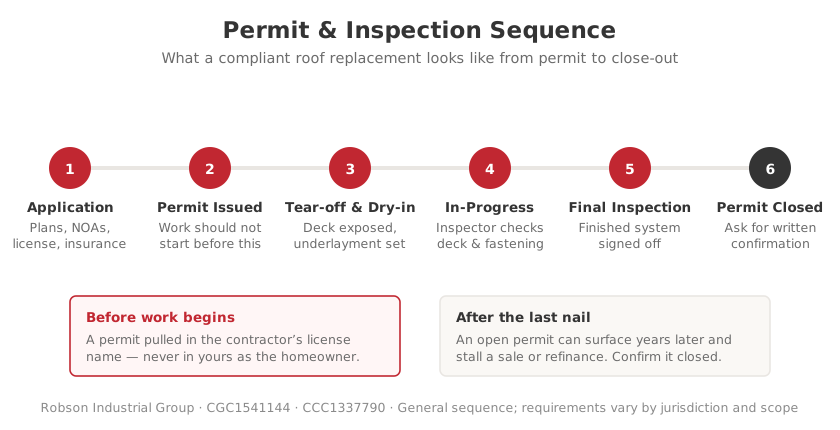
Hialeah is an incorporated municipality with its own Building Division. It does not use Miami-Dade County's building department for permitting. The Building Division is inside Hialeah City Hall at 501 Palm Avenue, 2nd Floor, Hialeah, FL 33010 (305-883-5825), open Monday–Friday 7:30 a.m.–3:30 p.m. and the first Saturday of each month, 9 a.m.–1 p.m. A roofing contractor who tells you Hialeah permits route through the county is either unfamiliar with the city or trying to skip a step, filing with the wrong office causes real delays. Here is the sequence for a standard residential roof replacement:
- Permit application. Your contractor submits the permit application directly to the City of Hialeah Building Division, either through the city's online portal or in person at 501 Palm Avenue. For HVHZ roofing work, the submittal must include two copies of the High-Velocity Hurricane Zone Uniform Permit Application, the required NOA fee sheet, and a copy of the signed contract between owner and contractor. The application includes the scope, materials, and NOA numbers. You should receive a permit number — ask for it before any work begins.
- Permit approval and posting. The approved permit must be posted at the job site (typically on a sign in the front yard or inside a window visible from the street). Do not allow work to start without this step completed.
- Rough-in inspection (decking). After old roofing is removed, before any new material is installed, the building inspector verifies deck condition, attachment method, nail type, and fastener pattern. No underlayment can be installed until this passes.
- Underlayment inspection (for some systems). Some roof systems require a separate inspection of the underlayment before tile or shingles are installed.
- Final inspection. After the complete roof installation, the inspector verifies the finished product: tile patterns, ridge details, flashing, penetration seals, and drip edge installation.
- Certificate of Completion. After the final inspection passes, a Certificate of Completion (CC) is issued. You can verify this was recorded at miamidade.gov/permits. Keep this document — your insurance company and future buyer will want it.
How a New Roof Affects Your Home Insurance in Hialeah
Miami-Dade homeowners pay among the highest property insurance premiums in the country. A properly documented roof replacement can meaningfully reduce that cost.
After your roof passes final inspection, ask your contractor to schedule a wind mitigation inspection with a licensed inspector. The inspector verifies the actual construction details (fastener pattern, deck attachment method, opening protection) and submits the report to your insurer. Verified HVHZ construction typically results in a 15–35% reduction in wind premium, which on a typical Hialeah home can mean $800–$2,500 per year in savings.
What a Robson Roofing Estimate Includes in Hialeah
Because roof type varies so much by neighborhood in Hialeah, every written estimate from Robson Industrial Group starts with a determination of what you actually have, flat/low-slope or pitched, before pricing anything:
- On-roof inspection that identifies flat/low-slope membrane condition or, on pitched tile, a lifted sample section to check underlayment condition directly rather than guessing from the tile's appearance.
- Itemized materials with manufacturer, product line, and Miami-Dade NOA number for every layer — membrane, underlayment, tile or shingle, flashing.
- Permit line item priced separately, filed directly with the City of Hialeah Building Division in Robson's name as contractor of record, including the HVHZ Uniform Permit Application package.
- Deck condition disclosure with a per-sheet repair rate agreed in writing before tear-off begins.
- Wind mitigation inspection coordination scheduled after final inspection so your insurance documentation is ready without a second appointment.
- Manufacturer and workmanship warranty terms in writing, including GAF System Plus eligibility on qualifying installations.
This is one reason to insist on code-minimum HVHZ construction even if a contractor offers a cheaper alternative. The premium savings over five years often exceed the cost difference between minimum code and a shortcut.
Red Flag Summary Table
| What You Hear or See | What It Means | Action |
|---|---|---|
| No license number available | May not be licensed | Walk away |
| Cash discount for no receipt | No paper trail, no permit | Decline |
| We can waive your deductible | Insurance fraud under FL §817.234 | Report and walk away |
| No permit needed for this job | Almost certainly untrue for full replacement | Verify with county directly |
| Verbal-only scope of work | Nothing to enforce if disputes arise | Require written contract |
| We use our own materials (no NOA numbers given) | Materials may not be HVHZ-approved | Request NOA numbers or walk away |
| Door-to-door solicitation after a storm | Common storm-chaser pattern | Do not sign; independently vet any contractor |
| Out-of-state plates or address | May not be licensed in Florida | Verify Florida license on DBPR |
| Pressure to sign today | Preventing you from doing due diligence | Do not sign; take the time |
Financing Your Hialeah Roof Replacement
Financing may be available through third-party providers, subject to their approval and terms. Ask us for details.
Robson Industrial Group — License Verification
- FL Certified General Contractor: CGC1541144 — Verify on DBPR
- FL Certified Roofing Contractor: CCC1337790 — Verify on DBPR
- GAF Certified™ Residential Roofing Contractor: GAF ID 1164276
- Qualifier: Francisco Rijo
- Service area: All of Miami-Dade County including Hialeah, Hialeah Gardens, and surrounding areas
Contact us for a free roof inspection and written estimate →
Frequently Asked Questions
Do I need a permit to replace my roof in Hialeah?
Yes. Hialeah falls under Miami-Dade County jurisdiction, and all residential roof replacements require a building permit under FL §553.79. Your contractor must pull the permit before any work starts. Never accept a “permit-exempt” claim for a full replacement. It is not legal.
What is the difference between a CGC and a CCC license for roofing in Florida?
A Certified General Contractor (CGC) license covers roofing as part of the full scope of construction work. A Certified Roofing Contractor (CCC) license is issued specifically for roofing. Both are valid for roofing work in Miami-Dade. You can verify either at myfloridalicense.com under the DBPR contractor lookup.
How do I verify a roofing contractor’s license in Hialeah?
Go to myfloridalicense.com, click Verify a License, select the Contractor license type, and enter the license number (starts with CGC or CCC). Confirm the name on the license matches the company on your contract, that the status shows “Current, Active,” and that it is not flagged for disciplinary action.
Does my Hialeah home require HVHZ (High-Velocity Hurricane Zone) roofing standards?
Yes. All of Hialeah is within Miami-Dade County, which is a designated High-Velocity Hurricane Zone. Every roof replacement must use materials with an approved Miami-Dade Notice of Acceptance (NOA), 6-nail fastener patterns on field tiles, ring-shank nails for deck attachment, and SBS-modified underlayment. These are code minimums, not upgrades.
How do unlicensed roofing contractors typically approach Hialeah homeowners?
The most common patterns are: door-to-door visits after a storm offering “insurance claim help,” cash deals with no written contract, claims that a permit is not needed, refusal to provide a license number for verification, and pricing dramatically below market rate. Always ask for the license number before any discussion, and verify it on DBPR before signing anything.
Does Hialeah use its own building department, or does Miami-Dade County handle roofing permits?
Hialeah has its own municipal Building Division and does not route roofing permits through Miami-Dade County. The Building Division is at 501 Palm Avenue, 2nd Floor, Hialeah, FL 33010 (305-883-5825), open Monday–Friday 7:30 a.m.–3:30 p.m. and the first Saturday of each month. HVHZ roofing submittals require two copies of the High-Velocity Hurricane Zone Uniform Permit Application, the NOA fee sheet, and a copy of the signed contract.
Do older Hialeah homes have flat roofs or pitched roofs?
It depends heavily on the neighborhood. Palm Springs, one of Hialeah’s oldest sections, is dominated by 1950s ranch-style construction with a mix of low, flat rooflines and pitched Spanish Colonial-style red tile. Flat and low-slope sections typically run modified bitumen or built-up roofing with a shorter service life than pitched tile, and many are now well past a reasonable replacement window.
What does a Robson roofing estimate in Hialeah include?
An on-roof inspection that identifies actual membrane or underlayment condition, itemized materials with NOA numbers, a separately priced permit line filed directly with the City of Hialeah Building Division, disclosed per-sheet deck repair pricing, wind mitigation inspection coordination, and written warranty terms. Included on every estimate at no charge.
Ready for a Free Roof Inspection in Hialeah?
Robson Industrial Group is a state-licensed, GAF-certified roofing contractor serving all of Miami-Dade. We pull every permit, provide full written proposals with NOA numbers, and stand behind our work. Lic. CGC1541144 · CCC1337790.
Schedule Your Free Inspection →Related reading: How to Verify a Florida Roofing Contractor License (Step-by-Step) · HVHZ Compliance: What Miami Homeowners Need to Know · Miami Roof Replacement Cost 2026 · Kendall Roofing Contractor Guide