North Miami is an incorporated city in northeastern Miami-Dade County with its own municipal government, its own building department, and its own permit process. Separate from Miami-Dade County's building division. That distinction matters when you're hiring a roofing contractor, because the permit must be pulled through the right jurisdiction, the contractor must hold the right license, and all materials must meet the HVHZ requirements that apply throughout Miami-Dade.
This guide walks you through how to verify a contractor's credentials, what the City of North Miami's permit process requires, and what red flags signal an unlicensed or underqualified operator before you sign a contract.
What Licenses Are Required to Roof in North Miami?
Florida law requires any contractor performing roofing work to hold a license issued by the Florida Department of Business and Professional Regulation (DBPR). Three license types are relevant in North Miami:
| License Type | Abbreviation | Scope in North Miami | Can Pull North Miami Roof Permit? |
|---|---|---|---|
| Certified General Contractor | CGC | All construction including roofing | Yes |
| Certified Roofing Contractor | CCC | Roofing systems only | Yes |
| Registered Contractor | Various | Limited to specific county/city | Only if registered in Miami-Dade |
The critical distinction is between Certified and Registered licenses. A Florida Certified license (CGC or CCC) is valid statewide. A Registered license is tied to a specific jurisdiction: a contractor registered in Broward, for example, cannot legally pull permits or do roofing work in North Miami without separate registration. Always confirm the license is Certified if you want statewide validity.
Every contractor license must have a designated qualifier: the individual who passed the licensing exam and holds legal responsibility for the work. The qualifier's name appears on the DBPR record. If a contractor sends a different person to supervise the job, confirm that person is affiliated with the licensed entity. An unlicensed "supervisor" on your project is a red flag that can void your permit and your warranty.
How to Verify a North Miami Roofing Contractor's License
The DBPR online lookup takes under two minutes and tells you everything you need to know before a contractor sets foot on your property.
City of North Miami Building Department: What You Need to Know
North Miami is an incorporated municipality, which means roofing permits within city limits go through the City of North Miami Building Department, not Miami-Dade County's building division. This is a common point of confusion, and a source of permit problems when contractors unfamiliar with North Miami try to pull through the wrong jurisdiction.
Address: 776 NE 125th Street, North Miami, FL 33161
Jurisdiction: All properties within the incorporated City of North Miami limits
Process: Online permit applications available; inspections scheduled through the city's portal
Not to be confused with: Miami-Dade County Building Department (handles unincorporated Miami-Dade only)
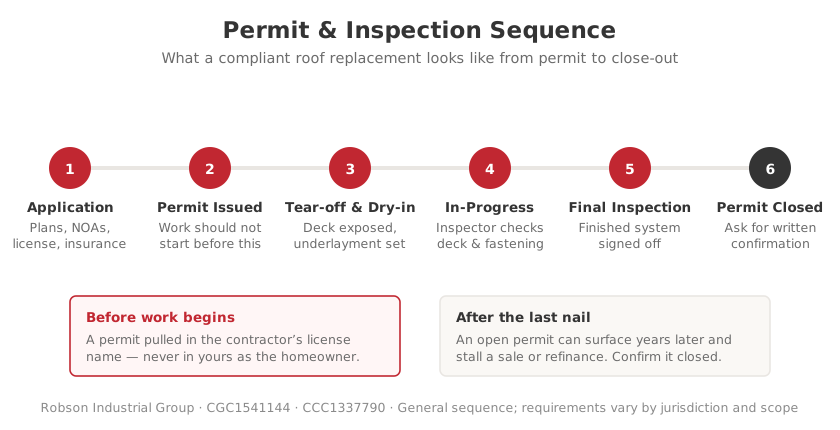
Roofing permits in North Miami require the contractor to submit: the signed contract, the product's Miami-Dade NOA or Florida Product Approval number, the insurance certificates, the license copy, and the permit fee. Work cannot begin until the permit is issued and posted at the job site. A roofing contractor who tells you permits aren't necessary, or who asks you to sign the permit application yourself as the property owner, is steering you toward an unpermitted job, which creates problems at sale and can result in fines.
Property Owner Permit vs. Contractor Permit
Florida law allows a homeowner to pull their own permit as an owner-builder. However, this comes with significant strings attached: you cannot sell the property within one year of completion without disclosing the owner-builder status, and you accept full personal liability for code compliance. A licensed contractor pulling the permit under their own license provides you with a layer of professional accountability. If they do the work wrong, your recourse runs through their license and insurance. Both regulated by the state. Owner-builder permits eliminate that layer.
HVHZ Requirements in North Miami
North Miami is in Miami-Dade County and is therefore entirely within Florida's High-Velocity Hurricane Zone (HVHZ): the most stringent building code environment in the continental United States. HVHZ requirements apply to every roofing material and system used within city limits.
| HVHZ Requirement | What It Means | Why It Matters |
|---|---|---|
| Miami-Dade NOA | All roofing materials must have a Miami-Dade Notice of Acceptance (NOA) or Florida Product Approval | NOA verifies the product survived high-wind and impact testing specific to South Florida conditions |
| 6-nail minimum fastener pattern | Shingles require 6 nails per shingle, not 4 as on the rest of the country | Fewer nails is the single most common HVHZ code violation — and the most common cause of shingle failure in hurricanes |
| Ring-shank deck nails | Deck-to-truss fasteners must be ring-shank (annular-ring) nails, not smooth shank | Ring-shank nails resist pullout forces during high winds by a factor of 3–4× over smooth shanks |
| SBS-modified underlayment | Standalone felt underlayment is not approved for HVHZ; SBS-modified bitumen underlayment is required | SBS provides a secondary water barrier that stands up to standing water if primary roofing is damaged during a storm |
| 19/32" minimum deck thickness | Roof decking must be at least 19/32" thick plywood or OSB | Thinner decking fails the fastener pullout test required by the HVHZ building code |
| CCC or CGC license required | Only Certified contractors (not Registered) are authorized to do HVHZ roofing | HVHZ complexity requires full licensing — Registered contractors are not trained or examined on HVHZ-specific requirements |
A contractor who quotes you a lower price by using 4-nail patterns, smooth-shank deck nails, or non-NOA materials is not saving you money: they're exposing you to a failed inspection, a re-roof at your expense, and a roof that may not survive the next named storm. The inspector will catch the violation, and the cost to correct it falls on you as the property owner if the contractor has disappeared.
North Miami's Housing Stock: What Contractors Need to Know
North Miami has a diverse housing stock with a significant percentage of homes built between the 1940s and 1980s. This creates several considerations that differ from newer construction neighborhoods:
Older Deck Conditions
Homes from the 1950s through 1970s frequently have lumber decking (1×6 boards) rather than plywood or OSB. When a modern shingle system is installed over board decking, contractors must nail into the boards and meet the HVHZ pullout standards, which often requires an additional layer of plywood over the boards. A contractor who skips this step because "it's always been done this way" is producing a non-compliant roof.
Pre-1978 Housing and EPA RRP
North Miami homes built before 1978 may still carry lead-based paint on eaves, fascia, and exterior trim, and disturbing it during a roof job without the right precautions can put lead dust into your family's air and yard. That is why federal law requires EPA RRP certification for this work. Robson Industrial Group holds EPA RRP Certification #NAT-F338229-1, certified only for purposes of Section 402 of TSCA. Confirm any contractor you're considering holds the same certification before letting them start.
Flat Roofs and Modified Bitumen
North Miami has a higher concentration of flat-roof structures than many Miami-Dade neighborhoods, including both residential properties with low-slope sections and commercial or mixed-use buildings. Flat roof systems in the HVHZ must use approved materials: typically TPO (thermoplastic polyolefin), modified bitumen (APP or SBS), or built-up roofing (BUR), all with Miami-Dade NOA approval. A contractor who specializes only in steep-slope shingle work is not necessarily qualified to specify, install, or warranty a flat roof system correctly.
Contractor Fraud Patterns in North Miami
Miami-Dade County has one of the highest concentrations of unlicensed contractor activity in Florida, and North Miami is not insulated from this problem. The Florida Department of Business and Professional Regulation regularly takes enforcement action against unlicensed operators in the area. Here are the fraud types that appear most frequently:
| Fraud Type | How It Works | How to Protect Yourself |
|---|---|---|
| License borrowing | An unlicensed operator pays a fee to use a licensed contractor's number without the qualifier overseeing the work | Verify the qualifier name matches who you're dealing with; ask to meet the qualifier in person |
| Storm chaser deposits | After heavy rain or wind events, contractors appear door-to-door, collect large deposits, and disappear | Never pay more than 10% upfront; verify the license before writing any check |
| Expired insurance | Contractor presents a valid-looking certificate for a policy that lapsed months ago | Call the insurer directly using the phone number you find independently — not the number on the certificate |
| Substandard materials with fake NOAs | Contractor installs non-HVHZ-approved materials and produces a fabricated or inapplicable NOA number | Look up the NOA number yourself on the Miami-Dade Product Control website to confirm it applies to the product being installed |
| Permit skipping | Contractor performs the work without pulling a permit, leaving you with an unpermitted installation | Pull the permit yourself through the City of North Miami's online portal before work begins — a legitimate contractor will have it there |
| Unnecessary repairs after inspection | Inspector recommends one item; contractor inflates the scope to full replacement | Get a second opinion from a licensed contractor before agreeing to replacement; ask the contractor to show you the specific failed areas |
| Inflated supplement fraud | Contractor submits a roofing insurance claim that includes items not actually damaged or not code-required in Miami-Dade | Review every line item on the insurance estimate; items like permit fees, drip edge, and ice/water shield are code-required in HVHZ and should be included legitimately — fabricated items are a different matter |
| Misrepresented GAF certification | Contractor claims "GAF-certified" status without holding a current GAF Certified Residential Roofing Contractor designation | Verify on GAF's contractor locator at gaf.com; Robson Industrial Group's GAF Certified™ ID is 1164276 |
What a Legitimate Roofing Proposal Includes
A professional roofing contractor in North Miami will provide a written proposal that contains all of the following before you sign anything:
- Florida contractor license number (CGC or CCC) printed on the proposal
- DBPR qualifier name matching the license record
- Specific roofing system: manufacturer, product line, and model (e.g., "GAF Timberline HDZ shingles")
- Miami-Dade NOA or Florida Product Approval number for all major components
- Number of nails per shingle (must be 6 for HVHZ)
- Underlayment specification (must be SBS-modified in HVHZ)
- Deck inspection clause (contractor will inspect existing decking and provide a per-sheet price for replacement)
- Permit fee responsibility clearly assigned (typically contractor pulls and includes in the price)
- Payment schedule with no more than 10% due at contract signing
- Written warranty terms: manufacturer product warranty AND contractor labor warranty (separate documents)
If a proposal is missing any of these items, request them before signing. A contractor who refuses to provide specifics about materials, NOA numbers, or nail patterns is telling you something important about how they operate.
Insurance Discounts for North Miami Homeowners
Florida homeowners who replace their roof with a system that meets enhanced wind-resistance standards may qualify for significant insurance premium discounts through the wind mitigation credit program. The discount is documented through the OIR-B1-1802 wind mitigation inspection form: a post-installation inspection performed by a qualified inspector who certifies the roof's resistance features.
In North Miami, where insurance rates have risen sharply over the past decade due to South Florida's loss history, the savings can be material:
| Wind Mitigation Feature | Typical Discount Range | Applicable to North Miami? |
|---|---|---|
| Hip roof shape | 15–25% on wind portion | Yes — if your roof is hip-shaped |
| Roof deck attachment (6-nail pattern) | Significant factor in wind rating | Yes — HVHZ standard but must be documented |
| Roof-to-wall connection (clips/wraps) | Varies by connection type | Yes — older North Miami homes may have staple connections that score lower |
| Secondary water resistance (SBS underlayment) | Additional credit factor | Yes — required by HVHZ code, earns SWR credit |
| New roof installed within 5 years | Possible "new roof credit" | Yes — timing-based, varies by insurer |
Ask your roofing contractor to ensure the installation is documented in a way that supports OIR-B1-1802 compliance, particularly the deck attachment pattern and secondary water resistance. A well-documented installation can offset a meaningful portion of the roof replacement cost through reduced premiums over the following years.
GAF Certified™ Roofing: What It Means for North Miami Homeowners
GAF, North America's largest roofing manufacturer, offers a tiered certification program for roofing contractors. Robson Industrial Group is a GAF Certified™ Residential Roofing Contractor (ID 1164276), which means we are authorized to offer the GAF System Plus Limited Warranty on qualifying installations.
The GAF System Plus Limited Warranty covers the entire roofing system, not just the shingles, and provides coverage that exceeds what a standard manufacturer product warranty offers. It requires that all primary components (shingles, underlayment, starter, cap, ventilation) are GAF products installed to manufacturer specifications. This warranty is only available through a GAF Certified Residential Roofing contractor. It cannot be offered by an uncertified installer regardless of what products they use.
Any contractor claiming "GAF certified" status should be verifiable at gaf.com using the contractor locator. If a contractor cannot be found there, they are not GAF-certified regardless of what their marketing says. Robson Industrial Group appears as GAF Certified™ under license CGC1541144 / CCC1337790: ID 1164276.
Financing
Financing may be available through third-party providers, subject to their approval and terms. Ask us for details.
Red Flags: When to Walk Away
| Red Flag | What It Likely Means |
|---|---|
| Contractor cannot provide a license number on the spot | Unlicensed, or borrowing someone else's license |
| Quote is significantly lower than all other bids | Cutting corners on materials, labor, permits, or insurance |
| Requires cash payment only | Off-the-books operation, no paper trail, no legal recourse if work is defective |
| Wants 50%+ deposit before work starts | Possible advance-fee fraud; Florida law limits residential deposits |
| Cannot name the specific product line or NOA number | May substitute materials after you sign, or doesn't understand HVHZ requirements |
| Discourages you from checking permit status | Planning to work unpermitted |
| Offers to "handle" your insurance claim for you | Possible assignment-of-benefits fraud or inflated claim; you should manage your own insurance relationship |
| Cannot provide proof of workers' comp | If a worker is injured on your property, you may be liable without contractor workers' comp coverage |
Questions to Ask Before Signing a North Miami Roofing Contract
- What is your Florida license number, and is the qualifier available to meet me? — Confirms the license is real and the qualifier is actually involved.
- Will you pull the permit through the City of North Miami Building Department? — Confirms the contractor knows the jurisdiction and will work legally.
- What is the NOA or Florida Product Approval number for the shingle system you're proposing? — A legitimate contractor can answer this immediately.
- What nail pattern will you use on the field? — Should be 6 nails per shingle for HVHZ. "Standard" or "4-nail" is a red flag.
- What underlayment are you installing? — Should be SBS-modified bitumen, not 15 or 30 lb felt alone.
- What happens if the inspector fails an item? — A legitimate contractor has a clear answer: they correct it at no additional cost.
- Does the warranty cover labor separately from the manufacturer warranty? — Many contractors offer only the manufacturer product warranty. A separate labor warranty from the installing contractor is what covers workmanship defects.
Frequently Asked Questions: North Miami Roofing
About this guide: Robson Industrial Group LLC is a Florida-licensed general contractor (CGC1541144) and roofing contractor (CCC1337790) serving Miami-Dade County, including the City of North Miami. GAF Certified™ Residential Roofing Contractor, ID 1164276. This guide is for educational purposes and does not constitute legal or insurance advice.