Roofing · Contractor Guide · July 2026
North Miami Beach Roofing: Post-War Reroofs, Waterfront Condo Boards & the 40-Year Recertification Wave
Why a roofing project in North Miami Beach is really two different jobs depending on the address: a 1950s-60s post-war reroof that has to meet today's code, or an Intracoastal-adjacent condo roof caught up in Miami-Dade's structural recertification requirements.
🇪🇸 Leer en EspañolNorth Miami Beach is not one housing market wearing two names. It is two genuinely different roofing markets inside one city limit. Despite the name, North Miami Beach sits entirely in Miami-Dade County, not Broward, and it no longer touches the Atlantic Ocean at all; its old beachfront boundary now belongs to Sunny Isles Beach across the Intracoastal Waterway. What North Miami Beach does have is a large, aging stock of single-family homes built during the city's post-war boom in the 1950s and 1960s, concentrated in neighborhoods like Uleta, Washington Park, Highland Village, and Skylake, sitting alongside a corridor of mid-rise and high-rise condominium and cooperative buildings closer to the water in areas like Eastern Shores and City Center.
Those two housing types do not shop for a roof the same way, and they should not be sold the same way. A 1962 CBS ranch in Uleta needs a contractor who understands what current Florida Building Code requires when you replace a roof that predates most of today's hurricane-hardening rules. A condominium tower a few blocks from the Intracoastal needs a contractor who has actually sat across from a condo board, an engineer of record, and a competitive-bid requirement, not one who is used to signing a contract directly with a single homeowner. This guide covers both, plus what every North Miami Beach roof shares regardless of building type: Miami-Dade's High Velocity Hurricane Zone (HVHZ) code, the City's permitting process, and the questions that separate a contractor who has actually worked this city from one who is guessing.
North Miami Beach's population is just under 44,000 across roughly 5.4 square miles, one of the more densely built cities in Miami-Dade County, with a housing stock that spans nearly a century, from the original Fulford-by-the-Sea plat of 1926 through the post-war housing boom to more recent waterfront condo development. That density and that age range are exactly why a generic, one-size-fits-all roofing quote misses the details that actually decide whether a North Miami Beach project goes smoothly.
Robson Industrial Group LLC holds Florida Certified General Contractor license CGC1541144 and Florida Certified Roofing Contractor license CCC1337790, both issued by DBPR with Francisco Rijo as the qualifying contractor. We are also a GAF Certified™ Residential Roofing Contractor (GAF ID: 1164276), which allows us to offer the GAF System Plus Limited Warranty on qualifying installations.
Get a Free Roofing Estimate in North Miami Beach
CGC1541144 · CCC1337790 · GAF Certified™ Residential Roofing (ID: 1164276)
Request Your Free EstimateWhy Roofing in North Miami Beach Is Different
The factors that decide whether a North Miami Beach roofing project goes smoothly depend heavily on which of the city's two housing markets you're in:
| Factor | North Miami Beach Reality | What It Means for Your Roof |
|---|---|---|
| Post-war single-family housing stock | A large share of homes in Uleta, Washington Park, Highland Village, Oakgrove, and Skylake were built in the 1950s and 1960s, many with their original or first-generation reroof still in place | Roofs at or past 20+ years of age are common; replacing them triggers current HVHZ code requirements that did not exist when the home was built |
| Waterfront condo & co-op corridor | Mid-rise and high-rise buildings concentrated near the Intracoastal in Eastern Shores and City Center, many now subject to Florida's post-Surfside structural inspection and reserve-funding laws | Roof and waterproofing decisions run through a board, an engineer of record, and a competitive-bid process — a fundamentally different sales and project cycle than a single-family home |
| HVHZ designation | Full Miami-Dade County HVHZ coverage, no exceptions | Miami-Dade NOA-rated materials, 6-nail fastening, ring-shank deck nails, SBS underlayment, and 19/32″ minimum decking are mandatory on every roof in the city |
| Dense, mixed-age building stock | Housing spans from the 1920s Fulford-by-the-Sea era through the 1950s-60s boom to recent waterfront construction, in just 5.4 square miles | Deck condition, roof-to-wall connection type, and even permit history vary block to block — an accurate estimate requires an actual site visit, not a satellite-image quote |
| Coastal flood exposure | The City maintains an active Floodplain Management program, flood elevation certificate records, and a King Tide monitoring effort given the city's proximity to the Intracoastal | Roofing and waterproofing scope on lower floors and at grade-adjacent structures should account for the City's flood zone designation for the property |
North Miami Beach Areas We Serve
North Miami Beach is not a single roofing job repeated across 5.4 square miles. A CBS ranch on a quiet street in Uleta has a different age, deck condition, and code-upgrade story than a waterfront condo tower in Eastern Shores, and both are different again from a mixed commercial-residential property along the City Center corridor. Treating every address the same is how a contractor misses the detail that determines whether a North Miami Beach roofing project runs into a surprise.
Uleta & Washington Park
These interior, post-war residential neighborhoods, among the areas identified in the City's own code compliance zone maps, are anchored by single-family CBS homes built primarily in the 1950s and 1960s, many still on an original or aging roof system. This is where the code-upgrade conversation matters most: a homeowner replacing a roof that has been on the house since before current hurricane-hardening standards existed needs a contractor who will walk through, in writing, exactly what the Florida Building Code requires beyond just swapping materials, not one who discovers a roof-to-wall connection issue mid-tear-off and treats it as a surprise change order.
Eastern Shores
Eastern Shores is one of North Miami Beach's waterfront communities, and it sits closest to the Intracoastal Waterway dynamic that defines the eastern edge of the city. Roofing and waterproofing work in this area increasingly runs through condominium and cooperative association boards rather than individual homeowners, and it has to account for the corrosive effect of proximity to brackish water on flashing, fasteners, and rooftop mechanical equipment. A contractor working in Eastern Shores needs to understand both HVHZ material requirements and the realities of coordinating a project through an association's approval process, not just a single-family sales cycle.
City Center & the NE 163rd Street / Chinatown Corridor
The area around North Miami Beach's civic core and its well-known commercial corridor along NE 163rd Street and NE 167th Street (locally referred to as the city's unofficial "Chinatown" for its concentration of Asian-owned businesses) mixes commercial roofing, mixed-use buildings, and adjacent residential streets. Flat, low-slope roofing dominates here, on both commercial buildings and the CBS homes nearby, which means built-up, modified bitumen, or TPO membrane systems are more common than pitched shingle or tile roofs in this part of the city.
Florida Roofing Contractor License Types
The Florida Department of Business & Professional Regulation (DBPR) issues the license categories relevant to roofing work anywhere in North Miami Beach:
| License Type | Code | What They Can Do | Verify At |
|---|---|---|---|
| FL Certified General Contractor | CGC | All construction including roofing statewide | myfloridalicense.com |
| FL Certified Roofing Contractor | CCC | Roofing work only, statewide | myfloridalicense.com |
| FL Registered Contractor | Varies | Licensed by county/municipality — valid only in that jurisdiction | Miami-Dade County licensing office |
Robson Industrial Group holds both CGC1541144 and CCC1337790, state-certified licenses valid throughout Florida, including the City of North Miami Beach and all of Miami-Dade County.
How to Verify a Florida Roofing License in 7 Steps
- Go to myfloridalicense.com and click “Verify a License”
- Select Department of Business & Professional Regulation
- Choose Contractor from the profession dropdown
- Enter the contractor’s license number (CGC, CCC, or registration number) and search
- Confirm the status is “Current, Active” — not Expired, Suspended, or Revoked
- Verify the name on the license matches the company name or qualifying contractor on your contract
- Check the license type covers roofing work (CGC covers all construction; CCC is roofing-specific)
Robson Industrial Group CGC1541144 verifiable at: myfloridalicense.com (CGC1541144). CCC1337790 verifiable at: myfloridalicense.com (CCC1337790).
HVHZ Requirements: What Miami-Dade Demands in North Miami Beach
North Miami Beach sits entirely within Miami-Dade County, which means every roofing project here, single-family or condo tower, falls under the High Velocity Hurricane Zone (HVHZ), the strictest roofing code standard in the continental United States. Unlike Broward or Palm Beach County, where Florida Product Approval alone can satisfy code, North Miami Beach roofing materials must carry a Miami-Dade Notice of Acceptance (NOA).
| Requirement | HVHZ Standard (Applies to All of North Miami Beach) |
|---|---|
| Product approval system | Miami-Dade NOA (Notice of Acceptance) — required for shingles, tile, membrane, underlayment, and accessories |
| Oversight body | Miami-Dade Product Control, enforced locally by the City of North Miami Beach Community Development Department |
| Deck nail requirement | Ring-shank deck nails, 6″ o.c. field / 6″ o.c. perimeter minimum |
| Underlayment | SBS-modified underlayment required on shingle and tile systems |
| Fastener pattern | 6-nail pattern per shingle in HVHZ wind zones |
| Minimum deck thickness | 19/32″ (0.59″) plywood or OSB decking minimum |
| Wind design speed | 175+ mph (Category 5 design pressure) |
| Insurance inspection form | Standard Florida wind mitigation inspection form |
City of North Miami Beach Roofing Permit Requirements
A building permit is required for all roofing work in Florida under FL Statute §553.79, and in North Miami Beach it is administered by the City's own Community Development Department. North Miami Beach is an incorporated city with its own permitting authority, separate from unincorporated Miami-Dade County.
| Permit Detail | City of North Miami Beach |
|---|---|
| Permit authority | North Miami Beach Community Development Department |
| Location | 17050 NE 19th Avenue, 1st Floor, North Miami Beach, FL 33162 |
| Phone | (305) 948-2966 |
| Hours | Monday–Friday, 8:00 AM–5:00 PM |
| Permit submission & tracking | City's Online Self-Service Permitting Portal (eDMS) |
| Permit holder | Must be the licensed contractor (not the homeowner, not a subcontractor, and not the condo association's property manager) |
| Product approval requirement | Miami-Dade NOA number required for all roofing materials |
| Inspections | Deck inspection + final inspection at minimum |
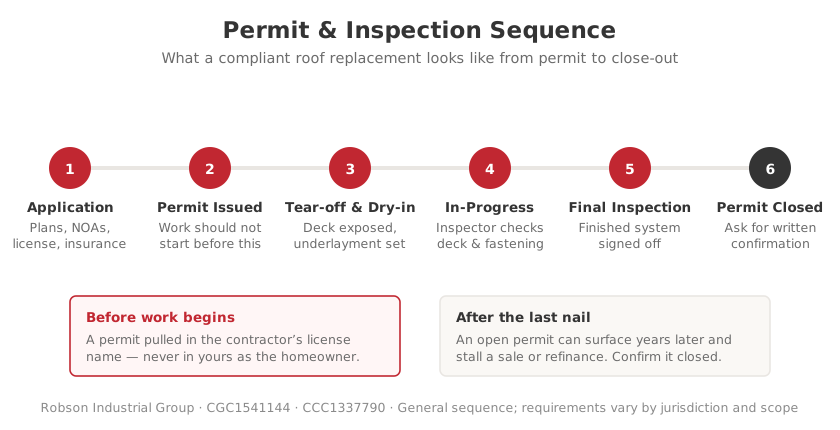
Permit-to-Inspection Sequence in North Miami Beach
- Site walk and roof assessment: Contractor evaluates deck condition, existing roof-to-wall connections, and (on condos) coordinates with the association's engineer of record
- Material selection: Contractor specifies Miami-Dade NOA-rated materials matching your roof type, pitch, and exposure
- Permit application: Contractor submits the building permit application through the City's Online Self-Service Permitting Portal, along with NOA documentation
- Permit issued: North Miami Beach Community Development Department reviews and issues the permit; HVHZ plan review typically runs longer than in non-HVHZ counties
- Tear-off and deck inspection: Existing roofing removed; inspector verifies deck condition, thickness, and nail pattern before new materials go down
- Installation: New underlayment, flashing, and field materials installed to NOA specifications, including the full 6-nail fastening pattern and ring-shank deck nails
- Final inspection: Inspector verifies the completed roof matches the permit, NOA specs, and HVHZ code
- Certificate of Completion: Issued after passing final inspection; wind mitigation inspection can now be scheduled for the insurance credit
Reroofing an Older North Miami Beach Home: What Changes Under Current Code
This is the section that matters most for the city's post-war housing stock. A meaningful share of North Miami Beach's single-family homes, particularly in Uleta, Washington Park, Oakgrove, Monticello, and Highland Village, were built during the 1950s and 1960s boom, when the roof-to-wall connection standards, deck attachment requirements, and material approval system in place today simply did not exist. Florida law does not grandfather an old roof into old rules once you replace it.
Code-Upgrade Triggers on Older Post-War Homes
When you pull a reroof permit in North Miami Beach, the inspection process is not a rubber stamp on whatever was there before. Common findings and required upgrades on 1950s-60s CBS homes include:
- Deck condition and thickness — original plank decking or undersized sheathing that does not meet the current 19/32″ HVHZ minimum has to be addressed before new material goes down, not covered over
- Roof-to-wall connections — Florida Building Code requires an upgrade to the connection between the roof structure and the wall (clips, straps, or wraps) on a substantial portion of reroofing projects in HVHZ, which is a structural item, not a cosmetic one
- Fastening pattern and underlayment — the 6-nail pattern, ring-shank deck nails, and SBS-modified underlayment now required did not exist as a standard when many of these homes were originally built or last reroofed decades ago
- Flashing at chimneys, vents, and transitions — older flashing details common on post-war CBS construction often fall short of current termination and lap requirements
An estimate that quotes a flat per-square price without walking the roof and disclosing which of these items is likely to apply is not a complete estimate on a North Miami Beach home built before the 1980s. Ask your contractor to state, in writing, what code-upgrade work they expect to find and how it is priced, before you sign, not after tear-off has started.
Flat and Low-Slope Roofs on CBS Construction
Many North Miami Beach post-war homes were built with flat or very low-slope CBS roof decks, originally covered with built-up (tar and gravel) roofing. These systems have largely reached or exceeded their service life across the city, and replacement typically means a modified bitumen or single-ply membrane system rather than a like-for-like built-up roof. Getting this transition right, including proper drainage slope, parapet flashing, and NOA-rated membrane selection, is a different skill set than a pitched shingle or tile installation, and it's worth asking directly whether your contractor has flat-roof HVHZ experience, not just sloped-roof experience.
Waterfront Condo & Co-Op Roofing: A Different Approval Process
Roofing and waterproofing work on a North Miami Beach condominium or cooperative building does not move through the same process as a single-family home, and a contractor who treats it the same way will misjudge the timeline, the decision-makers, and the documentation required.
Board Approval & Competitive Bid Requirements
Florida condominium law generally requires association boards to obtain competitive bids for contracts above a set share of the association's total annual budget, rather than simply accepting the first proposal. That means a roofing contract for a mid-rise or high-rise building typically has to go out for multiple bids, be reviewed against a defined scope of work, and be approved by the board, sometimes with a unit-owner vote if the project requires a special assessment. This process alone can take substantially longer than a single-family homeowner signing a contract at the kitchen table, and it needs to be factored into any project timeline discussion with your board.
Milestone Inspections, SIRS, and the Post-Surfside Landscape
Florida's structural safety laws enacted after the 2021 Surfside condominium collapse require associations for buildings three stories and taller to complete periodic milestone structural inspections and a Structural Integrity Reserve Study (SIRS) covering major building components, including the roof and waterproofing systems, with an earlier inspection deadline for buildings located near the coast. North Miami Beach has already seen the sharp end of this scrutiny firsthand: in the weeks following the Surfside collapse, the City stepped up its own building inspections and, on July 2, 2021, condemned the 10-story Crestview Towers condominium after an engineering report declared it unsafe. That local precedent is part of why North Miami Beach condo and co-op boards near the Intracoastal are treating roof, waterproofing, and structural findings with more urgency than they may have a decade ago, and why a licensed engineer's assessment often has to precede or accompany a board's decision on roofing scope, rather than following it.
Structural Engineer Coordination & High-Rise Access
On most condo and co-op roofing or waterproofing projects, the contractor works alongside, not instead of, the association's engineer of record, who typically defines the scope based on milestone inspection or SIRS findings. High-rise access also introduces logistics a single-family reroof never touches: crane or hoist staging that may require its own City permit, coordination with residents for balcony or window-adjacent work, and fall-protection and safety plans appropriate to multi-story membrane roofing. A contractor without direct high-rise or association experience will often underestimate both the timeline and the coordination this requires.
Common Roof Types in North Miami Beach
Because North Miami Beach's building stock spans single-family post-war homes, mixed commercial-residential streets, and waterfront towers, the roofing material and system on any given property vary more than in a newer, single-builder subdivision:
| Roof Type | Common On | Key Consideration in North Miami Beach |
|---|---|---|
| Built-up (aging) & modified bitumen membrane | Flat-roof CBS single-family homes, especially in Uleta, Washington Park, and Highland Village | Original built-up roofing has largely reached end of service life citywide; replacement usually means a modern modified bitumen or single-ply system, not a like-for-like patch |
| Dimensional asphalt shingle | Pitched-roof sections and additions on post-war homes throughout the city | Most cost-effective HVHZ-compliant option for pitched sections; GAF System Plus warranty eligibility applies here when installed to spec |
| TPO & single-ply membrane (high-rise/commercial) | Condo, co-op, and commercial buildings near the Intracoastal corridor and along the NE 163rd Street commercial strip | Requires a different bid, warranty, and inspection process routed through a board or property management, plus rooftop mechanical and drainage coordination not present on residential jobs |
What a Robson Estimate for a North Miami Beach Property Includes
A written estimate from Robson Industrial Group for a North Miami Beach roofing project accounts for the building type and its age, not just the square footage. Every estimate includes:
- Full roof walk-through — deck condition, existing fastening and flashing detail, and an honest assessment of which code-upgrade items are likely to apply before we quote a number
- Material specification with Miami-Dade NOA numbers — exact manufacturer, product line, and NOA rating for HVHZ compliance, not a generic material description
- Code-upgrade scope stated in writing — roof-to-wall connection work, deck repair allowance, and fastening/underlayment spec called out explicitly, since these are the items most likely to surprise an owner of an older North Miami Beach home
- Board and engineer coordination on condo/co-op projects — a proposal structured to respond to the association's engineer of record and competitive-bid process, not a generic single-family quote repurposed for a high-rise
- HVHZ fastener and underlayment spec — ring-shank nail gauge, 6-nail pattern, and SBS underlayment (or NOA-rated membrane system on flat/low-slope roofs) called out by name
- Permit and inspection coordination — City of North Miami Beach Community Development Department permit pulled in Robson’s name through the City's permitting portal, all inspections scheduled by us
- Written manufacturer and workmanship warranty terms — years and coverage spelled out, not “standard warranty applies”
If a competing estimate for your North Miami Beach property does not disclose likely code-upgrade items on an older home, or does not describe how it will work with your condo board's engineer, ask why before you sign.
Wind Mitigation Inspection & Insurance Discounts
After your new roof passes its City Certificate of Completion inspection, schedule a wind mitigation inspection. This inspection documents your roof’s protective features and can qualify you for meaningful insurance premium reductions in North Miami Beach:
| Mitigation Feature | Typical Insurance Discount | Notes |
|---|---|---|
| Hip roof shape | 15–25% reduction | Full hip (all slopes to eaves) scores highest on applicable pitched-roof homes |
| Miami-Dade NOA-rated materials | 5–15% reduction | Requires Certificate of Completion from City inspection |
| Roof-to-wall connection (clips/wraps) | 10–25% reduction | Especially significant on older homes upgrading from a toe-nail connection for the first time |
| Roof deck attachment (ring-shank/6″ o.c.) | 5–10% reduction | Enhanced patterns score above code minimum |
| Opening protection (impact windows/doors) | Up to 15% additional | Can combine with roofing credits |
| Combined credits (typical hip-roof reroof) | 15–35% total annual savings | Varies by insurer; request an updated quote after inspection |
The wind mitigation inspection typically costs $100–$175 and must be performed by a Florida-licensed wind mitigation inspector. It is separate from the City building inspection. It is performed for your insurance company, not the City.
GAF Certified™ Roofing and the System Plus Warranty
Robson Industrial Group is a GAF Certified™ Residential Roofing Contractor (GAF ID: 1164276). This certification requires meeting GAF’s standards for licensing, insurance, and installation training. It is not self-awarded. The practical benefit for North Miami Beach homeowners is access to the GAF System Plus Limited Warranty, which extends coverage beyond the standard shingle warranty to the entire roofing system, including underlayment, starter strips, ridge cap, ventilation, and installation workmanship, when qualifying GAF accessories are installed.
On an older North Miami Beach home where deck repair and code-upgrade work happen at the same time as the reroof, system-level warranty coverage matters more than it does on a straightforward re-cover, because there are more components interacting. Ask your contractor specifically whether they are a GAF Certified™ Residential Roofing Contractor (not a “GAF preferred” installer, which is a marketing term, not a certification). Verify the GAF ID at gaf.com/en-us/roofing-contractors.
9 Red Flags When Hiring a Roofer in North Miami Beach
- No DBPR license number provided, or a license number that does not match the contractor’s name on myfloridalicense.com
- No mention of code-upgrade items on an older home — a contractor who quotes a flat per-square price without walking the deck and discussing roof-to-wall connections on a 1950s-60s North Miami Beach home is guessing
- No experience with condo or co-op boards on a multi-family project — a contractor unfamiliar with engineer-of-record coordination and competitive-bid requirements will underestimate the timeline and the paperwork
- Cash-only or 100%-upfront payment demands — Florida law allows a reasonable deposit; full payment before materials are delivered is a red flag
- Offering to waive your insurance deductible — this is insurance fraud under Florida law (FL §817.234)
- No mention of pulling a City of North Miami Beach permit — any contractor who suggests skipping the permit is either unlicensed or cutting corners
- Materials quoted without Miami-Dade NOA numbers — NOA numbers are public and should appear on every roofing proposal for an HVHZ property
- Assignment of Benefits (AOB) demand before work begins — signing an AOB transfers your insurance claim rights to the contractor; never sign without your attorney reviewing
- No written warranty covering both materials and installation — labor warranties under 2 years on a full re-roof are inadequate
Proposal Checklist for North Miami Beach Property Owners & Boards
Before signing any roofing contract in North Miami Beach, verify all of these are in writing:
| Item | What to Look For |
|---|---|
| Contractor license numbers | CGC or CCC number matching myfloridalicense.com |
| Insurance certificates | General liability ($1M+ per occurrence) + workers’ compensation certificate of insurance (COI) naming your address |
| Material NOA numbers | Miami-Dade Notice of Acceptance number for shingles/membrane, underlayment, and accessories |
| Code-upgrade scope (older single-family homes) | Explicit statement on deck repair, roof-to-wall connection work, and how each is priced, not one blended estimate |
| Engineer & board coordination (condo/co-op) | Written confirmation the proposal responds to the engineer of record's scope and the association's bid process |
| Fastener & underlayment/membrane spec | Ring-shank nail gauge, 6-nail pattern, and SBS underlayment or NOA-rated membrane called out by name |
| Permit statement | Contractor agrees to pull the North Miami Beach Community Development Department permit in their name before starting |
| Payment schedule | Reasonable deposit at contract, progress payment at material delivery, final at Certificate of Completion |
| Warranty terms | Manufacturer product warranty (years) + labor/installation warranty (years) in writing |
Special Assessments & Financing for Condo and Co-Op Roof Projects
When a milestone inspection or Structural Integrity Reserve Study identifies roof or waterproofing work on a North Miami Beach condo or co-op, the association typically funds it one of three ways: existing reserve funds set aside for exactly this purpose, a special assessment billed to unit owners, or a combination of the two, sometimes paired with an association loan to spread the cost over time rather than requiring a single lump-sum payment from every owner. Which path a board chooses depends on how well-funded its reserves already are under the SIRS requirements, and boards that have been under-reserving for years are the ones most likely to face a large, unplanned special assessment when a roof issue surfaces.
If you serve on a board facing this decision, ask your roofing contractor to break the proposal into phases where realistic: emergency/life-safety work versus full system replacement, so the board and ownership have a clearer picture of what has to happen now versus what can be sequenced over a longer capital plan. A contractor experienced with North Miami Beach's condo stock should be able to have that conversation with your treasurer and property manager directly, not just hand over a single lump-sum number.
EPA Lead-Safe Rules: What They Require of Your Contractor (Pre-1978 North Miami Beach Homes)
Federal law does not put the burden on you to know whether your North Miami Beach home might contain lead-based paint. It puts the burden on the contractor. North Miami Beach's housing stock grew heavily during the post-war boom years of the 1950s and 1960s, which means a substantial share of the city's single-family homes were built well before 1978. If your property falls into that category, EPA’s Renovation, Repair & Painting (RRP) Rule requires whoever disturbs painted surfaces during a roofing project, including old fascia, soffits, and trim around roof penetrations, to be an EPA-certified renovation firm using lead-safe containment and cleanup practices.
This is where hiring the wrong contractor becomes a genuine liability issue, not just a quality-of-work issue. Before hiring anyone to work on a pre-1978 North Miami Beach home, ask for their EPA RRP certification number and verify it directly with the EPA. A legitimate contractor provides it without hesitation, and a contractor who brushes off the question or claims it "doesn't apply to roofing" is not being straight with you. Robson’s number is #NAT-F338229-1, expires 6/23/2031. Certified only for purposes of Section 402 of TSCA.
Frequently Asked Questions
Ready to Start Your North Miami Beach Roofing Project?
Licensed · CGC1541144 · CCC1337790 · GAF Certified™ (ID: 1164276) · EPA RRP Certified
Get Your Free EstimateCGC1541144 CCC1337790 GAF ID: 1164276 Robson Industrial Group LLC · 7290 NW 7th St, Unit 105, Miami, FL 33126 · (954) 546-4161 · sales@robsonindustrial.com
Roofing work in North Miami Beach?
This guide covers the permitting and inspection process. When you are ready to price the work itself (roof replacement, repairs, impact windows and doors), we can take it from here.
Get a free estimate or call (954) 546-4161
Nearby city guides: North Miami Roofing Contractor Guide · Miami Gardens Roofing Contractor Guide