Roofing · Contractor Guide · July 2026
Miami Lakes Roof Replacement: HOA Affidavits, Lakefront Lots & the Town's Own Permit Desk
Miami Lakes is an incorporated town with its own Building Department, and its own permit application already has an HOA Affidavit built into the paperwork. Here's what that means for your roof, plus HVHZ code and the lakefront details a generic bid misses.
🇪🇸 Leer en EspañolMiami Lakes is not a neighborhood inside unincorporated Miami-Dade County: it is its own incorporated town, the 31st municipality in the county when it voted to incorporate on December 5, 2000. That distinction matters more for a roofing project than most homeowners realize. The Town runs its own Building, Zoning & Code Compliance Department out of Town Hall on Main Street, issues its own permits through its own eTRAKiT portal, requires contractors to register directly with the Town in addition to their state license, and, unlike most municipalities in South Florida, bundles an HOA Affidavit directly into its standard Building Permit Application. If you have not pulled a permit in Miami Lakes before, that last detail alone can catch a contractor off guard.
Layer on top of that the town's origin as a single master-planned community: developed beginning in 1962 by the Graham family's Sengra Corporation (now the Graham Companies) on former dairy farm land, laid out by Lester Collins, former dean of the Harvard School of Design, with curving, tree-shaded streets and numerous curving lakes that stand out against the rectangular grid of surrounding Hialeah and Miami Gardens. Homes throughout much of the original town, particularly east of the Palmetto Expressway, sit on or near one of those namesake lakes, inside HOA-governed subdivisions that were part of the master plan from the start. A roofing contractor working in Miami Lakes needs to understand both halves of this picture: the Town's own municipal permitting process, and the HOA layer that the Town's own paperwork assumes is already in the room.
This guide walks through what the Town of Miami Lakes Building Department requires for a roofing permit, how the built-in HOA Affidavit actually works, what Miami-Dade's High Velocity Hurricane Zone (HVHZ) code demands of your materials, and the questions that separate a contractor who has actually pulled permits in this town from one who is guessing.
Robson Industrial Group LLC holds Florida Certified General Contractor license CGC1541144 and Florida Certified Roofing Contractor license CCC1337790, both issued by DBPR with Francisco Rijo as the qualifying contractor. We are also a GAF Certified™ Residential Roofing Contractor (GAF ID: 1164276), which allows us to offer the GAF System Plus Limited Warranty on qualifying installations.
Get a Free Roofing Estimate in Miami Lakes
CGC1541144 · CCC1337790 · GAF Certified™ Residential Roofing (ID: 1164276)
Request Your Free EstimateWhy Roofing in Miami Lakes Is Different
Miami Lakes homeowners are working with a different set of moving parts than a roofing project in unincorporated Miami-Dade or a village with no HOA layer at all. The factors that decide whether a project goes smoothly here are specific to this town:
| Factor | Miami Lakes Reality | What It Means for Your Roof |
|---|---|---|
| Its own incorporated Building Department | Separate from Miami-Dade County; own eTRAKiT portal, own staff, own contractor registration requirement | A contractor who only knows the county process can stall your project by skipping Town-specific registration or paperwork |
| HOA Affidavit built into the permit application | The Town's own Building Permit Application form includes an HOA Affidavit section as standard | HOA notification or approval status has to be resolved before submission — it is not an optional extra step, it is part of the form itself |
| Master-planned lakes and mature tree-shaded streets | Lester Collins-designed curving lakes and roadways throughout much of the original town east of the Palmetto Expressway | Lakefront lots add humidity and corrosion exposure for flashing and fasteners, plus landscaping considerations for equipment staging |
| HVHZ designation | Full Miami-Dade County HVHZ coverage | Miami-Dade NOA-rated materials, 6-nail fastening, ring-shank deck nails, SBS underlayment, and 19/32″ minimum decking are mandatory |
| Housing stock spanning 1962 to present | Original development began 1962; the Graham Companies still develop parcels today, so roof age, code generation, and material type vary block to block | An accurate estimate has to account for which code cycle a given roof was built or last replaced under, not assume a single uniform housing generation |
Miami Lakes Areas We Serve
Miami Lakes is a compact town, about 6.5 square miles, but it is not one uniform roofing job repeated block after block. A lakefront home in the original master-planned neighborhoods east of the Palmetto Expressway has a different HOA and access story than a townhome near Main Street's walkable town center, which is different again from a newer property in the western portion of Town near Royal Oaks Park. Treating every address the same is how contractors miss the detail that determines whether a Miami Lakes roofing project goes smoothly.
Original Lakefront Neighborhoods (East of the Palmetto Expressway)
The original Miami Lakes development, built starting in 1962 and master-planned by Lester Collins, sits east of the Palmetto Expressway and is defined by curving streets, mature tree canopy, and numerous curving lakes: a deliberate departure from the rectangular grid and rectangular lakes common in surrounding Hialeah and Miami Gardens. Many single-family homes here back directly onto one of the town's namesake lakes and sit within HOA-governed subdivisions that were part of the original master plan. Roofing work in this section of town has to account for two things at once: the age of the housing stock (much of it dating to the 1960s through 1980s, meaning deck condition and code-generation flashing details are common findings once tear-off begins), and the near-universal presence of an HOA that expects to be part of the roof color and material conversation before work starts.
Main Street Town Center & Surrounding Blocks
Main Street is Miami Lakes' town center: the walkable, New Urbanism-modeled district with Town Hall (opened in its current location at 6601 Main Street in April 2013), shopping, dining, and residential development within walking distance of each other. Properties in and around this district include a mix of townhomes, low-rise multifamily buildings, and single-family homes on smaller, more urban lots than the lakefront section of town. Roofing here often means coordinating access on tighter lots, working around shared walls or attached structures in townhome rows, and in some cases working with a condominium or homeowners association whose governing documents cover the whole building or block rather than a single detached house.
Western Miami Lakes / Royal Oaks Park Area
The western and southwestern portions of the Town, near community anchors like Royal Oaks Park and its Community Center, include neighborhoods developed later in the town's build-out than the original 1960s core. Housing stock here tends to be somewhat newer on average, which can mean roofs built under more recent Florida Building Code cycles with contemporary NOA-rated products already in place from the last reroof, but it does not exempt any property from current HVHZ requirements on a new installation, and HOA review still commonly applies within this part of town's platted subdivisions.
Florida Roofing Contractor License Types
The Florida Department of Business & Professional Regulation (DBPR) issues the license categories relevant to roofing work anywhere in Miami Lakes:
| License Type | Code | What They Can Do | Verify At |
|---|---|---|---|
| FL Certified General Contractor | CGC | All construction including roofing statewide | myfloridalicense.com |
| FL Certified Roofing Contractor | CCC | Roofing work only, statewide | myfloridalicense.com |
| FL Registered Contractor | Varies | Licensed by county/municipality — valid only in that jurisdiction | Miami-Dade County licensing office |
Robson Industrial Group holds both CGC1541144 and CCC1337790. State-certified licenses valid throughout Florida, including the Town of Miami Lakes and all of Miami-Dade County.
How to Verify a Florida Roofing License in 7 Steps
- Go to myfloridalicense.com and click “Verify a License”
- Select Department of Business & Professional Regulation
- Choose Contractor from the profession dropdown
- Enter the contractor’s license number (CGC, CCC, or registration number) and search
- Confirm the status is “Current, Active” — not Expired, Suspended, or Revoked
- Verify the name on the license matches the company name or qualifying contractor on your contract
- Check the license type covers roofing work (CGC covers all construction; CCC is roofing-specific)
Robson Industrial Group CGC1541144 verifiable at: myfloridalicense.com (CGC1541144). CCC1337790 verifiable at: myfloridalicense.com (CCC1337790).
HVHZ Requirements: What Miami-Dade Demands in Miami Lakes
Miami Lakes sits entirely within Miami-Dade County, which means every roofing project here falls under the High Velocity Hurricane Zone (HVHZ): the strictest roofing code standard in the continental United States. Unlike Broward or Palm Beach County, where Florida Product Approval alone can satisfy code, Miami Lakes roofing materials must carry a Miami-Dade Notice of Acceptance (NOA).
| Requirement | HVHZ Standard (Applies to All of Miami Lakes) |
|---|---|
| Product approval system | Miami-Dade NOA (Notice of Acceptance) — required for shingles, tile, underlayment, and accessories |
| Oversight body | Miami-Dade Product Control, enforced locally by the Town of Miami Lakes Building Department |
| Deck nail requirement | Ring-shank deck nails, 6″ o.c. field / 6″ o.c. perimeter minimum |
| Underlayment | SBS-modified underlayment required |
| Fastener pattern | 6-nail pattern per shingle in HVHZ wind zones |
| Minimum deck thickness | 19/32″ (0.59″) plywood or OSB decking minimum |
| Wind design speed | 175+ mph (Category 5 design pressure) |
| Governing code edition | Florida Building Code, 8th Edition — the Town's own roofing permit package references this edition directly |
Town of Miami Lakes Roofing Permit Requirements
A building permit is required for all roofing work in Florida under FL Statute §553.79, and in Miami Lakes it is enforced by the Town's own Building, Zoning & Code Compliance Department: a separate permitting authority from unincorporated Miami-Dade County.
| Permit Detail | Town of Miami Lakes |
|---|---|
| Permit authority | Building, Zoning & Code Compliance Department |
| Location | Town Hall, 6601 Main Street, Miami Lakes, FL 33014 |
| Phone | (305) 364-6100 (department direct: (305) 827-4015) |
| buildingdepartment@miamilakes-fl.gov | |
| Department Director | Daniel Angel, Building, Zoning & Code Compliance Director |
| Dedicated roof inspection staff | Town maintains a Building & Roof Inspector position on staff |
| Permit submission & inspections | Town's eTRAKiT online permitting portal |
| Department hours | Building Department M–F 8:00am–4:00pm; inspection requests M–F 8:00am–3:30pm |
| Required affidavit | HOA Affidavit, bundled into the standard Building Permit Application |
| Contractor registration | Mandatory Town of Miami Lakes contractor registration, separate from state licensing |
| Product approval requirement | Miami-Dade NOA number required for all roofing materials |
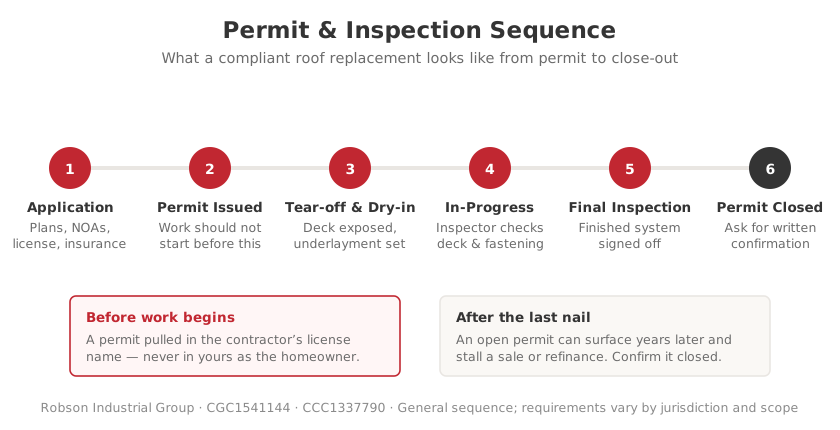
Permit-to-Inspection Sequence in Miami Lakes
- HOA status check: Contractor or homeowner confirms whether the property is governed by an HOA and, if so, secures the color/material approval or notification the association requires
- Material selection: Contractor specifies Miami-Dade NOA-rated materials matching your roof type, pitch, and exposure, consistent with the Florida Building Code, 8th Edition
- Permit application submitted: Contractor files the Town's Building Permit Application — including the built-in HOA Affidavit — through eTRAKiT, along with NOA documentation
- Plan Review: Building Department reviews the application; HVHZ plan review typically takes longer than in non-HVHZ counties, though an Early Start Request may allow qualifying work to begin during this stage
- Permit issued: Town issues the permit once review is complete and all required affidavits and NOA documentation are on file
- Tear-off and deck inspection: Existing roofing removed; the Town's Building & Roof Inspector verifies deck condition, thickness, and nail pattern before new materials go down
- Installation: New underlayment, flashing, and field materials installed to NOA specifications, including the full 6-nail fastening pattern and ring-shank deck nails
- Final inspection & Certificate of Completion: Inspector verifies the completed roof matches the permit, NOA specs, and HVHZ code; Certificate of Completion issued, after which a wind mitigation inspection can be scheduled for the insurance credit
The HOA Affidavit: Miami Lakes' Built-In Architectural Review
This is the section that most differentiates a Miami Lakes roofing project from a similar job in a municipality with no HOA paperwork woven into its permit process. Most South Florida cities and counties treat HOA approval, if it exists at all, as something a homeowner handles entirely on their own, outside the government's permit file. The Town of Miami Lakes takes a different approach: its Building Permit Application form includes an HOA Affidavit as a standard component of the submission package.
What the HOA Affidavit Actually Does
In practical terms, the HOA Affidavit is where the applicant (typically the contractor, on the homeowner's behalf) certifies the property's HOA status as part of the official permit record. Because this document is part of the Town's own application rather than a side letter the homeowner keeps in a drawer, an incomplete or inaccurate affidavit can become a hold point during Plan Review, not just a problem you discover later when your HOA sends a violation notice. A contractor who has actually pulled permits in Miami Lakes will ask about your HOA status at the estimate stage: not the day the permit application is being assembled.
Why This Matters More in the Original Lakefront Neighborhoods
Miami Lakes' original master-planned subdivisions, particularly east of the Palmetto Expressway, were built with homeowners associations as part of the community structure from the start. Consistent with the master-planned, New Urbanism approach Lester Collins designed into the town's layout. Many of these associations maintain design guidelines covering visible exterior changes, which commonly include roof color and, in some subdivisions, material or profile restrictions intended to keep a consistent streetscape. If your association has such guidelines, get the approval or notification documentation in writing before your contractor files the Building Permit Application: not after.
Contractor Registration Is a Separate Requirement
Beyond the HOA Affidavit, the Town of Miami Lakes requires every contractor to register directly with the Building Department before working here, regardless of their state license standing. Registration requires the contractor's insurance company to send Certificates of Insurance directly to the Town with a cover letter describing the trades covered: the Town states plainly there are no exceptions to this process. A contractor who is properly state-licensed but has never registered with the Town of Miami Lakes specifically cannot legally pull a permit here until that registration is on file.
Lakefront & Lake-Adjacent Roofing Considerations
The curving lakes that give Miami Lakes its name and its master-planned character were a deliberate design choice by landscape architect Lester Collins, and they shape roofing work on the properties that sit closest to them.
- Humidity and corrosion exposure: Homes directly adjacent to any of the town's lakes see sustained higher humidity at the roofline than inland properties, which accelerates wear on unprotected metal flashing, fasteners, and valley material over time — corrosion-resistant flashing and properly rated fasteners matter more here than on a dry inland lot.
- Mature landscaping and equipment staging: The tree-shaded streets Collins designed into the original town mean many lakefront lots have mature canopy that constrains where a dumpster, lift, or material delivery can be positioned without damaging landscaping the homeowner has maintained for decades.
- HOA design consistency along the waterline: Because lakefront lots are highly visible from the water and from neighboring properties across the lake, associations in these subdivisions tend to be more attentive to roof color and material consistency than in less visually connected parts of town — another reason the HOA Affidavit conversation should happen early.
- Access via curving, narrower streets: The original master plan favored walkable, curving residential streets over wide grid roads, which can mean tighter staging and delivery logistics than a straight-grid subdivision in neighboring Hialeah or Miami Gardens.
Impact Windows & Doors in Miami Lakes
Roofing is not the only envelope upgrade the Town of Miami Lakes Building Department permits under its own process: the Department publishes a dedicated New Windows and Doors Installation permit package, and impact-rated openings are frequently part of the same conversation as a roof replacement, since both fall under the same HVHZ product-approval framework.
| Requirement | What It Means in Miami Lakes |
|---|---|
| Miami-Dade NOA for windows/doors | Impact windows and doors must carry a Miami-Dade NOA rating, the same product-approval system that governs roofing materials |
| Town permit package | Filed separately from the roofing permit, using the Town's own New Windows and Doors Installation application |
| HOA review | Window and door style, frame color, and in some subdivisions grid pattern are common HOA design-guideline items, similar to roof color review |
| Insurance benefit | Impact-rated openings can add up to roughly 15% in additional wind mitigation insurance credit on top of roofing-related credits, when combined |
Homeowners planning a full storm-hardening project, roof plus openings, should ask their contractor to sequence the two permits together with the Town where possible, and to confirm HOA design approval covers both scopes rather than assuming roof approval automatically extends to windows and doors.
Common Roof Types on Miami Lakes Homes
Because Miami Lakes' housing stock spans more than six decades of continuous development, from the original 1962 groundbreaking through parcels the Graham Companies still develop today, the roofing material on any given property varies more than in a single-builder subdivision built out in one phase.
| Roof Type | Common On | Key Consideration in Miami Lakes |
|---|---|---|
| Dimensional asphalt shingle | Single-family homes throughout the original lakefront neighborhoods and later-developed western sections | Most cost-effective HVHZ-compliant option; GAF System Plus warranty eligibility applies here when installed to spec, and HOA color-palette approval is the most common review point |
| Flat & low-slope concrete tile | Homes built through the 1970s–1990s in the town's core neighborhoods | Structural load capacity should be verified before a like-for-like replacement; older or discontinued tile profiles may require a full-roof material match decision |
| Built-up or modified bitumen (flat roofs) | Townhomes and low-rise multifamily buildings near the Main Street town center | Often governed by a condominium or homeowners association covering the entire building, not a single unit — approval and scope questions look different from a detached single-family job |
What a Robson Estimate for a Miami Lakes Home Includes
A written estimate from Robson Industrial Group for a Miami Lakes roofing project accounts for the town's specific permitting layers, not just the square footage. Every estimate includes:
- HOA status confirmation — we ask up front whether your property is governed by an association and what design approval it requires, so the HOA Affidavit is accurate before we ever file the permit
- Material specification with Miami-Dade NOA numbers — exact manufacturer, product line, and NOA rating for HVHZ compliance, referenced to the Florida Building Code, 8th Edition
- Deck condition assessment — since Miami Lakes housing spans six decades of construction, we do not assume a uniform deck generation across the property
- Town of Miami Lakes contractor registration on file — confirmed and current before your permit application is submitted, not discovered as a problem mid-project
- HVHZ fastener and underlayment spec — ring-shank nail gauge, 6-nail pattern, and SBS underlayment called out explicitly
- Permit and inspection coordination — Town of Miami Lakes permit pulled in Robson’s name through eTRAKiT, all inspections scheduled by us
- Lakefront and landscaping protection plan where applicable — equipment staging planned around mature trees and lake-adjacent access on affected properties
- Written manufacturer and workmanship warranty terms — years and coverage spelled out, not “standard warranty applies”
If a competing estimate for your Miami Lakes home does not ask about your HOA status before quoting a number, ask why. On a property inside one of the town's association-governed subdivisions, that is the detail most likely to hold up your permit.
Wind Mitigation Inspection & Insurance Discounts
After your new roof passes its Town Certificate of Completion inspection, schedule a wind mitigation inspection. This inspection documents your roof’s protective features and can qualify you for meaningful insurance premium reductions in Miami Lakes:
| Mitigation Feature | Typical Insurance Discount | Notes |
|---|---|---|
| Hip roof shape | 15–25% reduction | Full hip (all slopes to eaves) scores highest |
| Miami-Dade NOA-rated materials | 5–15% reduction | Requires Certificate of Completion from Town inspection |
| Roof-to-wall connection (clips/wraps) | 10–25% reduction | Single wraps and double wraps score progressively higher |
| Roof deck attachment (ring-shank/6″ o.c.) | 5–10% reduction | Enhanced patterns score above code minimum |
| Opening protection (impact windows/doors) | Up to 15% additional | Can combine with roofing credits |
| Combined credits (typical hip-roof NOA install) | 15–35% total annual savings | Varies by insurer; request an updated quote after inspection |
The wind mitigation inspection typically costs $100–$175 and must be performed by a Florida-licensed wind mitigation inspector. It is separate from the Town's building inspection. It is performed for your insurance company, not the Building Department.
GAF Certified™ Roofing and the System Plus Warranty
Robson Industrial Group is a GAF Certified™ Residential Roofing Contractor (GAF ID: 1164276). This certification requires meeting GAF’s standards for licensing, insurance, and installation training. It is not self-awarded. The practical benefit for Miami Lakes homeowners is access to the GAF System Plus Limited Warranty, which extends coverage beyond the standard shingle warranty to the entire roofing system (underlayment, starter strips, ridge cap, ventilation, and installation workmanship) when qualifying GAF accessories are installed.
Ask your contractor specifically whether they are a GAF Certified™ Residential Roofing Contractor (not a “GAF preferred” installer, which is a marketing term, not a certification). Verify the GAF ID at gaf.com/en-us/roofing-contractors.
9 Red Flags When Hiring a Roofer in Miami Lakes
- No DBPR license number provided, or a license number that does not match the contractor’s name on myfloridalicense.com
- No Town of Miami Lakes contractor registration — a valid state license alone does not authorize a contractor to pull a permit here
- Never asks about your HOA status before quoting a price — on a Miami Lakes property inside an association, this is the most common source of permit delay
- Offers to fill out or sign the HOA Affidavit without your knowledge of what it certifies — you should see and understand this document before it is filed with the Town
- Cash-only or 100%-upfront payment demands — Florida law allows a reasonable deposit; full payment before materials are delivered is a red flag
- Offering to waive your insurance deductible — this is insurance fraud under Florida law (FL §817.234)
- No mention of pulling a Town of Miami Lakes permit — any contractor who suggests skipping the permit is either unlicensed or cutting corners
- Materials quoted without Miami-Dade NOA numbers — NOA numbers are public and should appear on every roofing proposal for an HVHZ property
- No written warranty covering both materials and installation — labor warranties under 2 years on a full re-roof are inadequate
Proposal Checklist for Miami Lakes Homeowners
Before signing any roofing contract in Miami Lakes, verify all of these are in writing:
| Item | What to Look For |
|---|---|
| Contractor license numbers | CGC or CCC number matching myfloridalicense.com |
| Town of Miami Lakes contractor registration | Confirmed current and on file with the Building Department, separate from state license |
| Insurance certificates | General liability ($1M+ per occurrence) + workers’ compensation COI naming your address |
| Material NOA numbers | Miami-Dade Notice of Acceptance number for shingles/tile, underlayment, and accessories |
| HOA Affidavit accuracy | Contractor confirms your property's HOA status correctly before filing; you have reviewed the affidavit content |
| Fastener & underlayment spec | Ring-shank nail gauge, 6-nail pattern, and SBS underlayment called out by name |
| Permit statement | Contractor agrees to pull the Town of Miami Lakes permit in their name before starting |
| Payment schedule | Reasonable deposit at contract, progress payment at material delivery, final at Certificate of Completion |
| Warranty terms | Manufacturer product warranty (years) + labor/installation warranty (years) in writing |
EPA Lead-Safe Rules: What They Require of Your Contractor (Pre-1978 Miami Lakes Homes)
Federal law does not put the burden on you to know whether your Miami Lakes home might contain lead-based paint. It puts the burden on the contractor. Miami Lakes' original development dates to 1962, and a meaningful share of the town's earliest neighborhoods east of the Palmetto Expressway were built through the 1970s, before the 1978 federal ban on residential lead-based paint. If your property was built before that year, EPA’s Renovation, Repair & Painting (RRP) Rule requires whoever disturbs painted surfaces during a roofing project (old fascia, soffits, and trim around roof penetrations) to be an EPA-certified renovation firm using lead-safe containment and cleanup practices.
Before hiring anyone to work on a pre-1978 Miami Lakes home, verify their EPA RRP certification number directly with the EPA: a legitimate contractor provides it without hesitation. Robson’s number is #NAT-F338229-1, expires 6/23/2031. Certified only for purposes of Section 402 of TSCA.
Frequently Asked Questions
Ready to Start Your Miami Lakes Roofing Project?
Licensed · CGC1541144 · CCC1337790 · GAF Certified™ (ID: 1164276) · EPA RRP Certified
Get Your Free EstimateCGC1541144 CCC1337790 GAF ID: 1164276 Robson Industrial Group LLC · 7290 NW 7th St, Unit 105, Miami, FL 33126 · (954) 546-4161 · sales@robsonindustrial.com
Roofing work in Miami Lakes?
This guide covers the permitting and inspection process. When you are ready to price the work itself (roof replacement, repairs, impact windows and doors) we can take it from here.
Get a free estimate or call (954) 546-4161
Nearby city guides: Hialeah Roofing Contractor Guide · Miami Gardens Roofing Contractor Guide · Doral Roofing Contractor Guide