Roofing & Impact Windows · Contractor Guide · July 2026
Key Biscayne Roofing & Impact Windows: Salt-Air Corrosion, Barrier-Island Wind Loads & Village Permits
Why a roofing or window project on Key Biscayne is never just a mainland job moved offshore: salt-air corrosion, oceanfront wind exposure, condo board approval, and the licensed contractor who plans for all three before the first fastener goes in.
🇪🇸 Leer en EspañolKey Biscayne is not a typical Miami-Dade roofing and window market, and treating it like one is the single most common mistake an off-island contractor makes. This is a barrier island, bordered by the Atlantic Ocean on the east and Biscayne Bay on the west, reached only by the Rickenbacker Causeway, where every property, whether a single-family home a few blocks off Crandon Boulevard or a 20-story oceanfront condominium tower, sits inside a level of wind exposure and salt-air corrosion that mainland Miami-Dade code treats as an edge case, not the baseline. Add in a housing stock split between owner-occupied single-family homes and condominium associations now operating under new state-mandated structural inspection law, and a Key Biscayne project has more moving parts than its square footage suggests.
This guide is written specifically for that situation: what the Village of Key Biscayne Building, Zoning & Planning Department requires for a roofing or opening-protection permit, how salt-air corrosion changes fastener and flashing selection, what Miami-Dade's High Velocity Hurricane Zone (HVHZ) code demands when combined with direct oceanfront exposure, how condominium board approval differs from a single-family permit, and the questions that separate a contractor who has actually worked Key Biscayne from one who is guessing.
Robson Industrial Group LLC holds Florida Certified General Contractor license CGC1541144 and Florida Certified Roofing Contractor license CCC1337790, both issued by DBPR with Francisco Rijo as the qualifying contractor. We are also a GAF Certified™ Residential Roofing Contractor (GAF ID: 1164276), which allows us to offer the GAF System Plus Limited Warranty on qualifying installations.
Get a Free Roofing or Impact Window Estimate in Key Biscayne
CGC1541144 · CCC1337790 · GAF Certified™ Residential Roofing (ID: 1164276)
Request Your Free EstimateCall (954) 546-4161 or email sales@robsonindustrial.com
Why Roofing & Impact Windows Are Different on a Barrier Island
Key Biscayne homeowners and condominium boards are not sourcing a contractor the way a buyer a few miles inland would. The factors that decide whether a project goes smoothly are specific to island conditions most mainland crews rarely encounter:
| Factor | Key Biscayne Reality | What It Means for Your Roof or Windows |
|---|---|---|
| Direct salt-air exposure | Every property sits within corrosive salt-air distance of the Atlantic Ocean, Biscayne Bay, or both | Standard galvanized fasteners and mill-finish aluminum flashing corrode faster on the island; stainless steel and corrosion-rated hardware are code-driven necessities, not upgrades |
| Oceanfront wind exposure | Exposure Category D (open water) conditions on oceanfront parcels, versus the more sheltered Exposure B/C typical of inland Miami-Dade lots | Design wind pressures on an oceanfront Key Biscayne structure can run meaningfully higher than the same HVHZ wind-speed zone produces inland — materials should be selected against actual site exposure, not the code floor alone |
| HVHZ designation | Full Miami-Dade County HVHZ coverage, no exceptions | Miami-Dade NOA-rated roofing, windows, and doors, 6-nail fastening, ring-shank deck nails, SBS underlayment, and impact-rated large-missile glazing are mandatory throughout the Village |
| Mixed single-family & condo housing stock | Owner-occupied single-family homes alongside numerous oceanfront and bayfront condominium towers, many built in the 1970s–1990s | Condo roof and opening-protection projects route through association boards, architectural review committees, and Florida's Milestone Inspection / SIRS structural laws before a Village permit is even filed — single-family projects go straight to permitting |
| Barrier-island access & staging | Single point of vehicle access via the Rickenbacker Causeway (a toll road), narrow residential streets, and condo loading-dock scheduling for high-rise work | Material delivery, crane staging for tower work, and dumpster placement require real logistics planning — an off-island crew that has not worked Key Biscayne can lose a day to access alone |
Key Biscayne Areas We Serve
Key Biscayne is roughly 1.25 square miles, but the roofing and window story changes block by block depending on how directly a property faces open water. A condominium tower fronting the Atlantic along Crandon Boulevard faces a different corrosion and wind-load reality than a single-family home on a bayfront canal a few streets west, and a property near the Village's southern residential streets close to Bill Baggs Cape Florida State Park has its own access and vegetation considerations. Quoting every Key Biscayne address off the same generic HVHZ spec is how a contractor misses the detail that determines whether a project performs.
Crandon Boulevard Oceanfront Corridor
Crandon Boulevard is Key Biscayne's main spine, and the stretch running along the Atlantic side is lined with the Village's tallest oceanfront condominium towers, most built between the 1970s and 1990s. These buildings face the most direct wind and salt-spray exposure on the island, and their common-element roofs (and increasingly their window and sliding-glass-door systems) are now being scheduled under Florida's Milestone Inspection and Structural Integrity Reserve Study requirements rather than deferred maintenance. Roofing and glazing work here requires association board coordination, loading-dock and elevator scheduling, and material specifications matched to the building's existing NOA-approved product line.
Bayfront & Canal-Front Single-Family Streets
West of Crandon Boulevard, toward Biscayne Bay, Key Biscayne's single-family streets sit on bayfront and canal-front lots that trade direct Atlantic wind exposure for brackish-water corrosion pressure on docks, seawalls, and ground-floor metal components. These homes are typically owner-occupied and go straight through the Village's standard single-family permit process without the condo board layer, but salt-air corrosion considerations for fasteners and flashing apply just as much here as they do oceanfront. Bay exposure is still barrier-island exposure.
South End Near Bill Baggs Cape Florida State Park
The southern residential streets of the Village, closer to Bill Baggs Cape Florida State Park and the historic Cape Florida Lighthouse, sit at the narrowest, most exposed point of the island, where both ocean and bay influence is felt on the same block. Homes here tend toward mature landscaping and lower-density single-family construction. A roofing or window project in this part of the Village should account for both open-water wind exposure and the mature tree cover common on these older residential lots when planning equipment staging and material delivery.
Florida Roofing Contractor License Types
The Florida Department of Business & Professional Regulation (DBPR) issues the license categories relevant to roofing and window work anywhere in Key Biscayne:
| License Type | Code | What They Can Do | Verify At |
|---|---|---|---|
| FL Certified General Contractor | CGC | All construction including roofing and window/door installation statewide | myfloridalicense.com |
| FL Certified Roofing Contractor | CCC | Roofing work only, statewide | myfloridalicense.com |
| FL Registered Contractor | Varies | Licensed by county/municipality — valid only in that jurisdiction | Miami-Dade County licensing office |
Robson Industrial Group holds both CGC1541144 and CCC1337790, state-certified licenses valid throughout Florida, including the Village of Key Biscayne and all of Miami-Dade County, covering both roofing and impact window/door installation.
How to Verify a Florida Contractor License in 7 Steps
- Go to myfloridalicense.com and click “Verify a License”
- Select Department of Business & Professional Regulation
- Choose Contractor from the profession dropdown
- Enter the contractor’s license number (CGC, CCC, or registration number) and search
- Confirm the status is “Current, Active” — not Expired, Suspended, or Revoked
- Verify the name on the license matches the company name or qualifying contractor on your contract
- Check the license type covers the scope of work (CGC covers all construction including windows and doors; CCC is roofing-specific)
Robson Industrial Group CGC1541144 verifiable at: myfloridalicense.com (CGC1541144). CCC1337790 verifiable at: myfloridalicense.com (CCC1337790).
Salt-Air Corrosion: The Detail Most Off-Island Bids Miss
This is the section that most separates a Key Biscayne project from anywhere else in Miami-Dade, including HVHZ neighborhoods just across the causeway. Salt-laden air off the Atlantic and Biscayne Bay accelerates the breakdown of standard construction metals in a way that inland HVHZ code does not fully account for on its own, and a contractor who specifies the same fastener and flashing package on Key Biscayne that they would use in an inland Miami-Dade neighborhood is setting the project up for premature corrosion failure well inside its expected service life.
Fastener & Hardware Selection
Standard electro-galvanized and even many hot-dip galvanized fasteners can begin showing corrosion staining and reduced holding strength within a few years of direct coastal salt exposure. For Key Biscayne roofing and window installations, 300-series stainless steel fasteners (often specifically 316 stainless for its added chloride resistance) are the appropriate specification for exposed hardware, ring shanks, and flashing clips, particularly on oceanfront and near-bayfront parcels. Miami-Dade Product Control and the Florida Building Code both address corrosion-resistant fastening requirements for construction within the code-defined distance of a saltwater body; on an island where every lot qualifies, this is not a discretionary upgrade a homeowner can decline to save cost without consequence.
Flashing & Metal Compatibility
Mill-finish aluminum flashing and trim, common on inland Miami-Dade jobs, pit and corrode visibly faster under sustained salt-air exposure. Key Biscayne roofing and window installations should specify either coated/anodized aluminum rated for coastal exposure or, on higher-exposure oceanfront work, stainless steel or copper flashing. Just as important is metal compatibility: mixing dissimilar metals in direct contact (aluminum flashing against stainless fasteners with no isolating layer, for example) creates galvanic corrosion that can fail faster than either metal would on its own. A contractor who has not worked barrier-island properties before may not think to check this.
Why This Matters More on Condominium Towers
A single-family roof with an undersized fastener spec is a homeowner's problem to catch early or replace sooner than expected. A condominium tower's common-element roof or window system with the same shortcut is a shared liability across every unit owner in the building, discovered years later during a Milestone Inspection or Structural Integrity Reserve Study when the deferred corrosion has already compromised more than the original scope. Boards evaluating roofing and glazing bids for Key Biscayne towers should specifically ask what fastener and flashing metal each bidder is specifying, not assume every HVHZ-compliant bid was built for coastal service life.
HVHZ + Oceanfront Wind Exposure: What Key Biscayne Demands
Key Biscayne sits entirely within Miami-Dade County, which means every roofing and opening-protection project on the island falls under the High Velocity Hurricane Zone (HVHZ): the strictest wind and impact code standard in the continental United States. What makes Key Biscayne different from an inland HVHZ property is exposure category: oceanfront and near-bayfront parcels on the island sit in open-water exposure conditions that generate higher design wind pressures than the same HVHZ wind-speed zone produces on a sheltered inland lot.
| Requirement | HVHZ Standard (Applies to All of Key Biscayne) |
|---|---|
| Product approval system | Miami-Dade NOA (Notice of Acceptance) — required for roofing materials, impact windows, doors, and accessories |
| Oversight body | Miami-Dade Product Control, enforced locally by the Village of Key Biscayne Building Department |
| Deck nail requirement | Ring-shank deck nails, 6″ o.c. field / 6″ o.c. perimeter minimum |
| Underlayment | SBS-modified underlayment required |
| Fastener pattern | 6-nail pattern per shingle in HVHZ wind zones |
| Minimum deck thickness | 19/32″ (0.59″) plywood or OSB decking minimum |
| Base wind design speed | 175+ mph (Category 5 design pressure), with oceanfront Exposure Category D lots generating higher actual design pressures than the same zone inland |
| Opening protection (windows/doors) | Large-missile impact-rated NOA glazing and framing required for occupied structures; no shutters-only compliance path on new or replacement installations in this code cycle |
Village of Key Biscayne Building Permit Requirements
A building permit is required for all roofing and opening-protection work in Florida under FL Statute §553.79, and in Key Biscayne it is enforced by the Village's own Building, Zoning & Planning Department. Key Biscayne is an incorporated village (since 1991) with its own permitting authority, separate from unincorporated Miami-Dade County.
| Permit Detail | Village of Key Biscayne |
|---|---|
| Permit authority | Village of Key Biscayne Building, Zoning & Planning Department |
| Location | Village Hall, 88 West McIntyre Street, Key Biscayne, FL 33149 |
| Main Village phone | (305) 365-5511 |
| Permit clerks (direct) | (305) 365-5512 |
| Permit submission & inspections | Village's Accela Citizen Access online portal |
| Governing codes | Florida Building Code and Miami-Dade County Code (HVHZ) |
| Permit holder | Must be the licensed contractor (not the homeowner, not a subcontractor) |
| Product approval requirement | Miami-Dade NOA number required for all roofing and window/door materials |
| Inspections | Deck/rough inspection + final inspection at minimum; additional inspections for high-rise window/door replacement per building code |
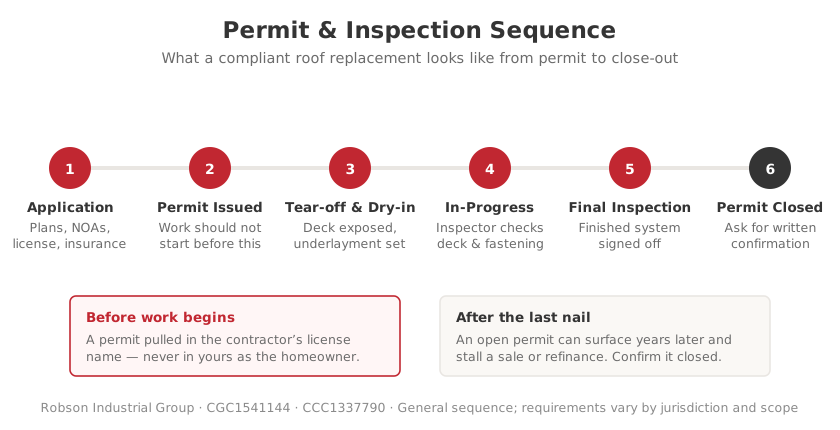
Permit-to-Inspection Sequence in Key Biscayne
- Site walk and exposure assessment: Contractor evaluates the property's actual wind exposure category, salt-air proximity, and access logistics before quoting materials
- Material selection: Contractor specifies Miami-Dade NOA-rated roofing, window, or door products matched to the property's exposure — not just the HVHZ code minimum — along with corrosion-rated fasteners and flashing
- Condo coordination (if applicable): For condominium work, contractor submits specifications to the association's board or architectural review committee for approval before Village permit application
- Permit application: Contractor submits the building permit application through the Village's Accela Citizen Access portal, along with NOA documentation for every material
- Permit issued: Village Building Department reviews and issues the permit; HVHZ plan review typically runs longer than in non-HVHZ jurisdictions
- Tear-off/removal and rough inspection: Existing roofing or openings removed; inspector verifies deck condition, opening rough framing, and fastening pattern before new materials go in
- Installation: New underlayment, flashing, roofing, or impact glazing installed to NOA specifications, including corrosion-rated hardware
- Final inspection: Inspector verifies the completed work matches the permit, NOA specs, and HVHZ code
- Certificate of Completion: Issued after passing final inspection; condominium associations log completion against their Milestone Inspection and SIRS records
Condo & High-Rise Board Approval vs. Single-Family Permitting
Key Biscayne's housing stock splits between owner-occupied single-family homes and numerous condominium towers, and the approval path for a roofing or window project is fundamentally different between the two.
Single-Family Homes
A single-family homeowner in Key Biscayne works directly with their contractor and the Village Building Department. There is no association layer. The homeowner selects the contractor, approves the material specification, and the contractor pulls the Village permit. The main coordination points are exposure-appropriate material selection and, on older homes, the pre-1978 lead-paint considerations covered later in this guide.
Condominium & Cooperative Buildings
Roofing on a condominium tower is almost always a common-element project, meaning it is scheduled, budgeted, and approved by the association's board rather than an individual unit owner. Window and sliding-glass-door replacement is typically the unit owner's financial responsibility but still requires architectural review committee approval, because every opening on the building's exterior needs to match the structure's existing NOA-approved product line and appearance standards. This means a Key Biscayne condo project has an approval layer a single-family home never sees, and it is increasingly tied to two pieces of Florida law enacted after the 2021 Surfside condominium collapse:
- Milestone Inspection (FL Statute §553.899): Condominium and cooperative buildings three stories or taller must undergo a structural Milestone Inspection at 30 years of age, or at 25 years if the building sits within three miles of the coastline — a threshold essentially every Key Biscayne condominium meets. Roofing and envelope condition are directly assessed as part of this inspection.
- Structural Integrity Reserve Study, or SIRS (FL Statute §718.112): Associations must complete a reserve study covering roofing, load-bearing components, waterproofing, and other structural elements, and are now required to fully fund reserves for those items rather than waiving or underfunding them.
The practical effect for Key Biscayne boards is that roofing and major envelope work is increasingly being scheduled on a fixed structural-compliance timeline rather than deferred until visible failure. A contractor bidding condominium roofing or window work on the island should be conversant in Milestone Inspection and SIRS terminology and able to coordinate directly with the board, property manager, and the building's engineer of record.
Impact Windows & Doors: Product Selection for Oceanfront Exposure
Opening protection is not optional anywhere in HVHZ Miami-Dade, but on a barrier island like Key Biscayne, the product tier matters more than it does a few miles inland. Impact windows and doors on the island are typically specified with higher design pressure (DP) ratings and large-missile impact glazing rated for the elevated wind pressures that oceanfront and near-bayfront Exposure Category D conditions generate, not simply the minimum DP rating that clears code for an inland Miami-Dade lot in the same wind-speed zone.
| Consideration | Why It Matters on Key Biscayne |
|---|---|
| Large-missile impact rating | Required throughout HVHZ; on oceanfront exposure, product lines rated for the upper end of the large-missile test range provide more real-world margin against wind-borne debris off open water |
| Higher design pressure (DP) rating | Oceanfront Exposure Category D generates higher wind pressures than the same wind-speed zone produces inland; window and door DP ratings should be selected against actual site exposure, not the code floor |
| Frame and hardware corrosion resistance | Standard mill-finish aluminum and steel hardware corrode faster under sustained salt-air exposure; coastal-rated finishes and stainless components extend service life |
| Matching existing NOA product line (condos) | Replacement units on a condominium must match the building's originally approved NOA system for both code compliance and architectural review approval |
On the roofing side, the same exposure-driven logic applies. Barrel and flat concrete tile remain common on Key Biscayne's older single-family homes, but standing-seam and other coastal-rated metal roofing systems have become increasingly common on both single-family and condominium common-element re-roofs specifically because metal roofing, correctly specified with corrosion-resistant fasteners and flashing, tends to outperform other systems under sustained salt-air conditions over a multi-decade service life, a meaningful consideration for a condo board funding a SIRS reserve schedule decades into the future.
What a Robson Estimate for a Key Biscayne Property Includes
A written estimate from Robson Industrial Group for a Key Biscayne roofing or impact window project accounts for island conditions, not just square footage or opening count. Every estimate includes:
- Exposure assessment — whether the property is oceanfront, bayfront, or interior, and what that means for wind pressure and salt-air exposure on materials
- Material specification with Miami-Dade NOA numbers — exact manufacturer, product line, and NOA rating for HVHZ compliance, selected against actual exposure rather than code minimum
- Corrosion-rated fastener and flashing spec — stainless steel or coastal-rated hardware called out explicitly, not left to a generic HVHZ fastener note
- Condo coordination plan (when applicable) — a stated plan for submitting specifications to the association's board or architectural review committee before permitting
- Access and staging plan — how equipment, materials, and dumpster or loading-dock logistics are handled given Key Biscayne's single-causeway access and, for towers, elevator/loading-dock scheduling
- Permit and inspection coordination — Village of Key Biscayne permit pulled in Robson’s name through Accela, all inspections scheduled by us
- Written manufacturer and workmanship warranty terms — years and coverage spelled out, not “standard warranty applies”
If a competing estimate for your Key Biscayne property does not specifically address salt-air corrosion in its fastener and flashing spec, ask why before you sign. It is one of the most common places an island project underperforms its expected service life.
GAF Certified™ Roofing and the System Plus Warranty
Robson Industrial Group is a GAF Certified™ Residential Roofing Contractor (GAF ID: 1164276). This certification requires meeting GAF’s standards for licensing, insurance, and installation training. It is not self-awarded. The practical benefit for Key Biscayne homeowners is access to the GAF System Plus Limited Warranty, which extends coverage beyond the standard shingle warranty to the entire roofing system (underlayment, starter strips, ridge cap, ventilation, and installation workmanship) when qualifying GAF accessories are installed.
On a coastal roof exposed to salt air and higher wind pressures, system-level warranty coverage matters more than it does on a sheltered inland roof, because there are more interacting components exposed to the same accelerated corrosion environment. Ask your contractor specifically whether they are a GAF Certified™ Residential Roofing Contractor (not a “GAF preferred” installer, which is a marketing term, not a certification). Verify the GAF ID at gaf.com/en-us/roofing-contractors.
9 Red Flags When Hiring a Contractor in Key Biscayne
- No DBPR license number provided, or a license number that does not match the contractor’s name on myfloridalicense.com
- No mention of corrosion-resistant fasteners or flashing in the written estimate — a spec that reads identically to an inland Miami-Dade bid is a sign the contractor has not adjusted for island exposure
- No coordination plan for condominium board approval on association work — a contractor who plans to permit first and inform the board later is setting up a stalled project
- Cash-only or 100%-upfront payment demands — Florida law allows a reasonable deposit; full payment before materials are delivered is a red flag
- Offering to waive your insurance deductible — this is insurance fraud under Florida law (FL §817.234)
- No mention of pulling a Village of Key Biscayne permit — any contractor who suggests skipping the permit is either unlicensed or cutting corners
- Materials quoted without Miami-Dade NOA numbers — NOA numbers are public and should appear on every roofing or window proposal for an HVHZ property
- Subcontractors you never meet doing the installation without you knowing their license status
- No written warranty covering both materials and installation — labor warranties under 2 years on a full re-roof or window replacement are inadequate
Proposal Checklist for Key Biscayne Property Owners & Boards
Before signing any roofing or window contract in Key Biscayne, verify all of these are in writing:
| Item | What to Look For |
|---|---|
| Contractor license numbers | CGC or CCC number matching myfloridalicense.com |
| Insurance certificates | General liability ($1M+ per occurrence) + workers’ compensation certificate of insurance (COI) naming your property or association |
| Material NOA numbers | Miami-Dade Notice of Acceptance number for roofing, windows, doors, and accessories |
| Fastener & flashing spec | Stainless steel or coastal-rated hardware called out by name, not a generic HVHZ note |
| Exposure-appropriate DP/wind rating | Product ratings matched to the property's actual exposure category, with justification, not just code minimum |
| Condo board coordination (if applicable) | Written confirmation the contractor will submit specs for association or architectural review approval before permitting |
| Permit statement | Contractor agrees to pull the Village of Key Biscayne permit in their name before starting |
| Payment schedule | Reasonable deposit at contract, progress payment at material delivery, final at Certificate of Completion |
| Warranty terms | Manufacturer product warranty (years) + labor/installation warranty (years) in writing |
EPA Lead-Safe Rules: What They Require of Your Contractor (Pre-1978 Key Biscayne Properties)
Federal law does not put the burden on you to know whether your Key Biscayne home or building might contain lead-based paint. It puts the burden on the contractor. Key Biscayne's original single-family subdivisions and several of its earliest condominium buildings date to the 1950s through the 1970s, well before the Village incorporated in 1991, which means a meaningful share of the island's housing stock predates the 1978 federal cutoff. If your property was built before 1978, EPA’s Renovation, Repair & Painting (RRP) Rule requires whoever disturbs painted surfaces during a roofing or window project (old fascia, soffits, window trim, or balcony rail surfaces) to be an EPA-certified renovation firm using lead-safe containment and cleanup practices.
This is a homeowner-risk issue, not just a paperwork requirement: hiring an uncertified contractor to disturb painted surfaces on a pre-1978 Key Biscayne property can expose your family (especially children) to lead dust, and it can expose you personally to liability if the contractor's failure to follow lead-safe practices is later discovered, since the legal responsibility for verifying certification before work begins sits with the property owner who hired the crew. Before hiring anyone to work on a pre-1978 Key Biscayne property, verify their EPA RRP certification number directly with the EPA. A legitimate contractor provides it without hesitation. Robson’s number is #NAT-F338229-1, expires 6/23/2031. Certified only for purposes of Section 402 of TSCA.
Frequently Asked Questions
Ready to Start Your Key Biscayne Project?
Licensed · CGC1541144 · CCC1337790 · GAF Certified™ (ID: 1164276) · EPA RRP Certified
Get Your Free EstimateCall (954) 546-4161 or email sales@robsonindustrial.com
CGC1541144 CCC1337790 GAF ID: 1164276 Robson Industrial Group LLC · 7290 NW 7th St, Unit 105, Miami, FL 33126 · (954) 546-4161 · sales@robsonindustrial.com
Roofing work in Key Biscayne?
This guide covers the permitting and inspection process. When you are ready to price the work itself (roof replacement, repairs, impact windows and doors), we can take it from here.
Get a free estimate or call (954) 546-4161
Nearby city guides: Coral Gables Roofing Contractor Guide · Pinecrest Roofing Contractor Guide