Roofing · Contractor Guide · July 2026
Pinecrest Roof Replacement: Tree Canopy Rules, Estate-Lot Access & Village Permits
Why a roof job in Pinecrest is never just a roof job: the Village's tree preservation ordinance, large-lot equipment access, Miami-Dade HVHZ code, and the licensed contractor who plans for all three before the first shingle comes off.
🇪🇸 Leer en EspañolPinecrest is not a typical Miami-Dade roofing market. This is a village built around large lots, mature tree canopy, and a deliberately low-density character its residents have fought hard to protect: the Village's own materials point to more than 50,000 street trees and an average residential market value north of $2 million. That combination changes the roofing job itself. A crew that can drop a dumpster on a standard 60-foot suburban lot and get to work does not automatically know how to stage equipment on a quarter-acre-plus estate lot without cutting into a protected oak canopy, or how to sequence a Village tree permit alongside a building permit so the project doesn't stall for weeks.
This guide is written specifically for that situation: what the Village of Pinecrest Building Department requires for a roofing permit, how the tree preservation ordinance intersects with tear-off and staging, what Miami-Dade's High Velocity Hurricane Zone (HVHZ) code demands of your materials and fastening, and the questions that separate a contractor who has actually worked estate lots in Pinecrest from one who is guessing.
Robson Industrial Group LLC holds Florida Certified General Contractor license CGC1541144 and Florida Certified Roofing Contractor license CCC1337790, both issued by DBPR with Francisco Rijo as the qualifying contractor. We are also a GAF Certified™ Residential Roofing Contractor (GAF ID: 1164276), which allows us to offer the GAF System Plus Limited Warranty on qualifying installations.
Get a Free Roofing Estimate in Pinecrest
CGC1541144 · CCC1337790 · GAF Certified™ Residential Roofing (ID: 1164276)
Request Your Free EstimateWhy Roofing in Pinecrest Is Different
Pinecrest homeowners are not choosing a roofing contractor the way a buyer in a dense, uniform-lot subdivision would. The factors that decide whether a project goes smoothly are specific to this village:
| Factor | Pinecrest Reality | What It Means for Your Roof |
|---|---|---|
| Tree canopy & preservation code | Village-regulated removal and trimming of protected trees; heavy canopy over many rooflines | Equipment staging, dumpster placement, and even limb clearance for tear-off can require Village tree authorization before roofing work begins |
| Large, irregular lots | Many lots run a quarter-acre to a full acre or more, often with long driveways and mature landscaping | Crane or lift staging, material delivery routing, and irrigation/landscape protection need to be planned before tear-off, not improvised on-site |
| HVHZ designation | Full Miami-Dade County HVHZ coverage | Miami-Dade NOA-rated materials, 6-nail fastening, ring-shank deck nails, SBS underlayment, and 19/32″ minimum decking are mandatory, not optional upgrades |
| Custom, older estate homes | Significant inventory built 1950s–1980s, many since expanded or remodeled with complex rooflines and custom tile | Deck condition, hip-and-valley complexity, and matching discontinued tile profiles all add estimating and installation detail a cookie-cutter bid misses |
| High-value property, low tolerance for corner-cutting | Average residential market value over $2 million per Village data | Homeowners here are more likely to be quoted by multiple contractors and to expect full documentation, NOA numbers, and a real deck-repair allowance in writing |
Pinecrest Areas We Serve
Pinecrest is not one uniform roofing job repeated block after block. A 1960s ranch shaded by a decades-old banyan canopy on Old Cutler Road has a different access and material story than a gated, canal-front home in Snapper Creek Lakes, which is different again from the wide, deep estate lots near the Village's civic core around Pinecrest Gardens. Treating every address the same is how contractors miss the detail that determines whether a Pinecrest roof project goes smoothly.
Old Cutler Road Corridor
The stretch of Old Cutler Road running through Pinecrest is lined with some of the most mature tree canopy in Miami-Dade County, including landmark banyan and gumbo-limbo specimens that predate most of the homes beneath them. Properties along and near this corridor tend to sit on deep, heavily landscaped lots where roofing access is constrained by canopy that cannot simply be cut back to make room for a dumpster or lift. Any limb clearance beyond routine trimming needs to go through the Village's tree preservation process first. Homes here also skew older, meaning deck condition and outdated flashing are common findings once tear-off begins.
Snapper Creek Lakes
This gated, canal-and-lake-front enclave in Pinecrest combines waterfront exposure with the same estate-lot scale found throughout the village. Roofing work here has to account for both the corrosion pressure of nearby brackish water on metal flashing and fasteners, and the access logistics of a gated community, scheduling deliveries and equipment through a guard gate, and coordinating tear-off timing with any HOA-style community rules that apply within the enclave. A contractor unfamiliar with Snapper Creek Lakes access protocols can lose a full day just getting equipment on-site.
Pinecrest Gardens / Village Civic Core Area
The neighborhoods surrounding the Village's civic core and Pinecrest Gardens, the former Parrot Jungle site, include some of the original large-lot subdivisions platted when Pinecrest incorporated as a village. Homes here are frequently original 1960s–1970s construction that has been added onto or remodeled over decades, which means roofs are often a patchwork of original sections and later additions with different deck types, pitches, and even material generations under one ridge line. An accurate Pinecrest estimate in this area starts with mapping the roof section by section, not quoting off a single square-footage number.
Florida Roofing Contractor License Types
The Florida Department of Business & Professional Regulation (DBPR) issues the license categories relevant to roofing work anywhere in Pinecrest:
| License Type | Code | What They Can Do | Verify At |
|---|---|---|---|
| FL Certified General Contractor | CGC | All construction including roofing statewide | myfloridalicense.com |
| FL Certified Roofing Contractor | CCC | Roofing work only, statewide | myfloridalicense.com |
| FL Registered Contractor | Varies | Licensed by county/municipality — valid only in that jurisdiction | Miami-Dade County licensing office |
Robson Industrial Group holds both CGC1541144 and CCC1337790. State-certified licenses valid throughout Florida, including the Village of Pinecrest and all of Miami-Dade County.
How to Verify a Florida Roofing License in 7 Steps
- Go to myfloridalicense.com and click “Verify a License”
- Select Department of Business & Professional Regulation
- Choose Contractor from the profession dropdown
- Enter the contractor’s license number (CGC, CCC, or registration number) and search
- Confirm the status is “Current, Active” — not Expired, Suspended, or Revoked
- Verify the name on the license matches the company name or qualifying contractor on your contract
- Check the license type covers roofing work (CGC covers all construction; CCC is roofing-specific)
Robson Industrial Group CGC1541144 verifiable at: myfloridalicense.com (CGC1541144). CCC1337790 verifiable at: myfloridalicense.com (CCC1337790).
HVHZ Requirements: What Miami-Dade Demands in Pinecrest
Pinecrest sits entirely within Miami-Dade County, which means every roofing project here falls under the High Velocity Hurricane Zone (HVHZ): the strictest roofing code standard in the continental United States. Unlike Broward or Palm Beach County, where Florida Product Approval alone can satisfy code, Pinecrest roofing materials must carry a Miami-Dade Notice of Acceptance (NOA).
| Requirement | HVHZ Standard (Applies to All of Pinecrest) |
|---|---|
| Product approval system | Miami-Dade NOA (Notice of Acceptance) — required for shingles, tile, underlayment, and accessories |
| Oversight body | Miami-Dade Product Control, enforced locally by the Pinecrest Building Department |
| Deck nail requirement | Ring-shank deck nails, 6″ o.c. field / 6″ o.c. perimeter minimum |
| Underlayment | SBS-modified underlayment required |
| Fastener pattern | 6-nail pattern per shingle in HVHZ wind zones |
| Minimum deck thickness | 19/32″ (0.59″) plywood or OSB decking minimum |
| Wind design speed | 175+ mph (Category 5 design pressure) |
| Insurance inspection form | Standard Florida wind mitigation inspection form |
Village of Pinecrest Roofing Permit Requirements
A building permit is required for all roofing work in Florida under FL Statute §553.79, and in Pinecrest it is enforced by the Village's own Building Department. Pinecrest is an incorporated village with its own permitting authority, separate from unincorporated Miami-Dade County.
| Permit Detail | Village of Pinecrest |
|---|---|
| Permit authority | Pinecrest Building Department |
| Location | Pinecrest Municipal Center, 12645 Pinecrest Parkway, Pinecrest, FL 33156 |
| Phone | (305) 234-2121 |
| building@pinecrest-fl.gov | |
| Building Director | Paul W. Buckler, R.A. |
| Permit submission & inspections | Village's eTRAKiT online permitting system |
| Permit holder | Must be the licensed contractor (not the homeowner, not a subcontractor) |
| Product approval requirement | Miami-Dade NOA number required for all roofing materials |
| Inspections | Deck inspection + final inspection at minimum |
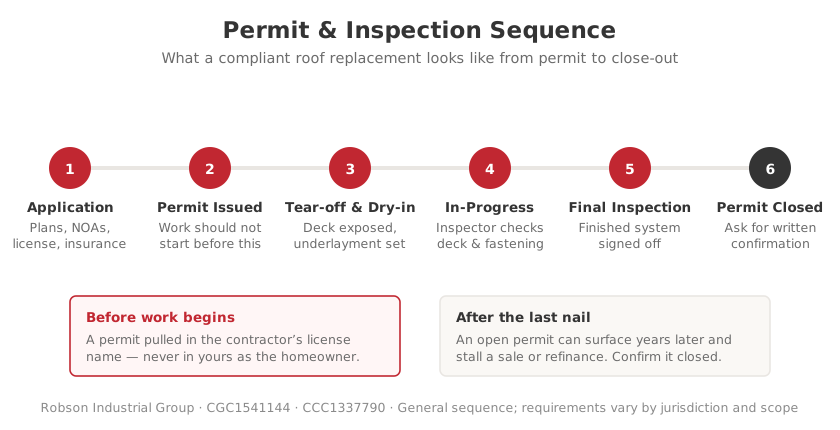
Permit-to-Inspection Sequence in Pinecrest
- Site walk and tree assessment: Contractor evaluates roof access, staging area, and any canopy limbs that may require Village tree authorization before equipment can be positioned
- Material selection: Contractor specifies Miami-Dade NOA-rated materials matching your roof type, pitch, and exposure
- Permit application: Contractor submits the building permit application through the Village's eTRAKiT system, along with NOA documentation and, if needed, a separate tree permit request
- Permit issued: Pinecrest Building Department reviews and issues the permit; HVHZ plan review typically runs longer than in non-HVHZ counties
- Tear-off and deck inspection: Existing roofing removed; inspector verifies deck condition, thickness, and nail pattern before new materials go down
- Installation: New underlayment, flashing, and field materials installed to NOA specifications, including the full 6-nail fastening pattern and ring-shank deck nails
- Final inspection: Inspector verifies the completed roof matches the permit, NOA specs, and HVHZ code
- Certificate of Completion: Issued after passing final inspection; wind mitigation inspection can now be scheduled for the insurance credit
Tree Canopy & Estate-Lot Access: The Detail Most Bids Miss
This is the section that most differentiates a Pinecrest roofing project from anywhere else in Miami-Dade. The Village's tree preservation program exists specifically because Pinecrest residents have valued their canopy enough to write it into local law, and a roofing contractor who does not plan around it will either delay your project or put you at risk of a code violation on your own behalf.
Tree Preservation & Roofing Access
The Village of Pinecrest requires a permit to remove protected trees and regulates significant trimming, with enforcement that includes fines for unauthorized cutting. For a roofing project, this matters at the staging stage: a dumpster placed under low canopy, a crane positioned to lift tile pallets to the roof, or even a tear-off crew clearing a path along a fascia line can all require limb clearance that crosses from “routine trimming” into work the Village regulates. A contractor who has actually worked Pinecrest lots will walk the property before quoting, flag any canopy conflicts, and tell you whether a tree permit or a licensed arborist needs to be involved before the roofing permit can even be scheduled: not discover the problem the morning the dumpster shows up and the driveway is blocked.
Large-Lot Equipment Staging
Many Pinecrest lots run a quarter-acre to well over an acre, often with long circular driveways, mature landscaping, irrigation lines, and sometimes fencing or gates that a standard suburban-lot staging plan does not account for. Material delivery, dumpster placement, and any crane or lift access need a real site plan: not a guess made the morning the truck arrives. Damage to irrigation heads, landscape lighting, or paver driveways during staging is one of the most common post-project disputes on larger properties, and it is entirely avoidable with a walk-through beforehand.
Older Custom Estate Construction (1950s–1980s)
A meaningful share of Pinecrest's housing stock dates to the Village's early decades, and many of these homes have been expanded, remodeled, or had additions built with different roof sections over the years. Common findings once tear-off begins include:
- Mixed deck generations — original sections may have older plank or undersized decking that does not meet the current 19/32″ HVHZ minimum, while additions have newer OSB or plywood
- Discontinued or custom tile profiles on estate homes with barrel or flat concrete tile roofs, requiring matching or a full-roof material decision rather than a simple patch
- Multiple roof pitches and transitions where additions meet the original structure, each needing its own flashing detail
- Aged fascia and soffit hidden behind mature landscaping, sometimes with lead-based paint if the home predates 1978
An estimate that does not walk every section of a Pinecrest estate roof separately is likely to miss one of these conditions before it becomes a mid-project change order.
Wildlife, Organic Debris & Roof Maintenance
Pinecrest’s canopy comes with a maintenance side effect that inland tract-home neighborhoods rarely deal with at the same scale: heavy organic debris load from overhanging trees, and a resident peacock population significant enough that the Village runs its own Peacock Mitigation Program. Leaf litter, seed pods, and small branches accumulate in valleys and behind chimneys faster under mature canopy, and roosting birds can scratch or displace loose tile over time. None of this changes the code requirements for a new roof, but it does change the maintenance conversation: a contractor who understands Pinecrest’s canopy should walk you through gutter and valley cleaning frequency as part of the post-installation warranty conversation, not leave you to discover the debris buildup after the first big rain event backs up a valley.
Common Roof Types on Pinecrest Estate Homes
Because Pinecrest’s housing stock spans seven decades of construction and remodeling, the roofing material on any given estate lot varies more than in a newer, single-builder subdivision. The three types we see most often each carry different cost, weight, and NOA considerations:
| Roof Type | Common On | Key Consideration in Pinecrest |
|---|---|---|
| Barrel & flat concrete tile | Mediterranean and Spanish-influenced estate homes, common on larger 1970s–1990s lots | Structural load capacity must be verified before a like-for-like replacement; discontinued profiles may require a full-roof match decision rather than a partial repair |
| Dimensional asphalt shingle | Ranch and mid-century homes, especially near the Village civic core and older subdivisions | Most cost-effective HVHZ-compliant option; GAF System Plus warranty eligibility applies here when installed to spec |
| Standing-seam or flat metal (accent/porch sections) | Additions, porte-cochere covers, and flat sections on remodeled estate homes | Often installed at a different time than the main roof; needs its own transition flashing detail where it meets tile or shingle sections |
What a Robson Estimate for a Pinecrest Home Includes
A written estimate from Robson Industrial Group for a Pinecrest roofing project accounts for the property, not just the square footage. Every estimate includes:
- Full property walk-through — roof section mapping, deck condition by section, canopy and access assessment, and identification of any tree-permit needs before we quote a number
- Material specification with Miami-Dade NOA numbers — exact manufacturer, product line, and NOA rating for HVHZ compliance, not a generic material description
- Deck repair allowance by roof section — since older Pinecrest estate homes often mix deck generations, we price repair potential per section rather than one blended number
- Tree and access coordination plan — a stated plan for equipment staging, canopy clearance needs, and any required Village tree authorization, submitted alongside your building permit
- HVHZ fastener and underlayment spec — ring-shank nail gauge, 6-nail pattern, and SBS underlayment called out explicitly
- Permit and inspection coordination — Pinecrest Building Department permit pulled in Robson’s name through eTRAKiT, all inspections scheduled by us
- Landscape and hardscape protection plan — how irrigation, paver driveways, and plantings are protected during staging and tear-off
- Written manufacturer and workmanship warranty terms — years and coverage spelled out, not “standard warranty applies”
If a competing estimate for your Pinecrest home does not include a real tree and access plan, ask why before you sign. It is one of the most common places a Pinecrest project runs over budget.
Wind Mitigation Inspection & Insurance Discounts
After your new roof passes its Village Certificate of Completion inspection, schedule a wind mitigation inspection. This inspection documents your roof’s protective features and can qualify you for meaningful insurance premium reductions in Pinecrest:
| Mitigation Feature | Typical Insurance Discount | Notes |
|---|---|---|
| Hip roof shape | 15–25% reduction | Full hip (all slopes to eaves) scores highest — common on Pinecrest estate homes |
| Miami-Dade NOA-rated materials | 5–15% reduction | Requires Certificate of Completion from Village inspection |
| Roof-to-wall connection (clips/wraps) | 10–25% reduction | Single wraps and double wraps score progressively higher |
| Roof deck attachment (ring-shank/6″ o.c.) | 5–10% reduction | Enhanced patterns score above code minimum |
| Opening protection (impact windows/doors) | Up to 15% additional | Can combine with roofing credits |
| Combined credits (typical full-hip NOA new roof) | 15–35% total annual savings | Varies by insurer; request an updated quote after inspection |
The wind mitigation inspection typically costs $100–$175 and must be performed by a Florida-licensed wind mitigation inspector. It is separate from the Village building inspection. It is performed for your insurance company, not the Village.
GAF Certified™ Roofing and the System Plus Warranty
Robson Industrial Group is a GAF Certified™ Residential Roofing Contractor (GAF ID: 1164276). This certification requires meeting GAF’s standards for licensing, insurance, and installation training. It is not self-awarded. The practical benefit for Pinecrest homeowners is access to the GAF System Plus Limited Warranty, which extends coverage beyond the standard shingle warranty to the entire roofing system (underlayment, starter strips, ridge cap, ventilation, and installation workmanship) when qualifying GAF accessories are installed.
On a large, architecturally complex Pinecrest roof with multiple sections and transitions, system-level warranty coverage matters more than it does on a simple single-pitch roof, because there are more junctions where components interact. Ask your contractor specifically whether they are a GAF Certified™ Residential Roofing Contractor (not a “GAF preferred” installer, which is a marketing term, not a certification). Verify the GAF ID at gaf.com/en-us/roofing-contractors.
9 Red Flags When Hiring a Roofer in Pinecrest
- No DBPR license number provided, or a license number that does not match the contractor’s name on myfloridalicense.com
- No plan for tree canopy or lot access in the written estimate — on a Pinecrest estate lot, this is one of the most common sources of mid-project delay and cost overruns
- Cash-only or 100%-upfront payment demands — Florida law allows a reasonable deposit; full payment before materials are delivered is a red flag
- Offering to waive your insurance deductible — this is insurance fraud under Florida law (FL §817.234)
- No mention of pulling a Village of Pinecrest permit — any contractor who suggests skipping the permit is either unlicensed or cutting corners
- Materials quoted without Miami-Dade NOA numbers — NOA numbers are public and should appear on every roofing proposal for an HVHZ property
- Subcontractors you never meet doing the installation without you knowing their license status
- Assignment of Benefits (AOB) demand before work begins — signing an AOB transfers your insurance claim rights to the contractor; never sign without your attorney reviewing
- No written warranty covering both materials and installation — labor warranties under 2 years on a full re-roof are inadequate
Proposal Checklist for Pinecrest Homeowners
Before signing any roofing contract in Pinecrest, verify all of these are in writing:
| Item | What to Look For |
|---|---|
| Contractor license numbers | CGC or CCC number matching myfloridalicense.com |
| Insurance certificates | General liability ($1M+ per occurrence) + workers’ compensation certificate of insurance (COI) naming your address |
| Material NOA numbers | Miami-Dade Notice of Acceptance number for shingles/tile, underlayment, and accessories |
| Deck repair scope by section | Explicit statement on how decking damage is priced per roof section, not one blended estimate |
| Tree & access plan | Written plan for equipment staging, canopy clearance, and any Village tree permit needs |
| Fastener & underlayment spec | Ring-shank nail gauge, 6-nail pattern, and SBS underlayment called out by name |
| Permit statement | Contractor agrees to pull the Pinecrest Building Department permit in their name before starting |
| Landscape protection clause | Written statement on protecting irrigation, pavers, and plantings during staging |
| Payment schedule | Reasonable deposit at contract, progress payment at material delivery, final at Certificate of Completion |
| Warranty terms | Manufacturer product warranty (years) + labor/installation warranty (years) in writing |
Financing
Financing may be available through third-party providers, subject to their approval and terms. Ask us for details.
EPA Lead-Safe Rules: What They Require of Your Contractor (Pre-1978 Pinecrest Homes)
Federal law does not put the burden on you to know whether your Pinecrest home might contain lead-based paint. It puts the burden on the contractor. If your property was built before 1978, which describes a significant share of Pinecrest’s original estate lots, EPA’s Renovation, Repair & Painting (RRP) Rule requires whoever disturbs painted surfaces during a roofing project (old fascia, soffits, and trim around roof penetrations) to be an EPA-certified renovation firm using lead-safe containment and cleanup practices.
Before hiring anyone to work on a pre-1978 Pinecrest home, verify their EPA RRP certification number directly with the EPA: a legitimate contractor provides it without hesitation. Robson’s number is #NAT-F338229-1, expires 6/23/2031. Certified only for purposes of Section 402 of TSCA.
Frequently Asked Questions
Ready to Start Your Pinecrest Roofing Project?
Licensed · CGC1541144 · CCC1337790 · GAF Certified™ (ID: 1164276) · EPA RRP Certified
Get Your Free EstimateCGC1541144 CCC1337790 GAF ID: 1164276 Robson Industrial Group LLC · 7290 NW 7th St, Unit 105, Miami, FL 33126 · (954) 546-4161 · sales@robsonindustrial.com
Roofing work in Pinecrest?
This guide covers the permitting and inspection process. For what we actually do in Pinecrest (roof replacement, repairs, impact windows and doors) see our Pinecrest service area page.
Get a free estimate or call (954) 546-4161
Nearby city guides: Palmetto Bay Roofing Contractor Guide · Coral Gables Roofing Contractor Guide