Roofing · Contractor Guide · July 2026
Coral Gables Roof Replacement: Board of Architects Review, Barrel Tile Matching & HVHZ Code
In the City Beautiful, a roof is not just a building-code question. It is a design-review question first. What the Board of Architects looks for, how barrel-tile matching actually works on a historic home, and how Miami-Dade's hurricane code fits into all of it.
🇪🇸 Leer en EspañolCoral Gables was not built the way most of South Florida was built. George Merrick platted the entire city in the 1920s as a single, unified vision of Mediterranean Revival architecture (the "City Beautiful") and nearly a century later, the city still enforces that vision through one of the most active architectural review processes in Miami-Dade County. Roof replacements are not exempt. Before your roofing permit is even reviewed by the Building Division, most Coral Gables properties need to clear either the Board of Architects or, for locally designated historic properties, a Certificate of Appropriateness, a design review step that most other Miami-Dade cities simply do not have.
This guide is written for that specific reality: what the Coral Gables Board of Architects actually looks at on a roofing submittal, how barrel-tile color and profile matching works on a historic Mediterranean Revival home, how the City of Coral Gables Building Division permit process runs, and how all of that fits together with Miami-Dade's High Velocity Hurricane Zone (HVHZ) code, because a roof here has to look right and hold up to 175+ mph design wind pressure at the same time.
Robson Industrial Group LLC holds Florida Certified General Contractor license CGC1541144 and Florida Certified Roofing Contractor license CCC1337790, both issued by DBPR with Francisco Rijo as the qualifying contractor. We are also a GAF Certified™ Residential Roofing Contractor (GAF ID: 1164276), which allows us to offer the GAF System Plus Limited Warranty on qualifying installations.
Get a Free Roofing Estimate in Coral Gables
CGC1541144 · CCC1337790 · GAF Certified™ Residential Roofing (ID: 1164276)
Request Your Free EstimateWhy Roofing in Coral Gables Is Different
A Coral Gables homeowner is not shopping for a roofer the way a homeowner in a typical unincorporated Miami-Dade subdivision is. The factors that decide whether a project clears smoothly are specific to this city:
| Factor | Coral Gables Reality | What It Means for Your Roof |
|---|---|---|
| Design review before permitting | Board of Architects (citywide) or Certificate of Appropriateness (locally designated historic properties) reviews most exterior roofing changes | Your roofing permit typically cannot be issued until design review has cleared — a separate step most Miami-Dade cities do not require |
| Mediterranean Revival architectural code | Approved exterior materials favor stucco, coral rock, brick, barrel tile, wood shutters, and wrought iron | Tile profile, color, and continuity with neighboring rooflines are evaluated, not just wind performance |
| Historic housing stock | Significant inventory dating to the 1920s–1950s, including individually designated landmarks and multi-property historic districts | Barrel-tile matching, deck condition on original construction, and lead-paint-era trim all factor into an accurate estimate |
| HVHZ designation | Full Miami-Dade County HVHZ coverage | Miami-Dade NOA-rated materials, 6-nail fastening, ring-shank deck nails, SBS underlayment, and 19/32″ minimum decking are mandatory — on top of, not instead of, the design review |
| High-value, high-visibility property | Rooflines are visible from public rights-of-way that the city actively regulates for streetscape consistency | A roof that technically meets code but does not match approved materials or colors can still be denied — or ordered redone |
Coral Gables Areas We Serve
Coral Gables is not one uniform roofing job. The design-review expectations and the roof types you will find vary meaningfully by section of the city, and treating every address the same is how a contractor unfamiliar with the Gables ends up with a rejected submittal.
The Historic Core — Biltmore-Granada Corridor
The neighborhoods around Coral Way, Granada Boulevard, and the Biltmore Hotel, near landmarks like the Biltmore itself, the Venetian Pool, and the Douglas Entrance, sit at the heart of Merrick's original 1920s plan. Barrel-tile Mediterranean Revival homes are dense here, and many properties are either individually designated landmarks or fall within a multi-property historic district, meaning a roof project is more likely to route through a Certificate of Appropriateness rather than a standard Board of Architects submittal. Deck condition on homes of this vintage is inconsistent, and tile-matching risk is higher because these roofs have often been patched or partially replaced over the decades.
The Themed Villages
Coral Gables' 1920s development included several architecturally themed residential clusters, among them the French Normandy Village, the French Country Village, the Chinese Village, and the Dutch South African Village, each built around a distinct, non-Mediterranean architectural vocabulary. Roofing on a themed-village home requires a design-review conversation specific to that village's style, since the barrel-tile-and-stucco standard that applies to most of Coral Gables does not automatically apply to a steep-pitched French Normandy roofline or a Chinese Village tile detail. These are a small share of the city's housing stock, but they are exactly the properties where a generic Mediterranean Revival tile bid is the wrong bid.
Gables Estates, Cocoplum & the Waterfront Enclaves
The city's gated, waterfront communities combine large-lot estate-home scale with brackish-water exposure that accelerates corrosion on flashing and metal fasteners. Newer or substantially rebuilt homes in these enclaves are more likely to be reviewed under standard Board of Architects new-construction and modification standards rather than historic preservation criteria, but the design bar for material quality and finish remains high, and gate access adds its own delivery and staging logistics that a contractor should plan for before quoting.
Florida Roofing Contractor License Types
The Florida Department of Business & Professional Regulation (DBPR) issues the license categories relevant to roofing work anywhere in Coral Gables:
| License Type | Code | What They Can Do | Verify At |
|---|---|---|---|
| FL Certified General Contractor | CGC | All construction including roofing statewide | myfloridalicense.com |
| FL Certified Roofing Contractor | CCC | Roofing work only, statewide | myfloridalicense.com |
| FL Registered Contractor | Varies | Licensed by county/municipality — valid only in that jurisdiction | Miami-Dade County licensing office |
Robson Industrial Group holds both CGC1541144 and CCC1337790, state-certified licenses valid throughout Florida, including the City of Coral Gables and all of Miami-Dade County.
How to Verify a Florida Roofing License in 7 Steps
- Go to myfloridalicense.com and click “Verify a License”
- Select Department of Business & Professional Regulation
- Choose Contractor from the profession dropdown
- Enter the contractor’s license number (CGC, CCC, or registration number) and search
- Confirm the status is “Current, Active” — not Expired, Suspended, or Revoked
- Verify the name on the license matches the company name or qualifying contractor on your contract
- Check the license type covers roofing work (CGC covers all construction; CCC is roofing-specific)
Robson Industrial Group CGC1541144 verifiable at: myfloridalicense.com (CGC1541144). CCC1337790 verifiable at: myfloridalicense.com (CCC1337790).
The Board of Architects: What Roofing Review Actually Looks At
This is the section that most separates a Coral Gables roofing project from anywhere else in Miami-Dade. The city's Board of Architects (BOA) reviews exterior modifications, including roofing material, tile profile, and color, on properties across Coral Gables, not only on individually designated historic homes. This is a design review layered on top of, and prior to, the standard building permit review. It exists because Coral Gables' founding plan treated architectural consistency as public infrastructure, not a private preference, and the city still administers it that way nearly a century later.
For a roofing project specifically, BOA review typically evaluates:
- Material — whether the proposed roofing (barrel tile, flat concrete tile, dimensional shingle, standing-seam metal on an accent section) is appropriate to the home's architectural style
- Profile — the tile's curve, pitch presentation, and how closely a replacement profile matches the original or matches remaining un-replaced sections
- Color — whether the tile or shingle color falls within the earth-tone range the city's Mediterranean design standards call for
- Continuity — how the new roofing reads against the streetscape and neighboring rooflines, particularly on corner lots and prominent frontages
Applications typically require roof plans and elevations, and the applicant or their architect is generally expected to be present at the Board meeting unless otherwise notified. Straightforward in-kind re-roofs (same material, same profile, same color, no visible change) can often be handled through a faster administrative or staff-level review. A material change, a color change, or a full tear-off replacing a discontinued profile is far more likely to require a full Board hearing, and typical review cycles run roughly 3 to 8 weeks each, with more involved projects going through two to four cycles before final sign-off. None of that clock starts until a complete submittal package is in.
Board of Architects vs. Certificate of Appropriateness: Two Different Bodies
Coral Gables runs two related but distinct design-review tracks, and knowing which one applies to your address before you submit anything saves an entire review cycle:
| Board of Architects (BOA) | Certificate of Appropriateness (COA) | |
|---|---|---|
| Applies to | Exterior modifications, additions, and new construction citywide | Locally designated historic landmarks and properties within designated historic districts |
| Standard applied | Coral Gables Mediterranean design guidelines | Historic preservation criteria, generally aligned with the Secretary of the Interior's Standards for Rehabilitation |
| Reviewing body | Board of Architects; many minor items handled at staff level | Historic Preservation staff, with larger changes going to the Historic Preservation Board for public hearing |
| Typical for a roofing project | Material, profile, and color review for non-designated properties | Same review criteria, applied with additional weight on preserving the original historic fabric of the specific landmark or district |
If you are not certain which track applies to your property, the Development Services Department can confirm designation status before you or your contractor prepares a submittal package. Guessing wrong wastes weeks.
Historic-District Barrel-Tile Matching: Where Most Submittals Get Sent Back
Barrel tile is the signature roofline of Coral Gables' Mediterranean Revival housing stock, and it is also the single most common source of a rejected or revised roofing submittal. The city's approved materials list favors clay or concrete barrel tile in approved earth tones: the warm terracotta and burnt-orange range associated with the original 1920s roofscape. Getting a tile decision wrong on a historic home is expensive to fix after the fact.
Full Replacement vs. Partial Match
A full tear-off and full-roof tile replacement is, in one sense, the simpler design-review case: the entire roof becomes one consistent new material, profile, and color, and the Board evaluates it as a single, cohesive design. A partial reroof, replacing storm damage on one section or extending a roof for an addition, is the harder case, because the new tile has to visually match the surviving original tile in curve, thickness, and color, and manufacturers routinely discontinue specific historic profiles. When an exact profile match is not available, your contractor and architect need a strategy: sourcing salvaged or reclaimed tile for visible sections, blending a close commercial match on less visible slopes, or making the case to the Board for a full-roof replacement instead of a mismatched patch.
Structural Load Before Material Decisions
Clay and concrete barrel tile are significantly heavier than asphalt shingle or lightweight metal, and a like-for-like tile replacement on an original 1920s–1950s structure should never be assumed without verifying the roof structure can still carry that load, especially after decades of Florida humidity and any prior alterations. This verification needs to happen before a tile decision is finalized and before that decision goes in front of the Board, not discovered during tear-off after a specific material has already been approved.
Color Sampling and Approval
Because color falls within a specific approved earth-tone range rather than an open palette, submitting physical tile or color samples, not just a manufacturer's product sheet, gives the Board and city staff something concrete to evaluate against neighboring rooflines. A contractor who has actually taken barrel-tile projects through Coral Gables review will bring sample tile to the pre-application conversation, not just a catalog number.
When Historic Code Meets Hurricane Code
Here is the tension that makes Coral Gables roofing genuinely different from a straightforward historic-district job in a state without hurricane exposure: the city's design standards govern what your roof looks like, while Miami-Dade's HVHZ code governs how it has to be engineered to survive a Category 5 design wind event. Both apply at full force, simultaneously, to the same roof.
A century-old barrel tile profile was never engineered against a modern 6-nail HVHZ fastening pattern or a Miami-Dade Notice of Acceptance test protocol. The practical answer is not a conflict between old and new. It is a product category that exists specifically to resolve it. Miami-Dade NOA-rated clay and concrete barrel tile systems, rated for HVHZ wind uplift with modern fastening (mechanically fastened, foam-set, or a hybrid system depending on the manufacturer's tested assembly), let a roof read as period-appropriate from the street while meeting current structural code underneath. The same logic applies to impact-rated windows and doors on a historic home: modern impact glass systems are now manufactured in true-divided-lite and simulated-divided-lite profiles, and in colonial bar and Bahama-shutter configurations, specifically so a home can meet current wind-borne-debris code without looking like it does.
What this means for your project: the material decision that clears the Board of Architects and the material decision that satisfies HVHZ code need to be the same decision, made once, with both requirements on the table at the same time, not a design choice made first and a code compliance problem discovered later.
HVHZ Requirements: What Miami-Dade Demands in Coral Gables
Coral Gables sits entirely within Miami-Dade County, which means every roofing project here falls under the High Velocity Hurricane Zone (HVHZ), the strictest roofing code standard in the continental United States, and a requirement that applies regardless of the property's architectural style or historic status. Roofing materials must carry a Miami-Dade Notice of Acceptance (NOA), not just the statewide Florida Product Approval accepted in Broward or Palm Beach.
| Requirement | HVHZ Standard (Applies to All of Coral Gables) |
|---|---|
| Product approval system | Miami-Dade NOA (Notice of Acceptance) — required for tile, shingles, underlayment, and accessories |
| Oversight body | Miami-Dade Product Control, enforced locally by the City of Coral Gables Building Division |
| Deck nail requirement | Ring-shank deck nails, 6″ o.c. field / 6″ o.c. perimeter minimum |
| Underlayment | SBS-modified underlayment required |
| Fastener pattern | 6-nail pattern per shingle, or manufacturer-tested tile attachment system, in HVHZ wind zones |
| Minimum deck thickness | 19/32″ (0.59″) plywood or OSB decking minimum |
| Wind design speed | 175+ mph (Category 5 design pressure) |
City of Coral Gables Building Division Permit Requirements
A building permit is required for all roofing work in Florida under FL Statute §553.79, and in Coral Gables it is enforced by the city's own Development Services Department. Coral Gables is an incorporated city with its own permitting authority, separate from unincorporated Miami-Dade County.
| Permit Detail | City of Coral Gables |
|---|---|
| Permit authority | Development Services Department, Building Division |
| Location | 427 Biltmore Way, Coral Gables, FL 33134 |
| Phone | (305) 460-5245 |
| DevelopmentServices@coralgables.com | |
| Building Division hours | Monday–Friday, 7:30 a.m.–2:30 p.m. |
| Permit submission | Citizen Self Service (CSS) online portal |
| Design review (prerequisite) | Board of Architects or Certificate of Appropriateness, as applicable, cleared before permit issuance |
| Typical minor roofing permit review | Roughly 7–15 business days once design review has cleared |
| Product approval requirement | Miami-Dade NOA number required for all roofing materials |
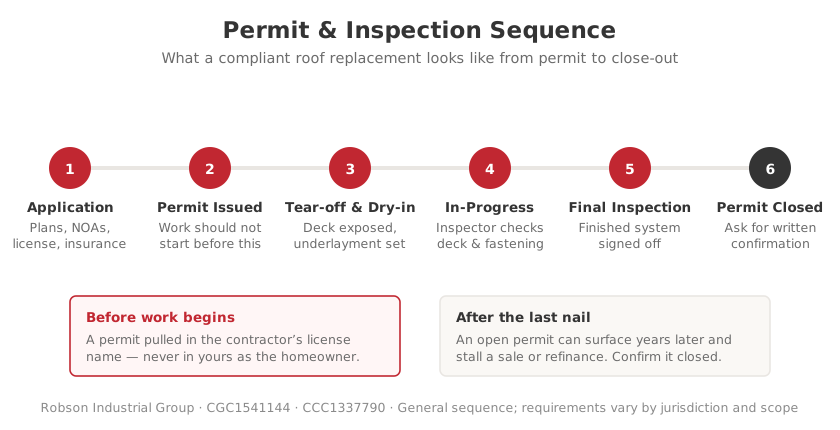
Design Review to Final Inspection: The Full Sequence in Coral Gables
- Property research: Contractor or architect confirms whether the property is individually designated, within a historic district, or subject to standard Board of Architects review
- Material and color selection: Tile profile, material, and color are chosen with both the design-review standard and Miami-Dade NOA availability in mind — the same decision has to satisfy both
- Design-review submittal: Roof plans, elevations, and material/color samples submitted to the Board of Architects or Historic Preservation staff, as applicable
- Design-review approval: Staff-level approval for straightforward in-kind work, or a full Board/Historic Preservation Board hearing for material, color, or profile changes
- Building permit application: Submitted through the CSS portal with NOA documentation once design review has cleared
- Permit issued: Building Division reviews and issues the permit, typically 7–15 business days for a minor residential reroof
- Tear-off and deck inspection: Existing roofing removed; inspector verifies deck condition, thickness, and structural capacity for the approved tile weight before new materials go down
- Installation: New underlayment, flashing, and tile or field materials installed to NOA specifications and matching the approved design-review submittal exactly
- Final inspection and closeout: Building Division verifies the completed roof matches the permit and NOA specs; if design review conditions were attached, those are verified as well
Common Roof Types on Coral Gables Homes
Because Coral Gables spans a century of construction under a consistent architectural code, the roofing material on any given property is more predictable than in a newer subdivision, but the review path and matching complexity vary by type:
| Roof Type | Common On | Key Consideration in Coral Gables |
|---|---|---|
| Clay or concrete barrel tile | The overwhelming majority of Mediterranean Revival homes across the city, especially in the historic core | Color and profile must fall within approved earth tones; partial matches on original homes are the highest-risk submittals |
| Flat concrete tile | Mid-century and later homes, and some flatter roof sections on larger properties | Still subject to material and color review; NOA rating required same as barrel tile |
| Dimensional asphalt shingle | Some non-designated properties and interior sections not visible from the public right-of-way | More likely to require a case-by-case design-review conversation given the city's strong preference for tile on primary rooflines |
| Standing-seam or flat metal | Porch covers, additions, and accent sections on remodeled homes | Needs its own transition flashing detail where it meets tile, and its own design-review sign-off for visibility from the street |
Roofing and Impact Windows: Historic-Compatible Material Options
A Coral Gables project rarely stops at the roof. Homeowners restoring or upgrading a Mediterranean Revival property are frequently weighing impact windows and doors at the same time, and the same design tension applies: HVHZ wind-borne-debris code demands impact-rated glazing, while the Board of Architects and historic-district standards care about how that glazing reads on a 1920s facade.
- Roofing: Miami-Dade NOA-rated clay or concrete barrel tile in approved earth tones is the default correct answer for a primary Coral Gables roofline; a manufacturer-tested tile attachment system (mechanically fastened, foam-adhesive-set, or hybrid) is what actually earns the wind rating, not the tile shape alone.
- Impact windows: True-divided-lite and simulated-divided-lite impact window profiles are built specifically to replicate the multi-pane, narrow-muntin look of original 1920s window sash while meeting current wind-borne-debris code — a detail that matters directly to Board of Architects and historic-preservation review.
- Impact doors and shutter-style hardware: Colonial-bar impact glass doors and impact-rated Bahama-style or colonial shutter hardware allow a home to keep its period street presence while adding a code-compliant layer of wind protection.
- Color and finish coordination: Window frame color and roofing tile tone are both evaluated as part of the same overall streetscape impression during design review — treating them as a single coordinated material decision, rather than two separate contracts, avoids a mismatched result the Board is more likely to flag.
Robson Industrial Group handles roofing and impact window/door installation as coordinated scopes on Coral Gables projects specifically because the design-review conversation for both is the same conversation.
What a Robson Estimate for a Coral Gables Home Includes
A written estimate from Robson Industrial Group for a Coral Gables roofing project accounts for the design-review path, not just the square footage. Every estimate includes:
- Historic-designation research — confirming whether your property is individually designated, within a historic district, or subject to standard Board of Architects review, before we specify materials
- Material specification with Miami-Dade NOA numbers — exact manufacturer, tile profile, and NOA rating for HVHZ compliance, chosen with design-review approval odds in mind
- Tile-matching assessment on partial reroofs — a stated plan for sourcing, blending, or making the case for full replacement when an exact profile match is not available
- Structural load verification — confirming the existing deck and framing can carry the approved tile weight before that tile is submitted for design review
- Design-review submittal support — roof plans, elevations, and physical material/color samples prepared for the Board of Architects or Historic Preservation staff
- HVHZ fastener and underlayment spec — ring-shank nail gauge, 6-nail pattern or tested tile attachment system, and SBS underlayment called out explicitly
- Permit coordination — City of Coral Gables building permit pulled in Robson’s name through the CSS portal, sequenced correctly after design-review approval
- Written manufacturer and workmanship warranty terms — years and coverage spelled out, not “standard warranty applies”
If a competing estimate for your Coral Gables home does not mention the Board of Architects or Certificate of Appropriateness process at all, ask why before you sign. It is the single most common place a Coral Gables project stalls or gets sent back for revision.
GAF Certified™ Roofing and the System Plus Warranty
Robson Industrial Group is a GAF Certified™ Residential Roofing Contractor (GAF ID: 1164276). This certification requires meeting GAF’s standards for licensing, insurance, and installation training. It is not self-awarded. The practical benefit for Coral Gables homeowners on qualifying installations is access to the GAF System Plus Limited Warranty, which extends coverage beyond the standard product warranty to the entire roofing system: underlayment, starter strips, ridge details, ventilation, and installation workmanship, when qualifying GAF accessories are installed.
On a Coral Gables home where the roof also has to satisfy design review, system-level warranty coverage on the shingle or accent-roof sections adds a layer of protection that a single-product warranty does not. Ask your contractor specifically whether they are a GAF Certified™ Residential Roofing Contractor (not a “GAF preferred” installer, which is a marketing term, not a certification). Verify the GAF ID at gaf.com/en-us/roofing-contractors.
9 Red Flags When Hiring a Roofer in Coral Gables
- No DBPR license number provided, or a license number that does not match the contractor’s name on myfloridalicense.com
- No mention of Board of Architects or Certificate of Appropriateness review in the written estimate — on a Coral Gables property, this is the single most common source of a stalled or rejected project
- Quoting a tile color or profile without physical samples — a catalog number alone is not enough to predict what the Board will approve
- Cash-only or 100%-upfront payment demands — Florida law allows a reasonable deposit; full payment before materials are delivered is a red flag
- Offering to waive your insurance deductible — this is insurance fraud under Florida law (FL §817.234)
- Suggesting the design-review step can be skipped — any contractor who proposes working around Board of Architects or Historic Preservation review is either unfamiliar with Coral Gables or cutting corners that will surface later
- Materials quoted without Miami-Dade NOA numbers — NOA numbers are public and should appear on every roofing proposal for an HVHZ property
- Assignment of Benefits (AOB) demand before work begins — signing an AOB transfers your insurance claim rights to the contractor; never sign without your attorney reviewing
- No written warranty covering both materials and installation — labor warranties under 2 years on a full re-roof are inadequate
Proposal Checklist for Coral Gables Homeowners
Before signing any roofing contract in Coral Gables, verify all of these are in writing:
| Item | What to Look For |
|---|---|
| Contractor license numbers | CGC or CCC number matching myfloridalicense.com |
| Insurance certificates | General liability ($1M+ per occurrence) + workers’ compensation certificate of insurance (COI) naming your address |
| Historic-designation confirmation | Written confirmation of whether your property requires BOA or COA review, and which one |
| Material NOA numbers | Miami-Dade Notice of Acceptance number for tile or shingles, underlayment, and accessories |
| Tile-matching plan | Explicit plan for color/profile matching on any partial reroof, including a fallback if exact match is unavailable |
| Structural load verification | Written confirmation the deck and framing were checked before the tile decision was finalized |
| Design-review submittal scope | Confirmation the contractor will prepare or support the BOA/COA submittal package, not just the building permit |
| Fastener & underlayment spec | Ring-shank nail gauge, fastening pattern or tested tile attachment system, and SBS underlayment called out by name |
| Payment schedule | Reasonable deposit at contract, progress payment at material delivery, final at approved close-out |
| Warranty terms | Manufacturer product warranty (years) + labor/installation warranty (years) in writing |
EPA Lead-Safe Rules: What They Require of Your Contractor on a Pre-1978 Coral Gables Home
Federal law does not put the burden on you to know whether your Coral Gables home might contain lead-based paint. It puts the burden on the contractor. This matters more in Coral Gables than in most Miami-Dade cities simply because of the age of the housing stock: the city was largely built out between the 1920s and the 1950s, decades before the 1978 cutoff, which means a large share of the very homes most likely to fall under Board of Architects or historic-district review are also pre-1978 properties.
The rule itself is straightforward. If your property was built before 1978, EPA’s Renovation, Repair & Painting (RRP) Rule requires whoever disturbs painted surfaces during a roofing project, including old fascia, soffits, barge boards, and trim around roof penetrations, to be an EPA-certified renovation firm using lead-safe containment and cleanup practices during demolition and tear-off. This applies regardless of whether the home is individually designated historic or simply old; the trigger is the construction date, not the designation status.
Before hiring anyone to work on a pre-1978 Coral Gables home, verify their EPA RRP certification number directly with the EPA. A legitimate contractor provides it without hesitation. Robson’s number is #NAT-F338229-1, expires 6/23/2031. Certified only for purposes of Section 402 of TSCA.
Frequently Asked Questions
Ready to Start Your Coral Gables Roofing Project?
Licensed · CGC1541144 · CCC1337790 · GAF Certified™ (ID: 1164276) · EPA RRP Certified
Get Your Free EstimateCGC1541144 CCC1337790 GAF ID: 1164276 Robson Industrial Group LLC · 7290 NW 7th St, Unit 105, Miami, FL 33126 · (954) 546-4161 · sales@robsonindustrial.com
Roofing work in Coral Gables?
This guide covers the permitting and inspection process. For what we actually do in Coral Gables (roof replacement, repairs, impact windows and doors) see our Coral Gables service area page.
Get a free estimate or call (954) 546-4161
Nearby city guides: Pinecrest Roofing Contractor Guide · Kendall Roofing Contractor Guide · Key Biscayne Roofing Contractor Guide