Licensed Roofing Contractor in Miami Beach
Flat roof replacement, tile reroof, and commercial roofing for condos, HOAs, and homeowners throughout Miami Beach. Florida-licensed, HVHZ-compliant, GAF-Certified™. CGC1541144 · CCC1337790.
Miami-Dade Product Approvals (NOA)
System Plus Limited Warranty Available
HOA & Commercial Ready
Roofing Contractor Serving Miami Beach, FL
Miami Beach has a building stock unlike anywhere else in Florida. Art Deco and mid-century flat-roof condos, luxury single-family homes with barrel tile, and a coastal environment that accelerates roof deterioration at a rate most inland contractors are not prepared for. Salt spray, HVHZ wind loads, and extreme UV exposure combine to make roofing in Miami Beach genuinely different work.
As a licensed general contractor AND licensed roofing contractor (both are required under Florida §489 for commercial and condo work), Robson works directly with HOA boards, property managers, and individual homeowners to assess, scope, permit, and complete roofing projects to code. Every project uses only Miami-Dade NOA-approved materials, and every permit is pulled in our name, not yours.
We closed a commercial roofing project in Miami Beach in July 2026. We know this market, its building types, and its permit process.
Roofing Services in Miami Beach
TPO & Modified Bitumen
Commercial and low-slope residential flat roof replacement. The standard system for mid-century Miami Beach buildings and condo rooftops. 60-mil TPO preferred for coastal durability and HVHZ wind-uplift resistance.
Learn more →Barrel & Concrete Tile Reroof
Complete tile removal, re-deck inspection, and reroof using NOA-approved Florida product systems. Matching tile sourcing, stainless flashings for coastal properties, and full permit packages.
Get an estimate →Standing Seam & Metal Panels
Long-life metal roofing for residential and light commercial. Kynar-coated finishes specified for coastal salt resistance. Wind-resistant, low-maintenance, and fully compliant with Miami-Dade HVHZ codes.
Get an estimate →Condo & HOA Roofing
Board-ready condition reports, reserve study documentation, multi-unit coordination, and references from comparable projects. We work within HOA approval timelines and attend board meetings on request.
Commercial roofing →Roof Assessment & Condition Report
Written condition assessment for HOA boards, property managers, and real estate transactions. NOA-compliance status, drainage findings, and reserve-study-formatted reports available.
Get a report →Storm Damage & Emergency Tarping
Post-hurricane emergency response for Miami Beach properties. Temporary tarping, photo damage documentation, and insurance adjuster coordination during active storm season.
Contact us →Why Roofing in Miami Beach Requires a Specialist
Most roofing contractors work in standard conditions. Miami Beach combines six factors that change how roofing must be specified, installed, and permitted. These are not suggestions. Local inspectors enforce all of them.
HVHZ — The Strictest Building Code in the Country
Miami-Dade County is classified as a High-Velocity Hurricane Zone (HVHZ) — one of only two counties in the United States with this designation, along with Broward. Every roofing product installed must carry a Miami-Dade Notice of Acceptance (NOA). The specific shingle, membrane, underlayment, and fastener pattern all have to appear on an approved NOA document. Installing a non-NOA product is a permit failure, an insurance void, and a code violation. Robson only specs and installs NOA-compliant systems, and we can show you the product approval sheet before work begins.
Dual Licensing Required by Florida Law
Florida §489 requires that a contractor hold BOTH a Certified General Contractor license (CGC) AND a Certified Roofing Contractor license (CCC) to perform re-roofing on most commercial buildings, condominiums, and multi-family structures. Many contractors hold only one. If your building is a condo or commercial property, a contractor with only a CCC may be operating outside their license scope. Robson holds both: CGC1541144 and CCC1337790. Always verify at myfloridalicense.com before signing any contract.
Coastal Salt-Spray Zone
Miami Beach is effectively 100% within the coastal salt-spray zone. Nearly the entire island sits within 1,000 feet of the Atlantic Ocean or Biscayne Bay. Salt spray accelerates corrosion of metal components, degrades sealants and caulking faster, and attacks flashing details that last 20 years inland but fail in 8 to 10 years beachside. Product selection matters more here: Kynar-coated (PVDF) metal finishes over bare galvanized, factory-welded TPO seams over field-applied adhesives, and stainless or hot-dipped galvanized fasteners instead of standard zinc-plated hardware.
Historic District Considerations
The South Beach Historic District covers most of South Beach from 5th Street to 23rd Street and is governed by the Miami Beach Historic Preservation Board (MBHPB). For roofing work not visible from the street, which is the large majority of projects, a standard building permit is sufficient. However, any work that modifies the building's roofline profile, parapet height, or other visible elements may require a Certificate of Appropriateness from the MBHPB. We assess this during the initial scope review so there are no surprises during permitting.
Condo & HOA Access Logistics
Miami Beach buildings, especially the condo towers on Collins Avenue, Indian Creek Drive, and the mid-rise buildings on West Avenue, present logistics that do not exist on a standard residential job. Crane access may require street permits from the City of Miami Beach. Material staging must coordinate with underground parking access. Resident notification and elevator scheduling are required. Work windows may be limited by HOA quiet hours. Robson coordinates all of this. We have worked in multi-tenant Miami Beach buildings and understand the process.
Hurricane Season Preparation and Compliance
Hurricane season runs June through November. In Miami Beach's HVHZ, a roof that does not meet current NOA wind-uplift requirements is not just a maintenance concern — it is a liability and insurance exposure. We assess uplift compliance as part of every condition report and can advise on whether your current roof meets current code or would fail inspection if triggered by storm damage. Post-storm assessments and emergency tarping are also available during active hurricane events.
Miami Beach Neighborhoods We Serve
Miami Beach is not one building type. It is three distinct neighborhoods, each with different construction eras, building profiles, and roofing challenges. We serve all of them, plus the municipalities immediately to the north.
South Beach (33139) — Art Deco and Pre-1970 Flat Roof Buildings
South Beach's Art Deco Historic District runs from 5th Street to 23rd Street and contains most of the island's iconic 1930s through 1950s architecture. These buildings are almost universally flat-roofed, often with decorative parapets that trap water and create ponding drainage issues. Original built-up roofing from the 1970s through 1990s is reaching end of life on many of these structures. Modern replacement systems, typically TPO or modified bitumen, must be flat in appearance to comply with historic preservation guidelines. We have experience navigating both the MBHPB and the Miami Beach Building Department permit process for these buildings.
Mid-Beach (33140) — High-Rise Condos and Mid-Century Modern
The stretch along Collins Avenue from 23rd Street to 63rd Street is dominated by high-rise condominiums, many built in the 1960s and 1970s. These buildings have flat roofs with mechanical penthouse levels, and roofing replacements here require crane coordination, elevator access management, and HOA board approval processes. Many of these associations operate under Florida Statute §718 reserve study requirements and are planning for major capital improvement projects. Robson provides board-ready condition reports and phased project planning for these situations.
North Beach (33141) — Single-Family and Older Residential
North Beach contains the most traditional residential building stock in Miami Beach — single-family homes, duplexes, and smaller apartment buildings from the 1950s through 1980s. Many properties here have original barrel tile or concrete S-tile roofs at or near the end of their service life. We assess deck condition, tile attachment method, and dry-in condition on every North Beach project. Older tile roofs frequently have degraded underlayment that needs to be replaced regardless of the tile condition above.
Surfside, Bal Harbour, and Bay Harbor Islands
While technically separate municipalities, these communities immediately north of Miami Beach share the same HVHZ designation, similar building types, and the same demanding coastal exposure. We serve Surfside (33154), Bal Harbour (33154), and Bay Harbor Islands (33154) under the same licensed and compliant approach: same NOA requirements, same permit process, same quality standard.
Working With HOA Boards and Property Managers in Miami Beach
Condo association roofing projects are not like residential jobs. The decision-making process involves multiple stakeholders, statutory reserve requirements, procurement rules, and often a formal board vote before a single contract can be signed. We have worked within this process and understand what associations need from a roofing contractor.
Florida Statute §718 — What It Means for Your Roof
Florida's Condominium Act (§718.112) requires that associations of buildings three stories or higher conduct reserve studies and fund reserves for major capital components. Roofs are among the specifically listed items. A condition report from a licensed contractor is often the starting point for both reserve study updates and the board's decision to initiate a replacement project. Robson provides written condition assessments that include current condition rating on a 1 to 10 scale, estimated remaining life, and a detailed projected scope and cost for replacement.
The HOA Roofing Decision Process
Most condo associations follow a predictable sequence: a visible problem or routine inspection triggers a condition assessment request; the board reviews the assessment and votes to solicit bids; multiple licensed contractors submit proposals; the board votes on a contractor and approves funding through reserves or a special assessment; the project is scheduled to minimize disruption to residents. This process typically takes 4 to 12 weeks from initial assessment to contract signing.
Robson aligns with this process. We do not pressure HOA boards. We provide all the documentation needed for a board presentation: condition report, NOA-documented scope, insurance certificates, license verification, and project references. And we are prepared to attend a board meeting to answer questions directly from the board and residents.
What We Provide for HOA and Property Manager Clients
Choosing the Right Roofing Material for Miami Beach
Material selection in Miami Beach is not just about aesthetics or budget. Coastal salt exposure, HVHZ wind loads, and the specific characteristics of your building all affect which system will actually perform over 20 to 50 years. Here is how each major roofing type holds up in this specific environment.
Flat Roofs — TPO and Modified Bitumen
The dominant system on South and Mid-Beach buildings. For coastal Miami Beach, 60-mil TPO is strongly preferred over 45-mil. The thicker membrane provides better puncture resistance and longer seam life in UV-intense conditions. Factory-welded seams outperform field-applied adhesives in wind-uplift tests, which matters in the HVHZ. Modified bitumen with an APP or SBS cap sheet is a proven alternative and performs well. Both systems must carry a Miami-Dade NOA. Proper drainage design is critical — Miami Beach flat roofs with inadequate slope or blocked drains are the most common source of interior water damage. We evaluate drainage as part of every flat roof assessment.
Tile — Concrete and Clay
Tile is the best long-term performer in salt-spray coastal environments because the tile material itself does not corrode. Concrete tile is more common in South Florida and generally costs less than clay. Clay tile offers a more traditional appearance and slightly lower weight. The critical details for coastal tile performance are the underlayment system and the metal flashings. Two-layer underlayment is required by Florida code. Coastal and oceanfront properties should specify stainless steel or hot-dipped galvanized flashings, because standard galvanized corrodes within 8 to 12 years in a salt environment. Any re-tile project that skips full underlayment replacement is cutting a critical corner. The underlayment is what keeps water out of the structure; the tile above it is the protective layer that makes the underlayment last.
Metal Roofing
Metal is an excellent choice for Miami Beach if the right finish is specified. Kynar 500 (PVDF) coated steel or aluminum dramatically outperforms standard galvanized finishes in coastal environments. Galvanized steel without a quality finish coating can begin surface corrosion within 3 to 5 years in oceanfront conditions. Standing-seam systems outperform exposed-fastener panels because there is no exposed fastener to corrode or allow water infiltration. Aluminum substrate is naturally corrosion-resistant and is an excellent choice for high-salt-exposure properties. We specify the finish and substrate appropriate for your building's distance from the ocean and the project's budget.
Asphalt Shingle
Shingle is viable for North Beach single-family homes where the building profile and budget support it. In the HVHZ, standard 3-tab shingles are not acceptable. Dimensional architectural shingles with a minimum 130 mph wind rating and a Miami-Dade NOA are required. Life expectancy in coastal South Florida is 18 to 22 years, shorter than rated lifespans in cooler climates due to heat cycling and UV intensity. For oceanfront or bay-front properties, tile or metal is a better long-term choice because shingles are more susceptible to salt degradation than tile or properly coated metal systems.
How a Miami Beach Roofing Project Works
1. Free Roof Assessment
We inspect the roof, note existing conditions, measure square footage, check drainage slope and outlet points, identify any NOA compliance issues with the current system, and look for deck damage. We photograph everything. You get a written report with findings and recommended action.
2. Scope & Permit Package
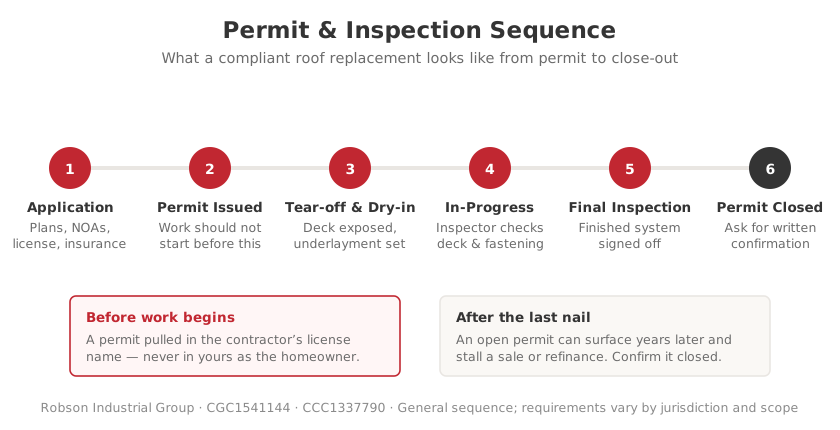
We prepare a full scope of work with NOA-approved materials specified by name and approval number. We submit the permit application to the City of Miami Beach Building Department (or Miami-Dade Building for properties in unincorporated Miami-Dade) and track it through to approval.
3. Pre-Project Coordination
For HOA and condo projects: resident notification letters, parking coordination, crane staging permits if needed, and material delivery scheduling around building access rules. For all projects: a written project schedule before we show up with a crew.
4. Installation
Licensed crew, NOA-compliant products with product approval sheets on-site, daily cleanup, and structured debris removal. Required building department mid-project inspections coordinated by us, not by you.
5. Final Inspection & Closeout
We pass final inspection with the building department and provide you with the signed inspection card, warranty documentation, and product NOA records. For qualifying GAF projects, we register the System Plus Limited Warranty in your name.
Frequently Asked Questions — Miami Beach Roofing
Do I need a licensed roofing contractor for my Miami Beach condo?
How much does a flat roof replacement cost in Miami Beach?
How long does a TPO flat roof last in Miami Beach?
Can Robson provide a condition report for our HOA reserve study?
What is a Miami-Dade Notice of Acceptance (NOA)?
Does Robson do roofing work for homeowners in Miami Beach or only commercial?
Is Robson GAF-certified?
What roofing material holds up best in Miami Beach's coastal environment?
How does the Miami Beach Building Department permitting process work?
Our HOA board needs multiple bids. What should we ask each contractor?
How long does a Miami Beach roof replacement take?
Can Robson work on buildings in the Miami Beach Historic District?
Related Resources
Commercial Roofing
Flat, TPO, and metal roofing for condo associations, property managers, and commercial building owners throughout South Florida.
Commercial Roofing →Roof Replacement Cost Miami 2026
Real price ranges for shingle, metal, and tile. What drives cost, what cuts corners, and how to finance a roof replacement in Miami-Dade.
Read the guide →Verify Our Licenses
CGC1541144 and CCC1337790: confirm both licenses are active at Florida DBPR before signing any roofing contract in Miami Beach.
Check DBPR →Get a Free Roofing Estimate in Miami Beach
No pressure, no obligation, just an honest assessment of your roof, a clear NOA-documented scope of work, and a licensed contractor who knows Miami Beach's code requirements, its building types, and its permit process. CGC1541144 · CCC1337790 · HVHZ-compliant · GAF-Certified™.
Request your free Miami Beach estimate
Or call us directly: (954) 546-4161 · CGC1541144 · CCC1337790