Pembroke Pines has grown into one of Broward County’s largest cities, and a significant share of its housing stock was built in the 1980s and 1990s, when concrete tile roofs were standard. That means tens of thousands of homes now have roofs approaching or past their expected lifespan. When a roof needs replacing, the contractor decisions homeowners make in the next few weeks will affect their home’s structural integrity, their insurance premium, and their family’s safety for the next 30 years.
This guide explains how to verify a contractor’s license, what Broward County permit requirements apply to your project, how your new roof can lower your insurance premium, and the red flags that signal an unlicensed or unqualified contractor. It is written by Robson Industrial Group, a Florida Certified Roofing Contractor (CCC1337790) and Certified General Contractor (CGC1541144) serving Pembroke Pines and the greater South Florida area.
Why Contractor Selection Matters More in Pembroke Pines
Pembroke Pines sits in Broward County, and the Florida Building Code defines the High-Velocity Hurricane Zone (HVHZ) as Miami-Dade and Broward counties in their entirety, so Pembroke Pines is in the HVHZ. Roofing systems are designed to HVHZ design wind speeds, roughly 170 mph and up (ASCE 7 Risk Category II), and must be installed per an HVHZ product approval: a Miami-Dade NOA or a Florida Product Approval whose evaluation specifically covers the HVHZ. A single missed fastener or incorrect underlayment can void an insurance wind mitigation discount worth hundreds of dollars per year.
Additionally, Pembroke Pines is served by two permit authorities depending on your specific address: the City of Pembroke Pines Building Division and, for certain unincorporated areas, the Broward County Permitting, Licensing and Consumer Protection Division. A contractor who does not know which authority governs your address will cause permit delays and potentially a failed inspection.
Pembroke Pines by Neighborhood: Newer Construction, Different Roofing Questions
Unlike some of the older cities in Miami-Dade, most of Pembroke Pines was built out from the 1980s through the 2000s as large, master-planned communities, which changes the questions worth asking before you hire a roofer.
- Chapel Trail, on the city's west side, sits adjacent to the 450-acre Chapel Trail Nature Preserve wetland. Homes here back up to a genuine Everglades-edge wetland system, which means gutters and valleys collect more organic debris (leaf litter, seed pods, insect activity) than roofs further from the preserve — a maintenance factor worth asking your contractor about when they inspect valleys and drains.
- Pembroke Falls is a gated, master-planned community built around stocked lakes and an 18,000-square-foot clubhouse. Nearly every home here falls under HOA architectural review, which typically restricts tile color, profile, and sometimes manufacturer — get your HOA's approved roofing materials list before your contractor finalizes a proposal, not after.
- Silver Lakes is actually an umbrella of roughly 39 individual communities, some gated and some not, built primarily through the 1990s and 2000s. Concrete tile dominates, and a large share of that original tile stock is now 25–35 years old — approaching or past the point where underlayment failure, not the tile, becomes the deciding factor in a replace-versus-repair decision.
Why Western Pembroke Pines Roofs Face Different Conditions Than the Rest of Broward
Much of western Pembroke Pines, including Chapel Trail and the Silver Lakes communities, was reclaimed from Everglades wetland and built out with an extensive canal and lake network (part of the South Florida Water Management District's C-11 canal basin) engineered specifically to manage stormwater runoff for these newer developments. That network keeps flooding in check at ground level, but it also means many homes sit directly adjacent to open water, which increases humidity exposure and accelerates algae and moss growth on concrete tile: the dark streaking you see on older tile roofs throughout these communities. Left untreated, that growth holds moisture against the tile surface and shortens the underlayment's service life even when the tile itself looks structurally sound.
The other factor specific to Pembroke Pines' newer, more open western developments is wind exposure: with less mature tree canopy and lower-density construction than older, more established neighborhoods, roofs here can see more direct wind loading during tropical storms. This is part of why the HVHZ design wind speeds and product-approval fastening requirements are not just a code formality in this part of the county. They reflect a real, measurable exposure difference.
Florida Roofing Contractor License Types
Before you accept a single proposal, verify that the contractor holds an active Florida state license. Roofing is its own licensed trade: the CCC is what authorizes roofing work and pulls the roofing permit on any structure, and a general contractor without a roofing license must subcontract the roof to a licensed roofer (F.S. 489.113(3)). There are three license types you’ll encounter:
| License Type | Issued By | Scope in Pembroke Pines |
|---|---|---|
| CCC — Certified Roofing Contractor | DBPR (state) | Roofing license valid statewide; the license of record for the roof and the roofing permit. Robson’s license: CCC1337790 |
| CGC — Certified General Contractor | DBPR (state) | General contracting valid statewide (structural, full-building scope); must subcontract the roof to a licensed roofer unless it also holds a roofing license. Robson’s license: CGC1541144, held alongside CCC1337790 |
| Registered Contractor | Local jurisdiction | Valid only in the county or city that issued it — NOT statewide |
Always ask for the CCC roofing license number. Registered contractors are permitted under FL §489.105 but their license does not cross county lines: a contractor licensed only in Miami-Dade cannot legally perform roofing work in Broward without additional registration. If your contractor has a registered license, verify that it was issued by Broward County or the City of Pembroke Pines, not another jurisdiction.
How to Verify Any Roofing License in 7 Steps
Verbal claims cost nothing. A license number costs nothing to fabricate. The only verification that matters is checking the state database directly:
- Go to myfloridalicense.com
- Click “Verify a License”
- Select “Contractor” from the profession dropdown
- Search by name or the license number the contractor gave you
- Confirm License Type (CCC for roofing; CGC for general scope), Status (Active), and Qualifier Name
- Note the Expiration Date — it must be current at time of contract signing and project completion
- Call the qualifier’s number on the license record to confirm they are the actual person running your job, not someone renting their credentials
Robson Industrial Group’s licenses can be verified at myfloridalicense.com: CCC1337790 and CGC1541144, Qualifier Francisco Rijo.
Broward County vs. City of Pembroke Pines: Which Permit Authority Applies?
This is one of the most common sources of delay on Pembroke Pines roofing projects. Whether you apply through the City or the County depends on whether your address is within the incorporated city limits:
| Jurisdiction | Authority | Address Confirmation |
|---|---|---|
| City of Pembroke Pines | City of Pembroke Pines Building & Development Review Division 601 City Center Way, Pembroke Pines, FL 33025 | Incorporated areas within city limits |
| Unincorporated Broward County | Broward County Permitting, Licensing and Consumer Protection Division 1 N University Dr, Plantation, FL 33324 | Areas not in city limits (check Broward’s GIS tool) |
Your contractor should confirm the correct authority before submitting the permit application. Applying to the wrong jurisdiction will result in rejection and project delays of weeks or more. A reliable contractor operating regularly in Pembroke Pines will know this distinction automatically.
Wind Speed Requirements and Product Approval in Broward County
Pembroke Pines is in the HVHZ: the Florida Building Code defines it as Miami-Dade and Broward counties in their entirety. Materials must carry an HVHZ product approval (a Miami-Dade NOA, or a Florida Product Approval whose evaluation specifically covers the HVHZ) for the applicable wind speed, exposure category, and building height. A plain statewide FL approval with no HVHZ listing does not pass plan review.
| Requirement | Broward County Standard |
|---|---|
| In the HVHZ? | Yes — Broward and Miami-Dade, both in their entirety |
| Wind Speed Design | HVHZ design speeds, roughly 170 mph and up (ASCE 7 Risk Category II); the exact figure for a parcel comes from the FBC wind-speed map |
| Product Approval System | HVHZ product approval — a Miami-Dade NOA, or an FL Product Approval with HVHZ listing; look for the NOA or FL# number on the product |
| Fastener Pattern | Per the product’s NOA or HVHZ-listed approval document; typically 6-nail pattern for tile |
| Underlayment | SBS-modified or equivalent per the approval; standard felt alone is often insufficient at HVHZ design speeds |
| Deck Inspection | Inspector verifies decking, fastener pattern, underlayment before covering |
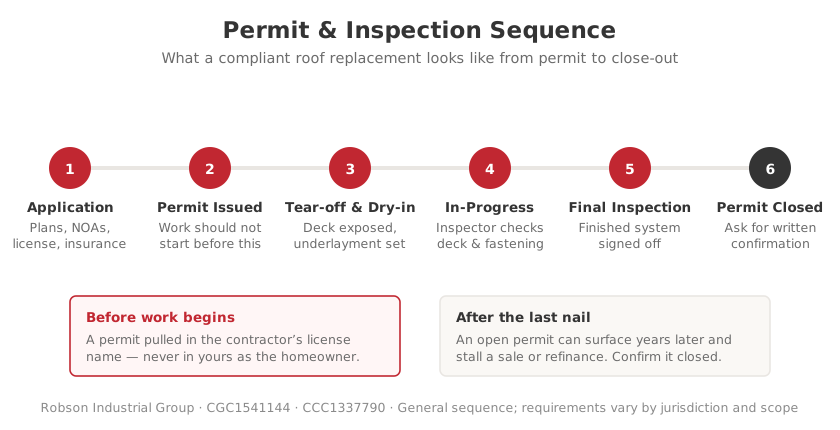
| Inspection Sequence | Permit issued → decking/framing inspection → underlayment/flashing inspection → final roof inspection |
Any contractor who uses materials without checking the HVHZ product approval for your specific wind zone is risking a failed inspection and potentially an insurance claim denial if storm damage occurs. Ask for the NOA or HVHZ-listed FL# number on every product they plan to use.
Wind Mitigation and Insurance Discounts After a New Roof
A new roof is your single best opportunity to lower your homeowner’s insurance premium. Florida insurers are required to recognize wind mitigation features documented by a licensed wind mitigation inspector after your new roof is installed. The items most likely to generate savings in Pembroke Pines include:
- Roof Covering — HVHZ-approved shingles or tile rated for the local wind speed
- Roof Deck Attachment — 6-nail pattern with appropriate fastener type earns maximum credit
- Roof-to-Wall Connection — single wraps, double wraps, or clips each earn different credit levels
- Roof Shape — hip roof earns a larger discount than gable in Broward
- Opening Protection — impact windows and doors or code-plus shutters
A properly installed roof with HVHZ-approved materials and documented nail patterns typically earns a 15% to 35% reduction in the wind portion of your homeowner’s insurance premium. For many Pembroke Pines homeowners paying $5,000–$10,000+ per year in insurance, this is a $750–$3,500 annual savings. Every year. Ask your contractor to confirm which credits your new installation will qualify for.
GAF-Certified™ Roofing for Pembroke Pines Homeowners
Robson Industrial Group is a GAF Certified™ Residential Roofing Contractor (GAF ID: 1164276). GAF Certification requires demonstrated installation quality and ongoing training standards beyond the base Florida license requirement. GAF Certified Residential Roofing contractors can register the GAF System Plus Limited Warranty (a GAF materials warranty backed by North America’s largest roofing manufacturer) only when installing qualifying GAF roofing systems. The GAF warranty covers GAF materials; workmanship is covered separately by Robson’s own written warranty, with the term stated in your contract.
For Pembroke Pines homeowners considering the long-term value of their roof investment, the manufacturer backing and quality standard GAF Certification represents is a meaningful differentiator from a contractor offering only the minimum warranty or no warranty at all.
What a Robson Estimate for a Pembroke Pines Home Includes
Given how much of Pembroke Pines falls under HOA architectural review, every written estimate from Robson Industrial Group starts by confirming what your community actually allows before pricing materials:
- HOA-compliant material check — we confirm your community's approved tile color, profile, and manufacturer list (Pembroke Falls, Chapel Trail, Silver Lakes, and other gated communities all maintain their own) before finalizing a proposal.
- Full deck and underlayment inspection, not just a tile-surface walk — important on Silver Lakes and Chapel Trail homes where original tile is now 25–35 years old.
- Itemized materials with HVHZ product approvals (NOA or HVHZ-listed FL#) for every layer: tile or shingle, underlayment, flashing.
- Permit line item priced separately, filed with the correct authority (City of Pembroke Pines or Broward County) based on your specific address.
- Written milestone payment schedule — never 100% upfront.
- Manufacturer and contractor workmanship warranty terms in writing, including GAF System Plus (GAF materials) eligibility on qualifying systems; workmanship is covered by Robson’s own written warranty.
Typical Roof Replacement Costs in Pembroke Pines (2026)
Prices below reflect licensed, permitted, fully insured work with HVHZ-approved materials. Quotes that come in dramatically below these ranges should be questioned carefully: they often indicate unlicensed labor, lower-grade materials, or a permit that will not be pulled.
| Roof Type | Typical Range (2,000 sq ft) | Notes |
|---|---|---|
| 3-tab asphalt shingles | $10,000 – $15,000 | Less common in Broward; shorter lifespan in South FL heat |
| Architectural (dimensional) asphalt | $13,000 – $20,000 | More wind-resistant; widely used |
| Concrete tile (flat or barrel) | $22,000 – $45,000 | Most common in Pembroke Pines; 50-year+ lifespan |
| Metal (standing-seam or 5V crimp) | $20,000 – $50,000 | Highest wind rating; growing in popularity |
| Flat/low-slope (TPO, modified bitumen) | $8,000 – $18,000 | Common on additions, sunrooms, garages |
Factors that adjust the final number: deck condition (rotted decking adds $1,000–$4,000+), tile underlayment upgrade (SBS vs standard), permit fees (typically $300–$800 in Broward), two-story access surcharge ($500–$1,500), and complexity of ridge, hip, and valley counts.
9 Contractor Fraud Types Active in Pembroke Pines
South Florida is consistently one of the highest-fraud roofing markets in the country. After any named storm or heavy rain season, the following schemes accelerate in Broward County:
| # | Scheme | What It Costs You |
|---|---|---|
| 1 | Storm chaser — out-of-state truck arrives same day as the storm, pressure-signs you before you have time to verify anything | Unlicensed work, voided insurance, no warranty |
| 2 | License rental — real license number but the actual crew is unlicensed | No liability, no recourse if work fails |
| 3 | No permit pulled — tells you “permit isn’t necessary for re-roofing” | Open permit risk on title; insurance claim denied at next storm |
| 4 | Assignment of Benefits (AOB) fraud — signs you up to assign insurance rights before assessing legitimate damage | Dispute with insurer, inflated claims, litigation risk |
| 5 | Unlicensed material substitution — quotes HVHZ-approved materials, installs cheaper non-approved product | Failed inspection, possible structural liability |
| 6 | Low-ball then add-on — bids $6,000 below market, discovers “damage” mid-job requiring $8,000 more | Held over a barrel mid-project with tarps on your roof |
| 7 | No workers’ comp — crew has no coverage; worker injured on your property triggers your homeowner liability | Personal lawsuit exposure |
| 8 | Subcontractor swap — you sign with one company, unknown subcontractors show up | Unknown licensing status, no accountability chain |
| 9 | Manufacturer label bait-and-switch — shows you shingle samples, installs different product | Shorter warranty, lower wind rating |
Proposal Checklist: What a Legitimate Contract Must Include
A complete, enforceable roofing proposal from a licensed Pembroke Pines contractor will include every item below. Missing items are not bureaucratic details: they are how contractors limit their own liability:
- Contractor’s full legal business name, license number (CCC for the roof; CGC if it also covers general scope), and qualifier name
- Certificate of Insurance (COI) with general liability and workers’ compensation — naming you as additional insured (ask any contractor for one and verify it with the insurer; Robson issues its certificate after the contract is signed, before work starts)
- Permit included in scope (contractor is responsible for pulling it)
- Specific manufacturer product names and HVHZ product approvals (NOA or HVHZ-listed FL#) for all materials
- Decking inspection scope — what triggers replacement and at what cost per sheet
- Fastener specifications: type, gauge, pattern (nail count per shingle or tile)
- Underlayment specification: SBS-modified vs. standard felt and the applicable NOA or HVHZ-listed FL# number
- Flashing scope: chimney, walls, skylights, valleys listed individually
- Warranty terms: manufacturer product warranty AND contractor labor warranty, duration and exclusions stated in writing
- Payment schedule tied to project milestones — never pay in full before work begins
Red Flags That Signal the Wrong Contractor
Any single one of these is reason to pause and require clarification before signing anything:
| Red Flag | Why It Matters |
|---|---|
| Cannot show an active CCC roofing license on DBPR (a company holding only a CGC must subcontract the roof — ask who the roofer of record is) | Working unlicensed — criminal violation in Florida |
| Asks you to pull the permit yourself | Contractors are legally responsible for permitting their own work |
| Offers to “leave the permit out” for a lower price | Unpermitted work creates title problems and insurance gaps |
| Pressure to sign “right now” to lock in price | Urgency is a manipulation tactic — prices don’t expire in hours |
| No workers’ compensation certificate available | You are the liable party if an uninsured worker is injured on your property |
| Proposal lists no NOA or HVHZ-listed FL# numbers | Cannot verify HVHZ compliance; opens door to material substitution |
| Tells you Pembroke Pines is “not HVHZ” or that plain statewide FL approval is enough | Broward is in the HVHZ in its entirety; a plain FL# without HVHZ listing fails plan review |
| Requires >30% deposit before permit is pulled | High deposit with no permit is a common advance-fee fraud structure |
| Out-of-state plates or no local track record | No accountability, no local permit history to check |
Financing
Financing may be available through third-party providers, subject to their approval and terms. Ask us for details.
If Your Pembroke Pines Home Predates 1978, Lead Paint Rules Apply to Your Roofer Too
Most of Pembroke Pines was built well after 1978, but pockets of older construction near the city's original core do predate it, and if yours is one of them, this matters more than homeowners realize. Disturbing painted trim, fascia, soffits, or siding during a roof replacement on a pre-1978 home triggers federal lead-safety obligations under the EPA's Renovation, Repair and Painting (RRP) Rule, whether or not the contractor mentions it. A contractor who is not EPA RRP certified and disturbs lead-based paint on a pre-1978 home is not just cutting a corner: they are exposing your household, and any children in it, to a real health risk, and exposing you to potential liability if the work is ever inspected. Robson Industrial Group holds EPA RRP certification #NAT-F338229-1 (expires 6/23/2031), certified only for purposes of Section 402 of TSCA. If your Pembroke Pines home was built before 1978, ask to see current EPA RRP certification before any contractor begins work. Do not take a verbal assurance.