Roofing · Contractor Guide · July 2026
Parkland Roof Replacement: HOA Architectural Review, New-Build Wind Code & Equestrian-Lot Access
Why a roof or impact-window project in Parkland runs through three gates most contractors only plan for one of: HOA architectural review, Broward's HVHZ wind code, and the acreage-lot access rules of the city's equestrian neighborhoods.
🇪🇸 Leer en EspañolParkland is one of the youngest, most tightly master-planned cities in Broward County, and also one of the few in South Florida that still has genuine acreage neighborhoods with horses in the backyard. That combination is unusual, and it changes how a roofing or impact-window project actually runs. In communities like Heron Bay or Parkland Golf & Country Club, an HOA Architectural Review Committee reviews your roof color and material before the city ever sees your permit application. A few miles away, in Pine Tree Estates or Cypress Head, there may be no HOA at all, but there is a barn, a paddock, and a driveway built for a horse trailer instead of a dumpster truck.
Most roofing guides written for “Broward County” or “South Florida” treat every city the same. Parkland does not work that way. This guide covers what the City of Parkland Building Division requires for a roofing or window permit, how HOA architectural review intersects with that permit, what Broward County's High Velocity Hurricane Zone (HVHZ) code demands of your materials, what changes between a newer-construction home and an older one when it comes time to reroof, and what to ask a contractor before you sign. Whether your address is behind a guard gate or at the end of a gravel drive.
Robson Industrial Group LLC holds Florida Certified General Contractor license CGC1541144 and Florida Certified Roofing Contractor license CCC1337790, both issued by DBPR with Francisco Rijo as the qualifying contractor. We are also a GAF Certified™ Residential Roofing Contractor (GAF ID: 1164276), which allows us to offer the GAF System Plus Limited Warranty on qualifying installations.
Get a Free Roofing or Impact-Window Estimate in Parkland
CGC1541144 · CCC1337790 · GAF Certified™ Residential Roofing (ID: 1164276)
Request Your Free EstimateWhy Roofing in Parkland Is Different
A Parkland homeowner is not choosing a contractor the same way someone in an older, unincorporated Broward neighborhood would. The variables that decide whether a project stays on schedule are specific to this city:
| Factor | Parkland Reality | What It Means for Your Project |
|---|---|---|
| HOA architectural review | Most master-planned communities (Heron Bay, Parkland Golf & Country Club, Parkland Isles, Miralago at Waterways, Watercrest) require ARC approval of roof material and color, and often window frame color, before work starts | ARC submittal has to be planned as its own step with its own timeline — not assumed to be a formality that happens after the contract is signed |
| HVHZ designation | Full Broward County HVHZ coverage under the Florida Building Code | HVHZ-rated materials, enhanced fastening, self-adhering underlayment, and minimum deck thickness are mandatory on every reroof, regardless of the home's age |
| Newer housing stock | Much of Parkland's single-family inventory was built from the late 1980s through the 2010s and 2020s, under multiple different Florida Building Code editions | A newer home is not automatically “done” when it comes to roofing code — the roof assembly itself still has to meet the code edition in effect at the time of your reroof permit |
| Equestrian-zoned acreage neighborhoods | Pine Tree Estates, Cypress Head, and Parkland Ranches include one-acre-plus lots, many with horses, barns, and unpaved or gravel access | Equipment staging, dumpster placement, and crew routing need a plan built around animals and outbuildings, not a standard suburban driveway |
| Mixed development eras within one city | Some sections of Parkland were platted decades before the master-planned boom of the 1990s and 2000s | Two homes a mile apart can have completely different permitting paths — one through an HOA ARC, one with no association oversight at all |
Parkland Communities We Serve
Parkland is not one roofing job repeated across a uniform grid. A tile reroof behind the guard gate at Heron Bay involves a different approval sequence than a shingle reroof on a one-acre lot in Pine Tree Estates. Treating every Parkland address the same is how a contractor misses the detail that determines whether a project clears HOA review, city permitting, and installation on schedule.
Heron Bay & Parkland Golf & Country Club
These two large, gated, master-planned communities anchor much of Parkland's newer housing stock, with homes built primarily from the late 1990s through the 2010s around golf courses, lakes, and clubhouse amenities. Both maintain active Architectural Review Committees that review roofing material, tile profile, and color against an approved list before the City ever sees a permit application, and both require a guard-gate coordination call ahead of any delivery or dumpster drop. Homes here tend to be newer, which means deck condition is rarely the surprise it can be in an older neighborhood, but discontinued tile profiles on original-construction homes from the community's earliest phases can still complicate a like-for-like match.
Parkland Isles, Cypress Cay & Miralago at Waterways
These gated, waterway-oriented communities combine the same ARC approval requirement with lakefront or canal-adjacent exposure, which adds corrosion considerations for metal flashing, fasteners, and any standing-seam accent roofing. Miralago at Waterways and similar newer-phase communities were built under more recent Florida Building Code editions, so the underlying structure often already reflects stronger wind-load engineering, but the roofing assembly on a reroof still has to be installed and permitted to the HVHZ code in effect at the time of the permit, not the code the home was originally built under. Access in these communities usually means a guard gate, sometimes narrower interior streets, and delivery windows that need to be scheduled around community rules.
Equestrian-Acreage Neighborhoods: Pine Tree Estates, Cypress Head & Parkland Ranches
Parkland was incorporated in 1963 as a deliberately rustic, low-density community, and its acreage neighborhoods are the clearest surviving link to that founding character. Pine Tree Estates offers roughly one-acre lots with deed provisions that allow horses and other livestock. Cypress Head is a gated enclave built around three-quarter-acre-plus lots surrounding a private lake. Parkland Ranches is another acreage subdivision in this same low-density character. None of these areas carry the same HOA architectural review burden as the golf-course communities, but all of them come with longer, sometimes unpaved driveways, active pastures, and structures (barns, run-in sheds, riding rings) that a standard staging plan does not anticipate. A contractor who has not worked an acreage lot in Parkland before will often underestimate how much longer equipment staging takes when there is livestock, footing, and fencing to protect.
Florida Roofing Contractor License Types
The Florida Department of Business & Professional Regulation (DBPR) issues the license categories relevant to roofing and window work anywhere in Parkland:
| License Type | Code | What They Can Do | Verify At |
|---|---|---|---|
| FL Certified General Contractor | CGC | All construction including roofing and window/door installation statewide | myfloridalicense.com |
| FL Certified Roofing Contractor | CCC | Roofing work only, statewide | myfloridalicense.com |
| FL Registered Contractor | Varies | Licensed by county/municipality — valid only in that jurisdiction | Broward County licensing office |
Robson Industrial Group holds both CGC1541144 and CCC1337790. State-certified licenses valid throughout Florida, including the City of Parkland and all of Broward County.
How to Verify a Florida Roofing License in 7 Steps
- Go to myfloridalicense.com and click “Verify a License”
- Select Department of Business & Professional Regulation
- Choose Contractor from the profession dropdown
- Enter the contractor’s license number (CGC, CCC, or registration number) and search
- Confirm the status is “Current, Active” — not Expired, Suspended, or Revoked
- Verify the name on the license matches the company name or qualifying contractor on your contract
- Check the license type covers the work you are hiring for (CGC covers all construction; CCC is roofing-specific)
Robson Industrial Group CGC1541144 verifiable at: myfloridalicense.com (CGC1541144). CCC1337790 verifiable at: myfloridalicense.com (CCC1337790).
HVHZ Requirements: What Broward County Demands in Parkland
Parkland sits entirely within Broward County, and Broward County falls fully inside the High Velocity Hurricane Zone (HVHZ) under the Florida Building Code: the same strict roofing standard that governs Miami-Dade. Roofing materials installed in Parkland must carry a valid product approval rated for HVHZ use.
| Requirement | HVHZ Standard (Applies to All of Parkland) |
|---|---|
| Product approval system | Florida Product Approval evaluated for HVHZ use, or a Miami-Dade Notice of Acceptance (NOA) — required for shingles, tile, underlayment, and accessories |
| Oversight body | Florida Building Commission product approval system, enforced locally by the City of Parkland Building Division |
| Secondary water barrier | Self-adhering polymer-modified bitumen sheet (ASTM D1970) required under all roof coverings |
| Deck fastening schedule | Enhanced pattern — commonly 8d ring-shank nails at 6″ o.c. panel edges, 12″ o.c. field, per the governing product approval |
| Shingle fastener pattern | 6-nail pattern per shingle required in high-wind applications |
| Minimum deck thickness | 19/32″ (0.59″) plywood or OSB decking minimum |
| Wind design speed | 170–180 mph design wind speeds depending on location within Broward County |
| Insurance inspection form | Standard Florida wind mitigation inspection form |
City of Parkland Roofing Permit Requirements
A building permit is required for all roofing work in Florida under FL Statute §553.79, and in Parkland it is enforced by the City's own Building Division. Parkland is an incorporated city with its own permitting authority, working alongside Broward County on projects that cross jurisdictional lines.
| Permit Detail | City of Parkland |
|---|---|
| Permit authority | City of Parkland Building Division |
| Location | Parkland City Hall, 6600 University Drive, Parkland, FL 33067 |
| Phone | (954) 753-5447 |
| Permit submission | My Government Online (MGO), or the joint City of Parkland / Broward County ePermits OneStop portal for projects touching both jurisdictions |
| Permit holder | Must be the licensed contractor (not the homeowner, not a subcontractor) |
| Product approval requirement | Florida Product Approval (HVHZ-rated) or Miami-Dade NOA number required for all roofing and impact-window materials |
| HOA coordination | Not required by the City, but required by most master-planned community governing documents before work begins |
| Inspections | Deck inspection (dry-in) + final inspection at minimum |
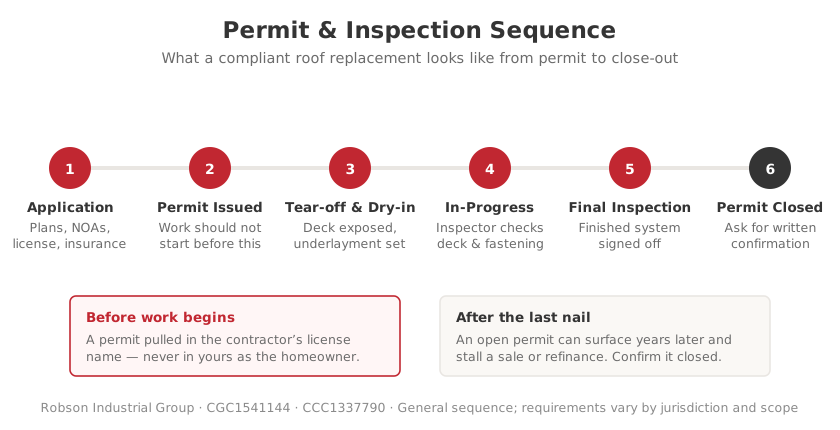
Permit-to-Inspection Sequence in Parkland
- Site walk and HOA check: Contractor evaluates the property, confirms whether an HOA governs the address, and identifies material and color options that are already on the community's approved list where one applies
- ARC submittal (if applicable): Contractor or homeowner submits material samples, color selection, and product specifications to the community's Architectural Review Committee for approval
- Material selection: Contractor specifies HVHZ-rated materials matching your roof type, pitch, and exposure, and confirms color/profile against ARC approval where required
- Permit application: Contractor submits the building permit application through MGO or ePermits OneStop, along with product approval documentation
- Permit issued: City of Parkland Building Division reviews and issues the permit; HVHZ plan review typically runs longer than in non-HVHZ jurisdictions
- Tear-off and deck inspection: Existing roofing removed; inspector verifies deck condition, thickness, and nail pattern before new materials go down
- Installation: New underlayment, flashing, and field materials installed to product-approval specifications, including the required fastening schedule and secondary water barrier
- Final inspection: Inspector verifies the completed roof matches the permit, product approval, and HVHZ code
- Certificate of Completion: Issued after passing final inspection; wind mitigation inspection can now be scheduled for the insurance credit
HOA Architectural Review: The Step Most Bids Miss
This is the section that most differentiates a Parkland roofing or window project from work in an unincorporated or non-HOA part of Broward County. Most of Parkland's best-known neighborhoods (Heron Bay, Parkland Golf & Country Club, Parkland Isles, Miralago at Waterways, Watercrest, and others) are governed by homeowners associations with an Architectural Review Committee (ARC) that has final say over exterior changes, and a roof or set of windows is one of the most visible exterior changes a home ever undergoes.
How ARC Approval Works Alongside Your City Permit
ARC approval and the City of Parkland building permit are two separate processes run by two separate authorities, and they do not automatically talk to each other. The City does not require proof of HOA approval to issue a roofing permit, and the HOA does not issue building permits, which means it is entirely possible to pull a valid City permit and still be in violation of your community's governing documents if you started work before ARC sign-off. The sequence that avoids problems: submit your material and color selection to the ARC first, wait for written approval, then submit the City permit application referencing that approval, then schedule work. A contractor unfamiliar with Parkland's HOA landscape will sometimes skip straight to the City permit and start work the moment it is issued, which is the single most common cause of HOA violation notices on Parkland reroofs.
Approved Materials & Color Lists
Most Parkland master-planned communities maintain a defined list of approved roofing colors and, in some cases, approved tile profiles or manufacturers, adopted to keep rooflines visually consistent across the community. Some communities also regulate impact-window frame color and, less commonly, glass tint. Before your contractor orders material, confirm the exact color and profile against your community's current approved list: not a list from a few years ago, since these lists are periodically updated. Ordering material that turns out not to match the current approved list is an expensive mistake to discover after installation.
Timeline Impact — Building In the Extra Review Window
ARC review typically adds one to three weeks ahead of the City permit application, depending on the community's board meeting schedule and whether your submittal is complete on the first pass. Incomplete submittals (missing color samples, missing manufacturer spec sheets) are the most common reason an ARC review takes longer than expected. A Parkland-experienced contractor builds this window into your project timeline from the first conversation, rather than treating it as a surprise delay discovered mid-project.
New Construction, Newer Code Cycles & What Changes on a Reroof
Why “Built to Code” Doesn’t Mean “Built to Today’s Code”
A meaningful share of Parkland's housing stock is newer than the South Florida average. Much of it built from the late 1980s through the 2020s, spanning several different editions of the Florida Building Code as wind-load standards were tightened after major storms. That has a real benefit: a home built under a more recent code edition typically started life with stronger roof-to-wall connections and structural wind-load engineering than an older home in an unincorporated part of the county. But that structural baseline is not the same thing as your roof covering meeting current code. Shingles, tile, underlayment, and flashing all wear out on their own schedule, unrelated to how the structure underneath was engineered, and when they are replaced, the replacement has to meet the HVHZ product approval and fastening requirements in effect at the time of the reroof permit: not the code the home was originally built under.
Reroofing vs. New Build: What Must Meet Current HVHZ Standards
On a new-construction home, the roof assembly is engineered and permitted as part of the original build under whatever code edition was current at the time. On a reroof of an existing home, regardless of the home's age, the roofing permit is a standalone permit reviewed against the current code edition. In practice this means a 2016-built Heron Bay home getting a reroof in 2026 needs materials and fastening that meet 2026 HVHZ product approval standards, even though the home itself was built to an earlier code cycle. Ask your contractor directly whether the products they are quoting carry current product approval documentation, and ask to see the approval number before you sign: not after material is delivered.
Equestrian-Zoned Lots & Barn/Paddock Access
Parkland's founding character was rustic and low-density, and its acreage neighborhoods (Pine Tree Estates, Cypress Head, and Parkland Ranches among them) are where that character is still most visible today. These are typically one-acre-plus lots, some with deed provisions specifically allowing horses and other livestock, and many with an active equestrian use: a barn, a run-in shed, a riding ring, or open pasture. None of this changes the HVHZ code that applies to your roof, but it changes almost everything about how the job is staged and executed.
- Animal safety and routing — delivery trucks, dumpsters, and equipment need a route and staging plan that keeps noise and activity away from paddocks and stalls, ideally coordinated with the homeowner around feeding and turnout schedules
- Footing and fencing protection — heavy equipment on pasture or unpaved ground can damage footing that matters for horse soundness; fencing and gates need to be identified and protected or temporarily secured before staging begins
- Long or unpaved driveways — some acreage lots have driveways longer than a standard suburban lot's entire street frontage, and not all are fully paved, which affects delivery truck access and dumpster placement
- Outbuildings on the same property — barns and run-in sheds sometimes have their own roofing that may be part of the same project scope, with different structural and material considerations than the main house
- No HOA architectural review, but no less planning required — without an ARC process, some homeowners assume an acreage-lot reroof is simpler across the board; the City permit and HVHZ requirements are identical, and the access planning is often more involved, not less
A contractor who has not worked an equestrian property in Parkland before will often quote the job as if it were a standard suburban lot, then discover the access complexity on the first day of work, costing time and, on occasion, damaging fencing or footing that was never priced into the estimate.
Impact Windows & Doors: HOA Approval and HVHZ Compliance in Parkland
Impact windows and doors follow a similar dual-track approval path to roofing in most Parkland HOA communities, plus their own HVHZ product approval requirement. Parkland sits in a wind-borne debris region under the Florida Building Code, which means new and replacement exterior glazing must either carry a large-missile-impact product approval rating or be paired with code-compliant opening protection.
- HOA frame color and style review — many Parkland communities regulate exterior window and door frame color, and some limit grid patterns or configurations, in addition to the roofing color list; confirm your community's current approved options before ordering
- Product approval documentation — every impact window and door installed in Parkland should carry a current Florida Product Approval or Miami-Dade NOA number specific to that product line, verifiable independent of the manufacturer's marketing materials
- Manufacturer lines we install — Robson Industrial Group installs impact window and door systems from established manufacturers including Eco Windows and PGT, matched to the wind-load and product-approval requirements of your specific address
- Permit requirement — window and door replacement requires its own City of Parkland permit and inspection, separate from a roofing permit, even when both projects happen at the same time
Common Roof Types on Parkland Homes
Because Parkland's housing stock spans several decades and multiple community styles, from Mediterranean-influenced tile in the golf-course communities to shingle roofs on acreage lots, the right material depends heavily on the neighborhood and the home's structural profile:
| Roof Type | Common On | Key Consideration in Parkland |
|---|---|---|
| Concrete & clay barrel tile | Mediterranean-style homes throughout Heron Bay, Parkland Golf & Country Club, and Miralago at Waterways | Structural load capacity should be verified before a like-for-like replacement; ARC approval almost always required, and discontinued profiles may require a full-roof match decision |
| Dimensional asphalt shingle | Ranch and traditional single-family homes in acreage and older-platted neighborhoods, and some newer-construction homes outside golf-course communities | Most cost-effective HVHZ-compliant option; GAF System Plus warranty eligibility applies here when installed to spec |
| Standing-seam or flat metal (accent/porch sections) | Barns, run-in sheds, and porte-cochere or lanai sections on acreage and estate-style homes | Corrosion resistance matters more near lakes and waterways in gated communities; needs its own transition flashing detail where it meets tile or shingle sections |
What a Robson Estimate for a Parkland Home Includes
A written estimate from Robson Industrial Group for a Parkland roofing or impact-window project accounts for the property and its governing rules, not just the square footage. Every estimate includes:
- Full property walk-through — roof section mapping, deck condition, HOA status confirmation, and identification of any ARC approval needs before we quote a number
- Material specification with current product approval numbers — exact manufacturer, product line, and Florida Product Approval or Miami-Dade NOA rating for HVHZ compliance
- ARC-ready material and color documentation — sample and spec sheets formatted for your community's Architectural Review Committee submittal, where one applies
- Deck repair allowance — priced based on the home's actual construction era and condition, not a blended assumption
- Access and staging plan — a stated plan for equipment routing and placement, including specific animal-safety and footing-protection provisions on equestrian-zoned lots
- HVHZ fastener and underlayment spec — fastening schedule and secondary water barrier called out explicitly
- Permit and inspection coordination — City of Parkland Building Division permit pulled in Robson’s name through MGO or ePermits OneStop, all inspections scheduled by us
- Written manufacturer and workmanship warranty terms — years and coverage spelled out, not “standard warranty applies”
If a competing estimate for your Parkland home does not account for ARC approval timing or acreage-lot access, ask why before you sign. It is one of the most common places a Parkland project runs over schedule or budget.
Wind Mitigation Inspection & Insurance Discounts
After your new roof passes its City Certificate of Completion inspection, schedule a wind mitigation inspection. This inspection documents your roof’s protective features and can qualify you for meaningful insurance premium reductions in Parkland:
| Mitigation Feature | Typical Insurance Discount | Notes |
|---|---|---|
| Hip roof shape | 15–25% reduction | Full hip (all slopes to eaves) scores highest — common on newer Parkland construction |
| HVHZ-rated materials | 5–15% reduction | Requires Certificate of Completion from City inspection |
| Roof-to-wall connection (clips/wraps) | 10–25% reduction | Single wraps and double wraps score progressively higher; newer-construction homes often already have stronger connections |
| Roof deck attachment (enhanced pattern) | 5–10% reduction | Enhanced patterns score above code minimum |
| Opening protection (impact windows/doors) | Up to 15% additional | Can combine with roofing credits |
| Combined credits (typical full-hip, HVHZ-rated new roof) | 15–35% total annual savings | Varies by insurer; request an updated quote after inspection |
The wind mitigation inspection typically costs $100–$175 and must be performed by a Florida-licensed wind mitigation inspector. It is separate from the City building inspection. It is performed for your insurance company, not the City.
GAF Certified™ Roofing and the System Plus Warranty
Robson Industrial Group is a GAF Certified™ Residential Roofing Contractor (GAF ID: 1164276). This certification requires meeting GAF’s standards for licensing, insurance, and installation training. It is not self-awarded. The practical benefit for Parkland homeowners is access to the GAF System Plus Limited Warranty, which extends coverage beyond the standard shingle warranty to the entire roofing system (underlayment, starter strips, ridge cap, ventilation, and installation workmanship) when qualifying GAF accessories are installed.
On a shingle reroof in one of Parkland's acreage or traditional neighborhoods, system-level warranty coverage is one of the clearest ways to compare two bids that otherwise look similar on price. Ask your contractor specifically whether they are a GAF Certified™ Residential Roofing Contractor (not a “GAF preferred” installer, which is a marketing term, not a certification). Verify the GAF ID at gaf.com/en-us/roofing-contractors.
9 Red Flags When Hiring a Contractor in Parkland
- No DBPR license number provided, or a license number that does not match the contractor’s name on myfloridalicense.com
- No plan for HOA architectural review in an association-governed community — this is one of the most common sources of violation notices and mid-project delay on a Parkland reroof
- No access plan for an equestrian-zoned lot — a contractor who has not asked about horses, footing, or driveway length before quoting is guessing at staging
- Cash-only or 100%-upfront payment demands — Florida law allows a reasonable deposit; full payment before materials are delivered is a red flag
- Offering to waive your insurance deductible — this is insurance fraud under Florida law (FL §817.234)
- No mention of pulling a City of Parkland permit — any contractor who suggests skipping the permit is either unlicensed or cutting corners
- Materials quoted without a current product approval number — approval numbers are public and should appear on every roofing or window proposal for an HVHZ property
- Subcontractors you never meet doing the installation without you knowing their license status
- No written warranty covering both materials and installation — labor warranties under 2 years on a full re-roof are inadequate
Proposal Checklist for Parkland Homeowners
Before signing any roofing or impact-window contract in Parkland, verify all of these are in writing:
| Item | What to Look For |
|---|---|
| Contractor license numbers | CGC or CCC number matching myfloridalicense.com |
| Insurance certificates | General liability ($1M+ per occurrence) + workers’ compensation certificate of insurance (COI) naming your address |
| Material product approval numbers | Florida Product Approval (HVHZ-rated) or Miami-Dade NOA number for shingles/tile, windows/doors, underlayment, and accessories |
| HOA/ARC status | Written confirmation of whether your community requires architectural review, and current status of that approval |
| Access & staging plan | Written plan for equipment routing, and animal-safety/footing provisions on equestrian-zoned lots |
| Fastener & underlayment spec | Fastening schedule and self-adhering secondary water barrier called out by name |
| Permit statement | Contractor agrees to pull the City of Parkland permit in their name before starting |
| Payment schedule | Reasonable deposit at contract, progress payment at material delivery, final at Certificate of Completion |
| Warranty terms | Manufacturer product warranty (years) + labor/installation warranty (years) in writing |
Financing
Financing may be available through third-party providers, subject to their approval and terms. Ask us for details.
Frequently Asked Questions
Ready to Start Your Parkland Roofing or Window Project?
Licensed · CGC1541144 · CCC1337790 · GAF Certified™ (ID: 1164276)
Get Your Free EstimateCGC1541144 CCC1337790 GAF ID: 1164276 Robson Industrial Group LLC · 7290 NW 7th St, Unit 105, Miami, FL 33126 · (954) 546-4161 · sales@robsonindustrial.com
Roofing work in Parkland?
This guide covers the permitting and inspection process. When you are ready to price the work itself (roof replacement, repairs, impact windows and doors) we can take it from here.
Get a free estimate or call (954) 546-4161
Nearby city guides: Coral Springs Roofing Contractor Guide · Coconut Creek Roofing Contractor Guide