Roofing · Coral Springs, FL · July 2026
Coral Springs Roofing Guide: Master-Planned HOA & Tile Roof Permits 2026
Coral Springs sits in western Broward County: inland, HOA-heavy, and inside the High Velocity Hurricane Zone (HVHZ), which the Florida Building Code defines as Miami-Dade and Broward counties in their entirety. That single fact changes which product approvals apply and what your contractor is legally required to submit. Most homeowners don't know these distinctions until a project stalls at the permit counter or a stop-work order appears because the HOA wasn't notified first. This guide closes that gap. It covers HVHZ product approval (NOA or HVHZ-listed FL#), HOA/ARC sequencing, the City of Coral Springs permit process, contractor license verification, material selection, and the nine fraud patterns that follow every storm season in this market.
Robson Industrial Group LLC is a Florida-licensed general contractor and roofing contractor serving Coral Springs and all of Broward County. Our licenses, CCC1337790 (FL Certified Roofing Contractor, our roofing license of record) and CGC1541144 (FL Certified General Contractor), are both held by qualifier Francisco Rijo and are publicly verifiable at the Florida DBPR. We are also a GAF Certified™ Residential Roofing Contractor (GAF ID: 1164276), which authorizes us to register the GAF System Plus Limited Warranty (GAF materials), a coverage option unavailable through non-certified contractors. Workmanship is covered separately by Robson's own written warranty.
Coral Springs Is in the HVHZ — What That Means for Your Roof
The Florida Building Code (Section 202) defines the High Velocity Hurricane Zone (HVHZ) as Miami-Dade County and Broward County, both in their entirety. Coral Springs, approximately 15 miles inland in western Broward, is in the HVHZ just as a Miami beachfront is. Crossing the county line changes the permit office, not the wind code.
In the HVHZ every roofing product (covering, underlayment, fasteners, insulation, edge metal, membrane) must be approved for HVHZ use: a Miami-Dade Notice of Acceptance (NOA), or a Florida Product Approval whose evaluation specifically covers the HVHZ (tested to the TAS protocols). A plain statewide FL approval with no HVHZ listing does not pass plan review in Broward, where the Board of Rules and Appeals and the City of Coral Springs Building Division enforce this. If a contractor tells you Coral Springs is "not HVHZ" or that ordinary FL Product Approval is enough, they are describing the wrong code.
Wind design speeds in Coral Springs are HVHZ design speeds, roughly 170 mph and up (ASCE 7 Risk Category II); the exact figure for a parcel comes from the FBC wind-speed map. Installation must follow the product approval's HVHZ installation requirements exactly. Deviations from those requirements can void your warranty and give your insurance carrier grounds to deny a storm claim.
When Robson Industrial Group LLC (license CCC1337790) submits a roofing permit for a Coral Springs home, our submittals include the HVHZ product approval (NOA or HVHZ-listed FL#) for every system component: shingle or tile, underlayment, starter strip, ridge cap, and fastener pattern. This is a code requirement, and the City of Coral Springs Building Division will check it during plan review.
| Factor | Miami-Dade County | Coral Springs (Broward County) |
|---|---|---|
| In the HVHZ? | YES — entire county | YES — entire county, entire city |
| Product approval standard | HVHZ approval required: Miami-Dade Notice of Acceptance (NOA) is the standard reference | HVHZ approval required: Miami-Dade NOA, or FL Product Approval whose evaluation covers the HVHZ; a plain statewide FL# without HVHZ listing is not accepted |
| Permit authority | Miami-Dade Building Dept. or city | City of Coral Springs Building Division · Broward Board of Rules and Appeals (BORA) |
| Wind design speed | HVHZ design speeds, roughly 170 mph and up (ASCE 7 Risk Category II); exact figure per parcel from the FBC wind-speed map | HVHZ design speeds, roughly 170 mph and up (ASCE 7 Risk Category II); exact figure per parcel from the FBC wind-speed map |
| Fastener requirements | Per the NOA's HVHZ schedule | Per the NOA / HVHZ approval's installation schedule |
| Underlayment requirement | Per the NOA for the specific system | Per the NOA / HVHZ approval for the specific system |
HOA and ARC Approval in Coral Springs: Sequence First, Permit Second
Coral Springs was master-planned and built by Arvida/JMB beginning in the 1970s. That history produced one of Broward County's most HOA-dense cities. Many neighborhoods, subdivisions, and gated communities maintain active Architectural Review Committees (ARCs) that must approve exterior changes before any permit is pulled and any work begins.
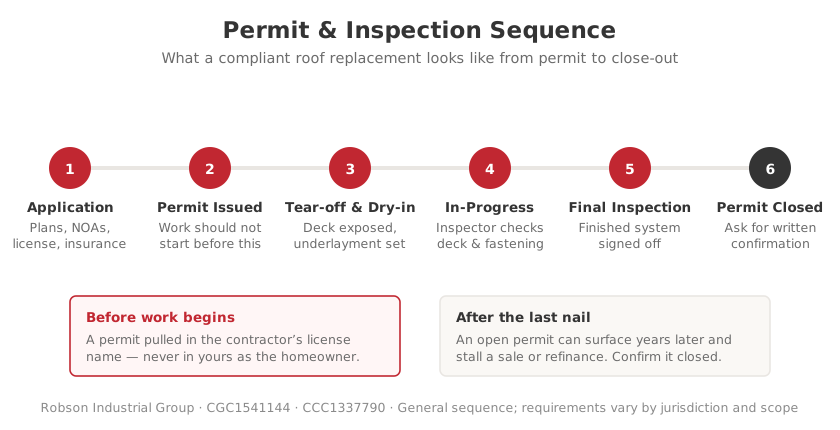
This sequencing failure is the most common and most expensive mistake we see in Coral Springs re-roof projects. A homeowner hires a contractor, the contractor pulls the permit and starts tearing off the roof. Then an HOA notice arrives requiring removal of the unauthorized material. Stop-work orders, mandatory restores to original spec, and legal disputes have all resulted from contractors who skipped the HOA step. The correct sequence is always: HOA/ARC approval → permit → work.
| Change Type | HOA/ARC Approval Required? | Typical Documentation Needed | Timing Risk |
|---|---|---|---|
| Same material, same color (like-for-like replacement) | Often No — or simple notification only | Contractor license copy, permit number after issuance | Low |
| Same material, different color or blend | Yes — ARC review required | Color sample chips, manufacturer spec sheet | 1–3 weeks |
| Material change (tile → shingle or shingle → tile) | Yes — typically requires board vote | Material samples, profile drawings, structural engineer letter if switching to heavier material | 3–6 weeks (board meeting cycle) |
| Profile change (flat tile → barrel tile or vice versa) | Yes — ARC/board review | Profile comparison rendering, structural load analysis | 3–6 weeks |
| Ridge cap or hip cap material/color change | Sometimes — depends on street visibility | Color and material spec sheet | 1–2 weeks |
| Flashing type or color change | Sometimes — if visible from street | Flashing specification sheet | 1–2 weeks |
| Skylight addition or removal | Yes | Product cut sheet, structural plan if required | 2–4 weeks |
Robson Industrial Group LLC (CCC1337790 / CGC1541144) prepares the full HOA/ARC submittal package for our Coral Springs clients. We include material samples, spec sheets, and our contractor credential documentation in the submittal. If your neighborhood requires a board meeting, we provide a written project summary and can attend if requested. HOA coordination is built into our project timeline. We do not start the permit clock until written HOA approval is in hand.
The Coral Springs Roof Permit Process: Step by Step
All roofing permits for homes within Coral Springs city limits are pulled through the City of Coral Springs Building Division, located at 9530 W Sample Rd, Coral Springs, FL 33065, phone (954) 344-1130. This is a city-operated permit office, not Broward County's unincorporated building department. If your contractor is submitting to the wrong jurisdiction, your permit is going nowhere.
The standard re-roof permit process follows these steps:
- HOA/ARC approval obtained and documented (if required for your change type). Written approval in hand before any permit application is submitted.
- Permit application prepared by the licensed contractor. The application from Robson Industrial Group LLC includes HVHZ product approvals (NOA or HVHZ-listed FL#) for every system component, fastener specifications, underlayment product spec, and our contractor license information — both CCC1337790 and CGC1541144.
- Application submitted online or in person to the City of Coral Springs Building Division.
- Plan review period — typically 5–10 business days for a standard re-roof via electronic submittal. Complex projects or additions may take longer.
- Permit issued and posted at the job site before any work begins. Florida law requires the permit to be visibly posted at the property during the project.
- Inspections called by the contractor at required stages — typically a nail pattern or fastener inspection before underlayment covers the deck, and a final inspection after all work is complete.
- Final inspection passed — City of Coral Springs inspector signs off, certificate of completion is issued, permit is closed. You now have a fully permitted, inspected re-roof.
Florida law prohibits waiving the permit on a re-roof. Section 553.79, Florida Statutes, and the FBC both require it. Any contractor who suggests skipping the permit to "save time" or "save money" is either unlicensed, avoiding inspection of substandard work, or planning to disappear. An unpermitted roof creates problems at resale (title issues) and in insurance claims (carrier may deny coverage on an unpermitted structure).
7-Step DBPR Contractor Verification for Coral Springs
Roofing is its own licensed trade in Florida. The Certified Roofing Contractor (CCC) license, issued by the Florida DBPR, is what authorizes roofing work and pulls the roofing permit on any structure. A Certified General Contractor (CGC) who does not also hold a roofing license must subcontract the roof to a licensed roofer (F.S. 489.113(3)). Verification takes under five minutes and protects you from fraud, uninsured work, and permit problems. Here is the exact process:
- Go to the DBPR license portal: myfloridalicense.com
- Select "Verify a License" from the navigation menu.
- Enter the contractor's license number. For roofing work, look for a CCC number (Certified Roofing Contractor). If the company shows only a CGC number (Certified General Contractor), ask who the licensed roofer of record is.
- Confirm the license type is correct — "Certified Roofing Contractor" for the roof, with "Certified General Contractor" as a bonus for structural scope. Registered contractors (county-level) are not valid statewide.
- Confirm the licensee name matches the qualifier who will supervise your project. Florida licenses are issued to individual qualifiers, not to company names alone.
- Check the expiration date and confirm there are no open disciplinary actions or complaints on record.
- Repeat for each license number the contractor holds — a contractor holding both CCC and CGC should have both verified.
Robson Industrial Group LLC's licenses are publicly verifiable at the DBPR website:
- CCC1337790 — FL Certified Roofing Contractor — Francisco Rijo — Verify CCC1337790 at DBPR →
- CGC1541144 — FL Certified General Contractor — Francisco Rijo — Verify CGC1541144 at DBPR →
| License Type | Abbreviation | Roofing Scope | Issued By | Homeowner Tip |
|---|---|---|---|---|
| Certified Roofing Contractor | CCC | All roofing work on any structure, statewide; authorizes and pulls the roofing permit | FL DBPR | The roofing license of record — look for it first |
| Certified General Contractor | CGC | General construction (structural deck repair, parapets, rooftop structures, full-building projects), statewide; must subcontract the roofing to a licensed roofer unless a CCC is also held (F.S. 489.113(3)) | FL DBPR | Valuable alongside a CCC; on its own, ask who the roofer of record is |
| Registered Roofing Contractor | CCC (Registered) | Roofing only within the specific county or municipality of registration | Local jurisdiction | Not valid statewide; confirm registration covers Broward County |
| Unlicensed | None | Illegal for any roofing work exceeding $500 in value | N/A | Never hire — no insurance recourse, homeowner may be held liable for injuries |
9 Red Flags: Contractor Fraud Patterns in Coral Springs
Coral Springs sees predictable waves of roofing fraud, most acutely in the weeks after named storms and throughout the June–November hurricane season. These patterns repeat every year. Recognizing them before you hire anyone is the cheapest protection available.
- No CCC roofing license number printed on the estimate. Any Florida-licensed roofing contractor can give you their license number on request and should print it on every document. If the estimate in your hand does not show a CCC number, treat the contractor as unlicensed for roofing until they prove otherwise; a company holding only a CGC must subcontract the roof, so ask who the roofer of record is. Robson Industrial Group LLC prints both CCC1337790 and CGC1541144 on every proposal, contract, and permit application.
- "We'll pull the permit after we start — it's faster that way." This is a code violation and a bright red line. The permit must be issued and posted before work begins. Contractors who say this are either unlicensed, trying to avoid the city inspector seeing their work, or planning to collect deposits and leave.
- Out-of-state storm chasers after hurricane season. They arrive with out-of-state plates and pickup trucks, knock on doors in damaged neighborhoods, promise fast turnaround and "insurance help," collect a large deposit, and often disappear. Florida's CCC license exists for precisely this reason — a Certified Roofing Contractor (CCC1337790 in Robson's case) is accountable to the Florida DBPR and cannot simply relocate when problems arise.
- A bid 30% or more below all other estimates. Roofing materials in South Florida trade at market prices. A materially lower bid usually means missing scope: no permit, unlicensed labor, sub-spec materials, no manufacturer warranty, or no final inspection. Low-bid roofs in Coral Springs routinely fail wind inspections or leak within the first year.
- Large upfront deposit demands. Florida Statute 489.126 does not cap deposits, but a contractor who takes more than 10% up front must apply for the permit within 30 days of that payment and start work within 90 days after the permit is issued. A contractor demanding 40–50% upfront before ordering materials is a financial risk. Robson Industrial Group LLC uses milestone-based payment schedules with modest initial deposits.
- "We don't need to bother the HOA — let's just start." Any contractor who dismisses the HOA approval requirement does not know or does not care about Coral Springs's building landscape. The stop-work order and mandatory restore costs fall on you, not the contractor. This is a non-negotiable sequence in this market.
- No HVHZ product approval on the proposal, or a claim that Coral Springs is "not HVHZ." Broward County is in the HVHZ in its entirety, so every roofing product installed in Coral Springs must carry a Miami-Dade NOA or an FL Product Approval with HVHZ listing; a plain statewide FL# is not enough. If it is not listed on the proposal, ask for it in writing. If the contractor cannot produce it, the product may not be code-compliant — and the City of Coral Springs Building Division will require it at permit review regardless.
- Unlicensed subcontracted labor doing the actual work. Some licensed companies subcontract installation to unlicensed crews. Under Florida law, the licensed qualifier (CCC1337790 / CGC1541144) must supervise the work. Ask explicitly who performs the installation and request that the contract require licensed, insured crews. Get it in writing.
- Certificate of insurance cannot be produced or shows a lapsed policy. Ask every contractor for a certificate of insurance and call the insurer to verify it. It should name you as a certificate holder and show active general liability and workers' compensation coverage. (Robson issues its certificate after the contract is signed, at the permit and HOA-document stage, before work starts.) A worker injured on your property without proper coverage can result in claims against your homeowner's insurance — or against you personally.
Roofing Material Selection for Coral Springs Homes
Coral Springs's housing stock was built primarily between the early 1970s and the mid-1990s. The dominant roofing systems are concrete tile and asphalt shingle, reflecting the era of construction and the preferences of the master-planned community's original developers. Metal roofing has grown significantly in recent years for homeowners prioritizing long-term durability and energy performance. Each material carries specific tradeoffs for the Coral Springs market that are worth understanding before committing.
| Material | Lifespan | HVHZ Product Approval | HOA Acceptance | Roof Weight | Installed Cost Range (est.) |
|---|---|---|---|---|---|
| Asphalt Shingle (e.g., GAF Timberline HDZ®) | 25–30 years | Miami-Dade NOA required (shingles are permitted in the HVHZ when installed to the NOA's nailing and underlayment schedule) | Varies by community; commonly approved; confirm with your HOA | Light (~2–3 lbs/sq ft) | $10,000–$18,000 (typical home) |
| Concrete Tile (flat, low-profile, or barrel) | 40–50+ years | NOA or HVHZ-listed FL# required | Preferred in many Coral Springs HOA communities | Heavy (~9–12 lbs/sq ft); structural check required if switching from shingle | $18,000–$35,000 (typical home) |
| Metal (standing seam or exposed fastener panel) | 50+ years | NOA or HVHZ-listed FL# required | Growing acceptance; HOA ARC approval almost always required for material change | Light (~1.5–2.5 lbs/sq ft) | $22,000–$45,000 (typical home) |
The Tile-to-Shingle Switch: Why a Structural Review Matters
Many Coral Springs homes were originally built with concrete tile roofs, with roof framing engineered for that heavier load (~9–12 lbs/sq ft). If you are considering switching to asphalt shingle (lighter, lower cost), the framing is typically overbuilt and the switch is generally straightforward. The reverse, switching from shingle to tile, requires a licensed structural engineer to review the existing framing before the City of Coral Springs Building Division will issue a permit. Robson Industrial Group LLC (CCC1337790 / CGC1541144) coordinates structural review as part of our material change process. We do not skip this step because it protects both the homeowner and the permit application.
GAF Certified™ and the System Plus Limited Warranty
As a GAF Certified™ Residential Roofing Contractor (GAF ID: 1164276), Robson Industrial Group LLC installs GAF roofing systems that qualify for the GAF System Plus Limited Warranty. This is a coverage tier available only through contractors who have earned the GAF Certified™ designation. It covers GAF materials. Workmanship is covered separately by Robson's own written warranty, with the term stated in your contract. For Coral Springs homeowners investing in an asphalt shingle re-roof, ask for both documents in writing and confirm which one covers what.
Wind Mitigation Inspection: Reduce Your Insurance Premium After Re-Roof
Once your new roof is installed and the City of Coral Springs Building Division closes the permit with a final inspection sign-off, you are eligible for a wind mitigation inspection using Florida OIR form OIR-B1-1802. This inspection documents your roof's wind-resistance features for your homeowner's insurance carrier: hip roof geometry, deck attachment method, sealed roof deck, opening protections, and fastener pattern.
A qualifying wind-mit inspection can reduce your Coral Springs homeowner's insurance premium by 15–35% depending on your home's features, roof system, and carrier. Given the sustained premium increases in the South Florida insurance market, a $300–$500 wind-mit inspection that returns $1,000–$3,000 in annual savings represents one of the highest-ROI steps available to a homeowner immediately after a re-roof. Robson Industrial Group LLC connects clients with a licensed wind-mit inspector as part of our post-completion process. Ask about scheduling at the time of your estimate.
Pre-1978 Homes in Coral Springs: EPA Lead-Safe Requirements
Coral Springs was incorporated in 1963, and residential construction began in the late 1960s and early 1970s. Homes built before 1978 may contain lead-based paint. Any roofing work (tear-off, flashing replacement, fascia repair) that disturbs painted surfaces on a pre-1978 home triggers the federal EPA Renovation, Repair and Painting (RRP) rule, which requires lead-safe work practices and a certified firm performing the work.
Robson Industrial Group LLC holds EPA RRP Firm Certification #NAT-F338229-1, valid through June 23, 2031, certified for purposes of Section 402 of the Toxic Substances Control Act (TSCA). We require EPA-prescribed lead-safe work practices on every qualifying project: containment, waste disposal protocols, and post-work cleaning verification. If your Coral Springs home was built before 1978, verify that your roofing contractor holds a current EPA RRP Firm Certification before any work begins. A contractor without it is creating federal compliance liability and exposing your household to lead dust.
Financing a Coral Springs Roof Replacement
Financing may be available through third-party providers, subject to their approval and terms. Ask us for details.
Get a Coral Springs Roof Estimate from a Licensed, Verified Contractor
Robson Industrial Group LLC: FL Lic. CCC1337790 & CGC1541144, GAF Certified™ Residential Roofing Contractor (GAF ID: 1164276). We pull permits, coordinate HOA/ARC approval, and carry full insurance. Serving Coral Springs and all of Broward County.
Call (954) 546-4161 NowProposal and Contract Checklist: 10 Items Every Coral Springs Homeowner Should Require
| # | Item | What to Verify | Robson Status |
|---|---|---|---|
| 1 | Contractor license number(s) | CCC (roofing license) printed on proposal and contract, CGC also if structural scope; verifiable at DBPR | CCC1337790 & CGC1541144 on every document |
| 2 | Certificate of insurance | Active general liability + workers' comp; homeowner named as certificate holder; call the insurer to verify | Issued after the contract is signed, at the permit and HOA-document stage, before work starts |
| 3 | Permit pulled by the licensed contractor | Explicitly stated in contract; no "owner-builder" permits for a full re-roof | All permits pulled by Robson under CCC1337790 |
| 4 | HVHZ product approvals (NOA or HVHZ-listed FL#) for all major components | Listed for shingle/tile system, underlayment, starter strip, ridge cap | Included in all Robson permit submittals |
| 5 | Project timeline | Start date, estimated duration, HOA submittal timeline if applicable | Documented in every written contract |
| 6 | Payment schedule | Milestone-based; initial deposit no more than 10–15% of total | Milestone payments — no large advance deposits |
| 7 | Manufacturer material warranty | Duration, transferability to new owner, what triggers voiding; plus Robson's own written workmanship warranty (term in your contract) | Provided per manufacturer program on every project; workmanship warranty stated in the contract |
| 8 | GAF System Plus Limited Warranty (for GAF shingle projects) | Only available from GAF Certified™ contractors — ask for it by name; it covers GAF materials | Available — Robson is GAF Certified™, GAF ID: 1164276 |
| 9 | Debris removal and cleanup | Who hauls tear-off material? When? Nail sweep included? Property protected? | Full cleanup and nail sweep included as standard scope |
| 10 | Wind-mit inspection coordination | Does contractor assist with scheduling OIR-B1-1802 inspection after permit closes? | Robson connects clients with a licensed wind-mit inspector at project close |
Why GAF Certified™ Matters for Coral Springs Homeowners
The GAF Certified™ Residential Roofing Contractor designation is not a self-declared marketing label. It requires GAF to verify the contractor's active license status, current insurance coverage, and documented installation competency before the designation is granted. Robson Industrial Group LLC carries GAF ID: 1164276. The practical benefit to homeowners is access to the GAF System Plus Limited Warranty, a manufacturer-backed limited warranty that covers GAF materials on a qualifying system.
In Coral Springs's competitive re-roofing market, the majority of contractors can purchase and install GAF shingles. But most cannot register the System Plus Limited Warranty because they have not earned the GAF Certified™ designation. When you hire Robson Industrial Group LLC (CCC1337790 / CGC1541144), the manufacturer warranty covers the GAF materials, and the installation quality that actually determines how your roof performs in a storm is backed separately by Robson's own written workmanship warranty, with the term stated in your contract.
Frequently Asked Questions — Coral Springs Roofing 2026
Is Coral Springs in the High Velocity Hurricane Zone, and does it use Miami-Dade NOA for roofing?
Yes, Coral Springs is in the HVHZ. The Florida Building Code defines the High-Velocity Hurricane Zone as Miami-Dade County and Broward County, both in their entirety, so crossing the county line changes your permit office, not your wind code. Every roofing product must be approved for HVHZ use: a Miami-Dade Notice of Acceptance (NOA), or a Florida Product Approval whose evaluation specifically covers the HVHZ. A plain statewide FL approval with no HVHZ listing does not pass plan review. Your proposal should reference HVHZ product approvals (NOA or HVHZ-listed FL#). A contractor who tells you Coral Springs is "not HVHZ" is describing the wrong code.
Do I need HOA approval before getting a roof permit in Coral Springs?
In most Coral Springs neighborhoods, yes, particularly for any material change, color change, or profile change. HOA/ARC written approval must typically be in hand before the City of Coral Springs Building Division will issue a permit. Robson Industrial Group LLC (CCC1337790 / CGC1541144) handles HOA submittal packages and sequences the permit pull correctly. Never let a contractor skip this step. The stop-work order risk and potential mandatory restore cost fall entirely on the homeowner.
How long does a roof permit take in Coral Springs?
Standard re-roof permits through the City of Coral Springs Building Division typically process in 5–10 business days via electronic submittal. If HOA/ARC approval is required first, add 1–6 weeks depending on whether the change requires a board vote or only ARC sign-off. Total lead time from signed contract to first day of installation is typically 3–6 weeks. Material lead times (especially for concrete tile) can extend this further during peak demand periods.
What roofing materials are common in Coral Springs?
Coral Springs was built primarily between the 1970s and 1990s, making concrete tile and asphalt shingle the dominant systems. Concrete tile offers a 40–50+ year lifespan and is the preferred material in many HOA communities. Asphalt shingle (such as the GAF Timberline HDZ®) offers lower upfront cost and faster installation. Metal roofing is growing for its 50+ year longevity and energy efficiency credentials. All three systems must carry HVHZ product approval (NOA or HVHZ-listed FL#) in Coral Springs.
Can I verify my Coral Springs roofing contractor's license?
Yes, use the Florida DBPR license portal at myfloridalicense.com. Look for an active CCC (Certified Roofing Contractor) license, the one that authorizes roofing work and pulls the roofing permit; a company with only a CGC (Certified General Contractor) must subcontract the roof. Robson Industrial Group LLC holds both CCC1337790 (FL Certified Roofing Contractor) and CGC1541144 (FL Certified General Contractor), issued to Francisco Rijo. Direct DBPR verification links for both licenses are provided in this guide. Verification takes under five minutes and should be completed before you hire anyone.