Roofing · Miami-Dade County, FL
Miami Roof Replacement: From Permit to Final Inspection — What to Expect
A roof failing inspection isn't rare in Miami-Dade. It's the default outcome for jobs that skip a step. Building officials here reject a meaningful share of roofing inspections on the first pass, usually for reasons that have nothing to do with workmanship and everything to do with paperwork: a permit that doesn't match the materials on the roof, a deck inspection that never happened, a dry-in stage the crew tried to skip past. If you're planning a roof replacement in Miami-Dade County, understanding the permit-to-inspection sequence isn't optional homework. It's the difference between a roof that closes out clean and one that sits under an open, unresolved permit for months while you scramble to fix documentation after the fact.
This is a High-Velocity Hurricane Zone (HVHZ), and HVHZ counties enforce roofing work differently than the rest of Florida. The inspection sequence exists because a roof assembly that looks fine from the ground can still fail catastrophically in wind if the deck underneath is rotten, the underlayment isn't rated for the product going over it, or the fastening pattern doesn't match what the manufacturer's Notice of Acceptance requires. Here's what actually happens between pulling the permit and getting your final sign-off, and where jobs go wrong.
Why the Permit Isn't Optional
Every roof replacement in Miami-Dade County requires a building permit for a full replacement, not just structural work. This isn't a courtesy step or a "best practice" a contractor recommends; it's a legal requirement under the Florida Building Code's HVHZ provisions, and Miami-Dade enforces it more tightly than most jurisdictions in the state. Roofing is one of the few residential trades where the county requires product-specific documentation on the permit application itself, not just a general scope description.
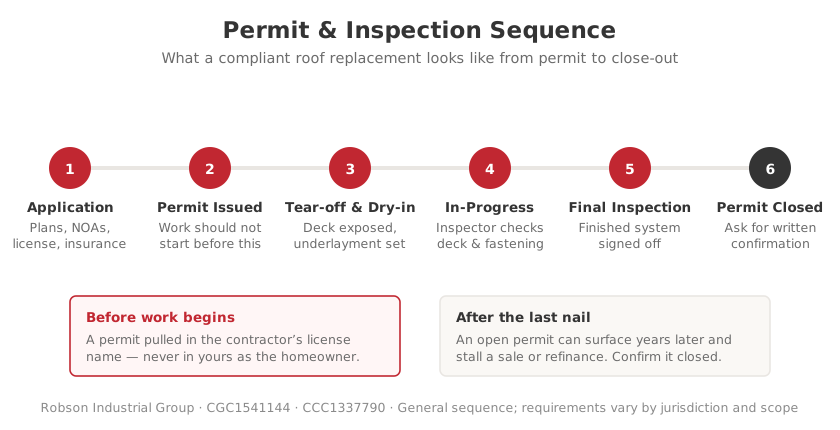
Beyond the legal requirement, the permit record follows the house. Insurance carriers pull county permit history when underwriting a new policy or processing a wind-damage claim, and an unpermitted roof can result in a denied claim even if the roof itself was installed correctly. Buyers' attorneys and title companies check for open or missing permits during any sale. An unpermitted re-roof is a routine deal-killer or, at minimum, a forced remediation before closing. A permit record with a properly closed final inspection is one of the few pieces of paper that protects you on both fronts.
Before Anything Goes on the Roof: The Pre-Permit Steps
Who Actually Pulls the Permit
In Florida, a licensed contractor pulls the permit for licensed trade work. A homeowner should never be the one submitting a roofing permit application on their own house unless they intend to act as their own contractor, which comes with its own liability exposure most homeowners don't want. When Robson manages a re-roof, we pull the permit under our own license, CGC1541144 for general contracting scope or CCC1337790 where the certified roofing contractor license applies, and that license number is what shows up on the county's public permit record tied to your address.
NOA Numbers on the Application
Every material going on the roof has to be listed on the permit application with its Notice of Acceptance (NOA) number: the underlayment, the secondary water barrier, the shingles or tile or metal panel system, and the fasteners. Miami-Dade's Product Control division maintains NOAs for every roofing product approved for use in the county, and the permit reviewer checks the application against those listings before approval. This is the step that trips up unlicensed or out-of-area crews the most: a product that's perfectly legal in a non-HVHZ county may not carry a valid Miami-Dade NOA, and if it's not on the approved list, the permit doesn't get approved to begin with.
Plan Review Timeline
Once submitted, the application goes through plan review before a permit number is issued. Straightforward residential re-roofs with standard, pre-approved product assemblies move faster than jobs with unusual roof geometry, additions to the structure, or products that require additional engineering documentation. This is the first place realistic timeline expectations matter. Plan review is a queue, not an instant approval, and it moves at the county's pace, not the contractor's.
Stage One: Tear-Off and the Deck Inspection
In an HVHZ county, roofing over existing layers is not allowed. Full tear-off to the deck is required on every re-roof, regardless of how many layers are currently up there or how good the existing roof looks from the ground. This is where a lot of homeowners who've had roofs re-covered in other states are surprised: Miami-Dade doesn't permit that shortcut, because a hidden, deteriorated deck under multiple roofing layers is exactly the kind of failure point that turns a bad storm into a catastrophic one.
Once the old roofing material is stripped off, the exposed wood deck is what the first required inspection is checking. The inspector is looking for rot, delamination, water staining that indicates chronic leaks, undersized or improperly spaced sheathing, and any deck damage that needs to be replaced before a single layer of new material goes down. This deck inspection typically has to pass before the crew can proceed to underlayment. Proceeding without it, or covering deck damage instead of replacing it, is one of the most common and most serious corners cut on rushed re-roof jobs.
Stage Two: Dry-In and the Secondary Water Barrier Inspection
After the deck passes and any needed sheathing repairs are made, the crew installs the underlayment and secondary water barrier, the layer of protection between the deck and the final roofing material that keeps the house dry if the outer roofing surface is ever compromised in a storm. This assembly has its own NOA-listed products and its own installation requirements around lap widths, fastening patterns, and coverage at penetrations, valleys, and edges. Once that layer is down but before the final roofing material (shingles, tile, or metal) goes on top, a second required inspection typically has to happen: the dry-in inspection. The inspector confirms the secondary water barrier is installed correctly and matches what's listed on the permit before it gets covered up and becomes unverifiable.
Skipping straight from tear-off to a finished roof without a documented dry-in inspection is a compliance red flag, not a shortcut that saves time. Once shingles or tile are on, the underlayment underneath is no longer visible or verifiable without tearing the new material back off. If a contractor is moving fast enough that there was never a window for a dry-in inspection to happen, that's worth asking hard questions about before the job continues.
Stage Three: Final Installation and Final Inspection
With dry-in approved, the crew installs the final roofing material, architectural shingles, tile, or standing-seam metal, depending on what's specified on the permit. The final inspection is the most detailed checkpoint in the process, and it's checking several things at once:
Fastening pattern and nailing schedule: the number, placement, and type of fasteners has to match what the product's NOA requires for the wind zone and roof pitch, not just "enough nails to hold it down." Product match: the material actually installed has to be the same product listed on the permit application, down to the specific line and NOA number; substituting a similar-looking product without amending the permit is a mismatch the inspector is specifically trained to catch. Flashing details: around chimneys, skylights, walls, and any roof penetration, since flashing failures are one of the most common sources of leaks in an otherwise sound roof. Ridge and hip work: proper ventilation and cap installation at the roof's high points. And general workmanship: clean lines, no exposed fastener heads, proper overhangs and drip edge.
When an Inspection Fails
A failed inspection isn't the end of the job, but it does stop the clock. The most common fail reasons on Miami-Dade roofing inspections are missing permit documentation on site (the inspector needs to see the approved permit and product NOAs at the property, not just on file at the county office), a product mismatch between what's on the permit and what's actually installed, exposed nail or fastener heads that weren't properly covered, and inadequate fastening that doesn't meet the pattern required for the wind zone.
When an inspection fails, the permit stays open. It does not close, and the job is not legally complete, until the deficiency is corrected and the inspector returns to re-verify. This is exactly the scenario that shows up later as a red flag to insurers and buyers: an open permit with a failed inspection and no documented resolution. It's also why choosing a contractor who manages this process carefully the first time matters more than choosing the fastest bid.
Realistic Timeline: Permit to Final Sign-Off
For a typical single-family re-roof in Miami-Dade, expect the permit review itself to take roughly one to three weeks, depending on the county's current plan review backlog and how straightforward the product assembly is. Once the permit is issued, the physical tear-off and installation for most residential roofs runs two to five days, weather permitting. Steep or complex roofs, tile re-roofs, and larger footprints run longer than a simple architectural shingle job on a standard gable roof. After the final roofing material is installed, scheduling the final inspection with the county typically adds a few more days on top of that, depending on inspector availability in your area.
Treat this as a realistic range, not a guaranteed date. County backlogs shift, weather delays tear-off and dry-in stages (roofing crews don't leave a deck exposed or a dry-in incomplete going into rain), and inspection scheduling depends on the county's queue, not the contractor's calendar. What a contractor can control is not adding delay on their end: submitting a complete, accurate permit application the first time, keeping documentation on site, and requesting each inspection promptly once that stage of work is done. Robson manages the entire permit process end-to-end for the homeowner: application, NOA documentation, scheduling each required inspection, and closing out the final sign-off. That way you're not the one tracking down a building inspector or chasing paperwork mid-project.
How to Know If Your Contractor Is Actually Pulling a Permit
This is worth checking yourself, and it takes about ten minutes. Miami-Dade County's permit portal lets you search active and historical permits by address. Before work starts, ask your contractor for the permit number and confirm it's live on the county system, tied to your address, and lists the correct contractor license. Cross-check that license number against the Florida Department of Business and Professional Regulation at myfloridalicense.com, which shows whether a license is active, its classification, and whether there's any disciplinary history attached to it. As an example of what that check looks like, Robson's general contracting license CGC1541144 and certified roofing contractor license CCC1337790 are both verifiable there. That's the exact lookup homeowners should be running on any contractor before signing a contract, not just with us.
A contractor who's reluctant to give you the permit number, who tells you permits "aren't necessary" for a re-roof, or who suggests self-permitting to save money is describing a liability problem, not a shortcut. The permit and its inspection trail are what protect the investment after the crew leaves the property.
Frequently Asked Questions
Can I re-roof over my existing shingles to save money?
No. Not in Miami-Dade County. HVHZ building code requires full tear-off to the deck on every re-roof, regardless of how many layers are currently installed or their condition. This ensures the deck can be inspected and any hidden damage addressed before new material goes on.
How long does the roofing permit itself take to get approved?
Plan review typically runs one to three weeks depending on the county's current backlog and how standard the product assembly is. Jobs with unusual roof geometry or products requiring extra engineering documentation can take longer.
What happens if my roofer skips the dry-in inspection?
Once the final roofing material is installed over the underlayment, the dry-in layer is no longer visible or verifiable without removing new material. A missing dry-in inspection is a compliance red flag and can complicate insurance claims or resale, since there's no documented proof the secondary water barrier meets code.
Does an open or failed permit affect selling my house later?
Yes. Buyers' attorneys and title companies routinely check county permit records during a sale, and an open or failed roofing permit is a common reason closings get delayed or renegotiated. A properly closed final inspection on file protects you when it's time to sell.
How do I verify a roofing contractor's license before signing a contract?
Ask for their license number and look it up directly at myfloridalicense.com to confirm it's active and see its classification and any disciplinary history. You can also search the Miami-Dade permit portal by your address once work starts to confirm the permit is live and lists the correct license number.
Doesn't a 7-year statute of limitations mean I can skip the permit?
No, that's a mix-up. Florida does have a statute of repose that limits how long after construction someone can sue over a defect, but that has nothing to do with whether a re-roof needs a permit. Miami-Dade requires a permit on every re-roof regardless of how long you plan to own the property, and going without one doesn't start any legal clock in your favor. It just leaves the work undocumented for insurance and resale purposes.