Roofing · South Florida
How Long Does a Roof Last in South Florida? Lifespan by Material
A roof that would last 30 years in Ohio can be down to bare granules and curling tabs in 18 here. That's not a defect, and it's not bad luck. It's Miami-Dade and Broward doing what South Florida does to a roof every single day: cooking it, salting it, soaking it, and occasionally trying to rip it off the deck during hurricane season. If you're asking how long your roof will last, the honest answer starts with where you live, not with a number on a shingle wrapper.
Why South Florida Eats Roofs Faster Than the Rest of the Country
Every lifespan estimate you'll find online, the ones printed on shingle packaging, the ones quoted by out-of-state contractors, assumes a climate that doesn't exist south of Orlando. South Florida roofs are working under conditions most of the country never sees, and they're working under all of them at once.
UV Load
Miami sits at roughly 25.7° north latitude with over 230 sunny days a year and a UV index that regularly hits "extreme" from spring through fall. Ultraviolet radiation breaks down the asphalt oils in shingles and the polymer binders in flat roofing membranes, drying them out and making them brittle years ahead of schedule. This is the single biggest driver of accelerated aging on any roof in this market.
Salt Air and Corrosion
Anywhere within a few miles of Biscayne Bay or the Atlantic, airborne salt settles on metal fasteners, flashing, and drip edge. Left unaddressed, that salt accelerates corrosion on exposed metal components, the parts holding your roofing system together, well before the field material itself fails.
Humidity, Near Year-Round
South Florida averages relative humidity in the 70-85% range for most of the year. That moisture load keeps roof decking and underlayment perpetually damp during rainy stretches, which is exactly the environment that promotes rot, mold, and adhesive breakdown in layers you can't see from the ground.
Hurricane Wind and Hail Cycling
Every named storm that brushes past South Florida, whether it makes direct landfall or not, puts wind uplift stress on shingles, tile, and membrane seams. Even roofs that survive a hurricane without visible damage have absorbed cyclical stress that shortens their remaining service life. This is why HVHZ (High-Velocity Hurricane Zone) installation standards exist for Miami-Dade and Broward, and why they matter more here than almost anywhere else in the country.
Afternoon Thunderstorms
Add near-daily summer thunderstorms, heavy, fast-moving rain events that repeatedly saturate and dry a roof surface, and you have a climate that is, without exaggeration, one of the harshest roofing environments in the continental United States.
Lifespan by Material, Adjusted for This Climate
Every range below reflects South Florida conditions specifically, not the national averages printed on a shingle bag. We install and repair all of these systems under license CGC1541144, so these numbers come from what we actually see coming off roofs in Miami-Dade, Broward, and West Palm Beach, not a manufacturer's lab in a mild climate.
Asphalt Shingles (Architectural/Dimensional, HVHZ-Rated)
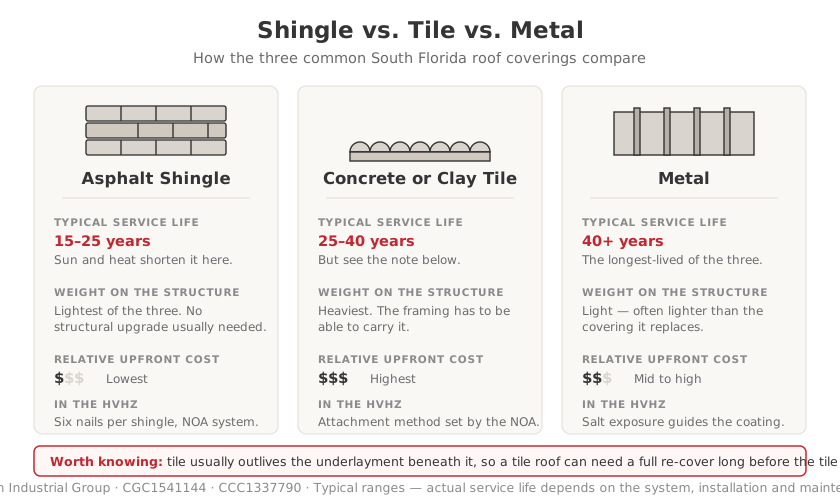
Nationally, a good architectural shingle is rated for 20-30 years. In South Florida, realistically plan on 15-20 years. The gap is almost entirely UV degradation combined with wind-cycling from tropical systems. HVHZ-rated shingles are engineered to survive the wind load, but the asphalt itself still ages faster under this sun than it would in a milder climate.
Concrete or Clay Tile
Tile is where most homeowners get the timeline wrong. The tile itself, the part you see, can genuinely last 30-50 years. But the tile isn't what fails first. The underlayment beneath it, the waterproofing layer doing the actual work of keeping water out, typically needs replacement around 15-20 years, even though the tile on top still looks perfect. We see this constantly: a homeowner assumes a 40-year-old tile roof is fine because nothing looks broken, when in reality the underlayment has already failed and water is getting into the deck through cracks and gaps the tile was never designed to stop on its own. If your tile roof is past the 15-20 year mark and has never had the underlayment inspected or replaced, that's the conversation to have before you have a leak.
Metal (Standing Seam, HVHZ-Rated)
Metal is the strongest performer in this market for a reason: it holds up to wind uplift better than any other common residential system, resists the granule loss and curling that ages shingles, and doesn't have an underlayment-versus-surface mismatch the way tile does. Expect 30-50 years from a properly installed, HVHZ-rated standing seam system, among the best return on investment for a coastal property that's going to sit through a lot of storm seasons.
Flat and Low-Slope Roofing (Modified Bitumen, TPO, Built-Up)
Common on additions, garages, porch extensions, and the classic Florida ranch-style flat sections, these systems handle ponding water and constant sun exposure with less margin than a pitched roof. Plan on 15-20 years, with membrane seams and flashing details as the first points of failure to watch.
A Note on Warranty Coverage
Robson Industrial Group is a GAF Certified contractor (GAF ID 1164276), which unlocks extended manufacturer coverage, the GAF System Plus Limited Warranty, on qualifying shingle roof systems installed as a complete GAF assembly. That warranty coverage is separate from the material lifespan estimates above; we cover what it actually includes and how homeowners qualify in our GAF System Plus Warranty guide, worth a read if you're comparing a GAF system against other manufacturers.
The Insurance Pressure Nobody Warns You About
Material lifespan is only half the equation in Florida. The other half is your homeowner's insurance carrier, and increasingly, carriers are the ones setting the real deadline on your roof, not the shingles.
Florida property insurers have become aggressive about roof age. It's now common for carriers to decline renewal, refuse new policies, or apply significant premium surcharges on homes with roofs over 15-20 years old, regardless of the roof's actual visible condition. A roof that's holding up fine can still trigger a non-renewal notice purely because of its age on record. This has turned roof replacement from a "wait until it leaks" decision into a financial planning decision tied to your policy renewal date.
There is a partial release valve: a 4-point inspection or a formal roof certification from a licensed contractor can sometimes satisfy an insurer that an older roof still has usable life left, buying you time before a full replacement is financially unavoidable. It's not a guarantee. Some carriers have hard age cutoffs no inspection will overturn, but for roofs in reasonable condition sitting near that 15-20 year line, it's worth doing before you assume replacement is your only option. We perform roof certifications, and we will tell you honestly whether certification is realistic for your roof or whether you're better off budgeting for replacement now. Whether your carrier accepts a given inspector is the carrier's call, so ask them in writing which inspectors they will accept. (We do not perform wind-mitigation inspections; that is a separate form, and it belongs with somebody who has nothing to sell you.)
Signs Your Roof Is Nearing the End, Even If It Looks Fine From the Driveway
Most roof failures don't announce themselves with a dramatic leak. They show up as small, easy-to-dismiss signals first:
Granule loss on shingles. Check your gutters after a hard rain. A heavy buildup of loose granules means the protective surface layer is wearing away.
Curling or cupping shingle edges. Visible from the ground with binoculars or a drone photo, curling means the asphalt has dried out and lost flexibility.
Cracked or shifted tile. Individual cracked tiles aren't an emergency, but a pattern of cracking across the roof suggests the underlayment underneath is also compromised.
Rising energy bills with no other explanation. A failing roof deck or degraded underlayment lets heat and humidity into the attic space, forcing your AC to work harder.
Interior staining on ceilings or upper walls. Even a faint yellow-brown ring means water has already found a path through, and the leak source is often nowhere near where the stain shows up.
Visible sagging. Any dip or wave in the roofline, viewed from the street, points to deck-level moisture damage and should be treated as urgent, not cosmetic.
How Installation Quality Changes the Real-World Number
The lifespan ranges above assume a correctly installed system. In practice, we see roofs fail 5-10 years early because of installation shortcuts that have nothing to do with material quality, and roofs outperform their expected range because the installation was done right the first time.
Three details matter more than anything else in this climate:
Secondary water barrier. A self-adhering underlayment layer beneath the primary roofing material is required under HVHZ code for a reason: it's the backup system that keeps water out if wind-driven rain gets past the surface layer during a storm. Skipping or under-installing it is one of the most common corner-cutting moves on cheap re-roofs.
Correct fastening schedule. HVHZ wind ratings are only real if the nailing or fastening pattern matches the engineering spec for that product and that wind zone. The same shingle installed with a builder-grade fastening pattern instead of an HVHZ-compliant one will fail at a lower wind speed than its rating suggests.
Attic ventilation. Poor ventilation traps heat and moisture against the underside of the deck, accelerating decay from below at the same time UV is degrading the surface from above. A roof getting cooked from both directions ages faster than one that can breathe.
This is the difference between a roof that hits the low end of its range and one that hits the high end, and it's why the contractor doing the install matters as much as the material you choose.
Maintenance That Actually Extends Lifespan
None of the ranges above are fixed. A well-maintained roof routinely outperforms a neglected one by several years, and the maintenance itself is neither expensive nor complicated:
Annual professional inspections. Catching a lifted shingle, a cracked tile, or a failing pipe boot before it becomes a leak is dramatically cheaper than repairing the water damage after the fact.
Clear gutters and downspouts. Standing water at the roof edge backs up under shingles and tile, accelerating rot at exactly the point where most leaks originate.
Trim overhanging branches. Falling limbs cause impact damage, and constant branch contact during windy days abrades shingle surfaces and tile edges over time.
Post-storm checks. After any named storm or significant wind event, a walk-around inspection (or a call to us) catches lifted flashing and displaced tile before the next rain turns it into an interior leak.
A roof is the single largest system protecting your home's structure, and in this climate it's under more stress than almost anywhere else in the country. Knowing your material's realistic lifespan, and watching for the signs above, is what keeps a roofing decision on your timeline instead of an insurance company's.
Frequently Asked Questions
How long does a roof really last in Miami compared to the rest of the country?
Expect the low end of national estimates, not the high end. Asphalt shingles that might last 25-30 years elsewhere typically last 15-20 years in South Florida due to intense UV exposure, salt air, humidity, and hurricane wind cycling. Metal and tile hold up better proportionally, but all materials age faster here.
If my tile roof is 25 years old and looks fine, do I need to worry?
Yes. The tile surviving doesn't mean the roof is sound. Underlayment beneath concrete and clay tile typically needs replacement around 15-20 years, well before the tile itself shows wear, and a 25-year-old tile roof has very likely outlived its underlayment already. A roof certification inspection will tell you exactly where you stand.
Can I get insurance to renew my policy with an older roof?
Many Florida carriers apply hard age cutoffs around 15-20 years regardless of condition, but a 4-point inspection or formal roof certification from a licensed contractor can sometimes demonstrate enough remaining life to satisfy a carrier. It's worth pursuing before assuming full replacement is your only path to keeping coverage.
Does a GAF Certified installer actually get me a better warranty?
Yes. GAF Certified Residential Roofing contractors like Robson Industrial Group (GAF ID 1164276) can offer the GAF System Plus Limited Warranty on qualifying complete shingle systems, which extends coverage beyond the standard manufacturer warranty available through non-certified installers.
What's the single biggest thing that shortens a roof's life in South Florida?
UV exposure combined with installation shortcuts. The climate alone will age a roof faster than the national average, but a roof installed without the correct secondary water barrier and fastening schedule for HVHZ code will fail years earlier than one installed to spec. The contractor matters as much as the material.