Roofing · Coral Gables, FL
Coral Gables Roofing: HOA Approval, Historic District Rules, and Permit Requirements
Replacing a roof in Coral Gables involves more approvals, more review boards, and more documentation than a typical South Florida project. Beyond the standard Miami-Dade building permit and HVHZ product approval requirements, Coral Gables homeowners may face HOA review, Historic Preservation Board scrutiny if their home is in a designated historic district, and the City of Coral Gables’ own permitting department, which operates separately from Miami-Dade County. CGC1541144 · CCC1337790.
This guide walks through each layer so you know what approvals are required, in what order, and what happens if you skip one.
Why Coral Gables Is Different From Other Miami-Dade Cities
Coral Gables is a municipality, which means it has its own Building and Zoning Department that issues building permits independently from Miami-Dade County. This is significant: you cannot pull a Miami-Dade County permit for work in Coral Gables. You need a City of Coral Gables permit, which requires submitting to the city’s own process, its own inspectors, and its own fee schedule.
In addition, Coral Gables has one of the most comprehensive historic preservation programs in Florida. The city was developed in the 1920s by George Merrick as a planned community, and a significant portion of the original Merrick-era homes, particularly in the Coral Gables Historic District and the Old Spanish-style neighborhoods, are subject to oversight from the Historic Preservation Board (HPB). If your home is in a designated historic district or is a contributing structure to such a district, any modification to the roof, including material changes, may require HPB approval before a permit is issued.
Step 1: Check Your HOA Requirements First
Many Coral Gables neighborhoods have active HOAs with architectural review boards (ARBs) that govern exterior modifications. HOA approval is a private process; it is separate from the city permitting process and the city does not enforce HOA rules, but skipping it creates problems: your contractor can pull a permit and install a new roof, and your HOA can still require you to redo it at your own expense if the material, color, or profile doesn’t comply with the governing documents.
Before signing a contract with a roofing contractor, pull your HOA’s Declaration of Covenants, Conditions, and Restrictions (CC&Rs) and Architectural Guidelines. Key items to check:
- Approved roofing materials — many Coral Gables HOAs specify concrete barrel tile, clay tile, or flat tile only. Some prohibit asphalt shingle entirely.
- Approved colors and profiles — a “natural terracotta” color approval may not extend to a painted or blended tile in a similar tone.
- ARB submission requirements — most ARBs require a product cut sheet, manufacturer color sample, and sometimes a photo mockup before approving a material change.
- Review timeline — ARB review can take 30–60 days. Build this into your project schedule.
If you are replacing like-for-like (the same material, color, and profile as the existing roof) some HOAs allow an expedited review or waive the ARB requirement. Confirm this in writing before you proceed.
Step 2: Check Historic District Status
Not all of Coral Gables is in a historic district, but a substantial portion of the older west and central neighborhoods is. The easiest way to check: look up your property on the City of Coral Gables’ Property Information System or call the Planning and Zoning Department. They can tell you whether your property is:
- Within a designated historic district (most restrictive — HPB review required for exterior changes)
- A locally designated landmark (most restrictive — HPB review regardless of district)
- Contributing to a historic district (HPB review required for changes that would affect the character-defining features)
- Non-contributing or outside districts (no HPB review — standard permit process)
If HPB review is required, your roofing contractor’s submission to the city’s building department will be routed through the HPB before a permit is issued. The HPB meets on a set schedule, typically monthly, so timing your submission matters.
HPB will evaluate whether the proposed material is consistent with the historic character of the home and district. Concrete barrel tile in a color consistent with the original period construction is generally approved. Metal roofing, flat roofing on a structure with a pitched historic profile, or a material change that significantly alters the roofline or character is more likely to require additional documentation or denial.
Step 3: The City of Coral Gables Building Permit
Every roofing project in Coral Gables requires a City of Coral Gables building permit, regardless of scope. A full replacement, a partial replacement covering more than 25% of the roof area, and in many cases even a significant repair all trigger a permit requirement under the Florida Building Code as adopted by the city.
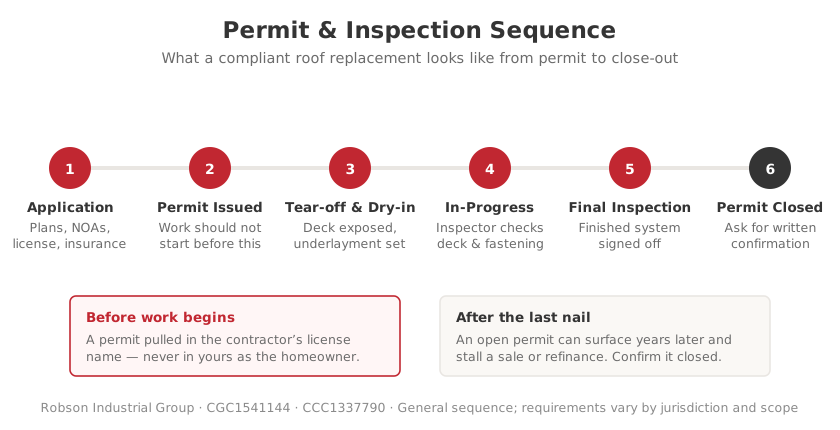
The permit application requires:
- Contractor license verification (the contractor must be licensed in Florida — a CGC or CCC license is required depending on the scope of work)
- Product approval documentation for all materials installed — specifically the NOA (Notice of Acceptance) from Miami-Dade Product Control, since Coral Gables falls within the HVHZ
- Structural calculations for wind uplift if the project involves structural decking, ridge, or fascia changes
- For historic properties: HPB approval letter or certificate of appropriateness, if required
The City of Coral Gables Building Department is at 405 Biltmore Way. They do not accept county permits in lieu of city permits. If a contractor tells you they can “work under a county permit” in Coral Gables, that is incorrect and the work will fail inspection.
HVHZ Requirements Apply in Full
Coral Gables is in Miami-Dade County, which is entirely within the High-Velocity Hurricane Zone (HVHZ). This means all roofing materials must carry a valid Miami-Dade NOA, and the installation must comply with the HVHZ chapter of the Florida Building Code, including the required nail pattern, underlayment specifications, and fastener schedule for the wind zone.
This applies to every material type installed in Coral Gables:
- Concrete and clay tile: the tile system (including the underlayment and adhesive foam, if used) must be NOA-approved as a system. The NOA covers the specific combination of tile, fastener pattern, and underlayment specified in the installation instructions.
- Asphalt shingle (where HOA allows): must have a Miami-Dade NOA. Most standard asphalt shingle products are not NOA-approved for the HVHZ. Products specifically engineered and tested for the zone exist, but the selection is limited.
- Metal roofing: must carry a Miami-Dade NOA for the HVHZ. Standing seam metal and exposed fastener metal panels are both available in NOA-approved configurations.
- Flat roofing / modified bitumen / TPO: for commercial or flat-roofed portions of residential structures — all must carry NOA.
Inspection Sequence
The City of Coral Gables inspection sequence for a roofing project typically follows this order:
- Pre-installation inspection (if required by the permit conditions) — inspector verifies existing deck condition and fastener pattern before tear-off is completed
- Dry-in inspection — underlayment and any secondary water barrier installed and visible before tile or shingle installation
- Final inspection — completed roof system, all flashings, ridge, and penetrations in place
All inspections are scheduled through the city’s online permit portal or by phone. The contractor, not the homeowner, is typically responsible for scheduling inspections and having a qualified supervisor on site during the inspection.
Insurance Implications
A permitted roofing project in Coral Gables, once completed and inspected, supports a wind mitigation inspection and the associated insurance discount. The Florida wind mitigation inspection form (OIR-B1-1802) includes a question about roof deck attachment and a roof covering category, both of which are documented in the permit and visible to the inspector.
A roof replaced without a permit may not qualify for the wind mitigation credit, even if the material meets HVHZ standards, because there is no permit documentation or inspection record to support the wind mitigation inspector’s finding.
Additionally, some Florida insurers require proof of permit for a roof replacement before endorsing a policy or renewing at the preferred rate. This is particularly common in Coral Gables, where older homes with clay tile roofs are on insurers’ watch lists due to age and replacement cost.
What Robson Does in Coral Gables
Robson Industrial Group performs full roof replacements and repairs in Coral Gables for residential homeowners under CGC1541144 and CCC1337790. We handle the permit application, coordinate the NOA documentation, and schedule all required inspections through the City of Coral Gables Building Department. If your project requires HOA submission or Historic Preservation Board documentation, we prepare the product submittals and can attend the ARB meeting if needed.
We work with concrete barrel tile, flat tile, clay tile, and metal roofing systems. All in NOA-approved configurations for the HVHZ. GAF Certified™ Residential Roofing Contractor, ID 1164276, for qualifying GAF system installations.
Coral Gables Service Area → Request a Free Coral Gables Estimate →
Frequently Asked Questions
Do I need a City of Coral Gables permit to replace my roof, or can I use a Miami-Dade county permit?
You need a City of Coral Gables building permit: not a Miami-Dade County permit. Coral Gables is a municipality with its own building department at 405 Biltmore Way. Miami-Dade County permits are not valid for work performed within Coral Gables city limits. Any contractor who tells you otherwise is incorrect, and work performed under a county permit will fail the city's final inspection.
Does my Coral Gables home need Historic Preservation Board approval before I can replace the roof?
It depends on whether your home is within a designated historic district, is a locally designated landmark, or is a contributing structure to a historic district. The easiest way to check is to contact the City of Coral Gables Planning and Zoning Department or look up your property on the city's Property Information System. If HPB review is required, the permit application will be routed through the HPB before a building permit is issued. The HPB meets monthly, so timing your submission to the next meeting deadline matters.
My HOA requires barrel tile. Do I still need to get city approval separately?
Yes. HOA approval and the city building permit are separate processes with different authorities. Your HOA governs the aesthetic and material requirements under the private CC&Rs and architectural guidelines. The city building permit governs code compliance, including HVHZ product approval (NOA), structural requirements, and inspector sign-off. You can receive HOA approval and still need to satisfy the city's permit requirements, and vice versa. Both must be satisfied before you start work.
What roofing materials are approved for the HVHZ in Coral Gables?
All roofing materials installed in Coral Gables must carry a Miami-Dade Notice of Acceptance (NOA): the HVHZ product approval issued by the Miami-Dade Product Control Division. This applies to concrete tile, clay tile, metal roofing, and flat roofing systems. Standard asphalt shingle products are generally not NOA-approved for the HVHZ; a limited selection of shingles engineered specifically for the zone does carry NOA, but you must verify the specific product. Ask your contractor for the NOA number and verify it at the Miami-Dade Product Control website before signing a contract.
How long does the Coral Gables roofing permit process take?
The permit timeline depends on whether historic preservation review is required. Without HPB review, a standard residential roofing permit in Coral Gables typically takes 1–3 weeks for approval from a complete submission. With HPB review, the timeline depends on the next HPB meeting date. Applications must be submitted before the deadline for the next meeting, and meetings are typically monthly. Budget 4–8 weeks for HPB projects. Your contractor should be managing the permit submission and tracking the review status.