Roofing Permits in Tamarac? HOA/Condo Approval & Licensing Guide
If you own a home or condo in Tamarac, FL, replacing or repairing your roof involves a set of rules that are genuinely different from what you may have read about in general Florida roofing guides. Tamarac is not a typical Broward city: incorporated in 1963, it was developed almost exclusively as an active adult and 55+ retirement community, meaning the overwhelming majority of its housing stock was built before 1978, the roofs are predominantly flat or low-slope CBS (concrete block and stucco) ranch construction, and virtually every neighborhood is governed by a homeowners or condominium association with strict Architectural Review Committee oversight. Add to that the extremely high prevalence of lead-based paint in pre-1978 structures and a fixed-income senior population that is unfortunately targeted by unlicensed storm chasers. Put it together, and you have a city where hiring the right, fully licensed, properly insured contractor is not just smart but essential.
Robson Industrial Group LLC (Lic. CCC1337790 · CGC1541144) is a Florida Certified Roofing Contractor and Florida Certified General Contractor serving Tamarac and all of Broward County. This guide walks you through every step: permit requirements, HOA/condo board approval, HVHZ product approval (Miami-Dade NOA or HVHZ-listed FL Product Approval), material selection for CBS ranch homes, protecting yourself from contractor fraud targeting senior communities, and how to verify any contractor's license before you hire.
Quick reference: City of Tamarac Building Division, 7525 NW 88th Ave, Tamarac, FL 33321, (954) 597-3530. All residential and commercial roofing permits for the City of Tamarac are issued by this office, NOT by unincorporated Broward County.
What Makes Tamarac Unique for Roofing
Tamarac occupies a distinctive place in Broward County's housing landscape. Founded in 1963 and largely built out by the mid-1980s, it was deliberately designed and marketed as an active adult community. Signature Tamarac developments, including Kings Point, Mainlands, Woodlands, Heathgate, and dozens of others, were built with age restrictions (typically 55+) and are governed by condominium associations or HOAs with detailed architectural standards. Today, Tamarac's population skews significantly older than the county average, and a large share of residents are on fixed incomes: retired, relying on Social Security and pensions, and acutely sensitive to unexpected housing costs.
This demographic reality shapes roofing decisions in several ways:
- Insurance pressure: Older roofs in South Florida trigger non-renewal letters and dramatic premium increases. Many Tamarac seniors discover their insurer requires a roof less than 15–20 years old to maintain coverage. A qualified wind-mitigation inspection (OIR-B1-1802) performed after a new roof is installed can reduce annual premiums by 15–35% — a meaningful savings for fixed-income households.
- HOA/condo-first approval: Most Tamarac homeowners need ARC or board approval before the city will even see a permit application. Submitting to the city before getting HOA approval is a common and costly mistake.
- Pre-1978 construction: Because the city was largely built before 1978, EPA lead-paint RRP rules apply to roofing work that disturbs painted surfaces. Your contractor must be EPA RRP certified — not just OSHA-trained.
- Low-slope and flat roofs: The CBS ranch construction typical of 1960s–1980s Tamarac uses flat or very low-slope rooflines. The correct material menu is different from what applies to steep-slope residential construction.
Why Tamarac IS in the HVHZ — HVHZ Product Approval (NOA or HVHZ-Listed FL#) Explained
One of the most persistent misconceptions among South Florida homeowners is that the High-Velocity Hurricane Zone stops at the Miami-Dade line or hugs the Broward coast. It does not. The Florida Building Code (Section 202) defines the High-Velocity Hurricane Zone (HVHZ) as Miami-Dade County and Broward County, both in their entirety. Tamarac, located in central Broward County, is inside the HVHZ, just like every other Broward city. Crossing the county line changes your permit office, not your wind code.
What does this mean for you? In the HVHZ, every roofing product (covering, underlayment, fasteners, insulation, edge metal, membrane) must be approved for HVHZ use: a Miami-Dade Notice of Acceptance (NOA), or a Florida Product Approval whose evaluation specifically covers the HVHZ (tested to the TAS protocols). A plain statewide Florida Product Approval with no HVHZ listing does not pass plan review in Broward. Broward's Board of Rules and Appeals (BORA) and the City of Tamarac Building Division enforce this.
When your contractor submits a permit application to the City of Tamarac Building Division, they must cite the HVHZ product approval (NOA number or HVHZ-listed FL number) for the roofing system being installed. Make sure they do. If a contractor tells you Tamarac is "not HVHZ" or that a plain statewide FL approval is enough, that is a sign they may not be familiar with your jurisdiction's requirements.
Table 1: Broward County (Tamarac) vs. Miami-Dade: Same HVHZ Code, Different Permit Office
| Factor | Tamarac / Broward County | Miami-Dade County |
|---|---|---|
| In the HVHZ? | YES — entire county, entire city | YES — entire county |
| Applicable code zone | Florida Building Code — HVHZ provisions | Florida Building Code — HVHZ provisions |
| Product approval required | HVHZ approval: Miami-Dade NOA, or FL Product Approval whose evaluation covers the HVHZ (a plain statewide FL# without HVHZ listing is not accepted) | HVHZ approval: Miami-Dade NOA is the standard reference |
| Wind design speed | HVHZ design speeds, roughly 170 mph and up (ASCE 7 Risk Category II); exact figure per parcel from the FBC wind-speed map | HVHZ design speeds, roughly 170 mph and up (ASCE 7 Risk Category II); exact figure per parcel from the FBC wind-speed map |
| Permit authority (residential) | City of Tamarac Building Division (954) 597-3530 · Broward Board of Rules and Appeals (BORA) |
Miami-Dade Building Department or municipality |
| Fastener / nail spacing requirements | HVHZ schedule per the product's NOA or HVHZ-listed approval | HVHZ schedule per the product's NOA |
| Roof deck attachment | HVHZ deck attachment per FBC and product approval | HVHZ deck attachment per FBC and product approval |
HOA & Condo Association Approval in Tamarac's 55+ Communities
In most Tamarac neighborhoods, your HOA or condominium association's Architectural Review Committee (ARC) has authority over exterior changes, and a new roof or significant re-roofing absolutely qualifies as an exterior change. Many 55+ condo associations in Tamarac are particularly strict because uniform appearance and property values are community priorities for retired residents who may have most of their net worth tied up in their unit.
The ARC approval process typically works as follows:
- Obtain your community's ARC application form from your association management company or board.
- Prepare the application package: proposed roofing material, manufacturer, color sample (with color code), profile/thickness details, and contractor information including license numbers (CCC1337790 and/or CGC1541144 for Robson).
- Submit the complete package to the ARC. Many Tamarac associations require wet-ink signatures and physical submission; others now accept email.
- Attend the ARC or board meeting if a hearing is required (especially for material changes).
- Receive written approval (get it in writing — not verbal).
- Only then submit your permit application to the City of Tamarac Building Division.
Condominium associations in Tamarac sometimes maintain a master policy that covers common-area roofing, meaning the board, not the individual unit owner, controls decisions on the roof over your unit. If you are in a condo, confirm in writing whether the roof is your responsibility or the association's before hiring any contractor.
Table 2: HOA/Condo Association Approval Requirements, Tamarac, FL
| Change Type | ARC Approval Required? | Typical Documentation Needed | Notes for 55+ Communities |
|---|---|---|---|
| Like-for-like material replacement (same material, same color) | Sometimes — check your docs | Written notice; product data sheet | Some associations waive ARC for identical replacements; still require written notification |
| Color change (same material) | Yes — ARC approval required | Color samples, manufacturer color chart | Strict enforcement; 55+ communities often have approved color palettes with no exceptions |
| Material change (e.g., mod-bit to metal) | Yes — often full board vote | Material spec sheet, HVHZ product approval doc (NOA or HVHZ-listed FL#), photos, contractor bid | Can take 4–8+ weeks; some boards require two meetings |
| Profile change (flat membrane to tile or vice versa) | Yes — full board vote likely | Structural assessment, product approval, manufacturer warranty info | Structural implications require engineer letter in many cases |
| Membrane type change on flat roof (mod-bit to TPO) | Maybe — depends on community rules | TPO product approval, reflectivity rating, color | White TPO may be encouraged for energy code compliance; verify HOA stance on reflective surfaces |
| Emergency repair (storm damage) | Notify ARC; may get expedited review | Insurance claim documentation; photo evidence | Emergency tarping typically OK without pre-approval; contact ARC immediately after securing |
Permit Process — City of Tamarac Building Division
All roofing permits in Tamarac are handled by the City of Tamarac Building Division, located at 7525 NW 88th Ave, Tamarac, FL 33321, (954) 597-3530. This is not the unincorporated Broward County permit office. Tamarac is a full municipality with its own building department. If someone tells you to pull a permit at the county office for work within Tamarac city limits, that is incorrect.
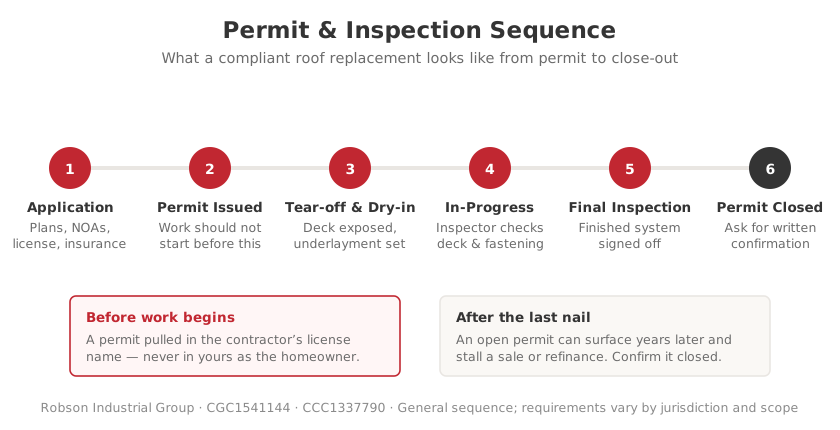
The general residential roofing permit process in Tamarac follows these steps:
- Contractor submits permit application to the City of Tamarac Building Division, including signed contract, scope of work, HVHZ product approval (NOA or HVHZ-listed FL number) for the roofing system, contractor license numbers (CCC1337790 / CGC1541144), and proof of insurance.
- Plan review — for standard residential re-roofing, this typically takes 1–3 weeks. New construction or structural modifications may take longer.
- Permit issuance — permit is issued and must be posted at the job site before work begins.
- Work commences — your contractor performs the removal, deck inspection, underlayment installation, and final roofing system installation per the permitted scope.
- Inspections — the building department typically requires a final inspection; some projects require a dry-in (underlayment) inspection before the final roofing layer is installed. Your contractor must schedule these.
- Final approval and permit closure — the permit is closed after a passing final inspection. Do not accept a project as complete until the permit is finaled.
Total timeline from application to completion typically runs 3–6 weeks for residential projects in Tamarac, accounting for plan review, permit issuance, and weather delays common in South Florida's summer rainy season. In hurricane season, factor in additional schedule risk.
Important: Florida law requires that the licensed contractor, not the homeowner, pull the permit for roofing work. Any contractor who asks you to pull the permit yourself, or who suggests working without a permit to "save time," is operating illegally and exposing you to enormous liability. Work done without a permit can result in forced tear-out, fines, and inability to sell your home. Robson Industrial Group LLC (CCC1337790 / CGC1541144) always pulls permits on every project.
Protecting Tamarac Seniors from Contractor Fraud
Tamarac's 55+ demographics make it a known target for unlicensed contractors and storm-chaser scams. After every tropical storm or hurricane event, predatory contractors descend on South Florida retirement communities with door-to-door pitches, pressure tactics, and offers that sound too good to be true. That is because they are. The FTC and Florida Attorney General consistently document that elderly homeowners suffer disproportionate losses from contractor fraud, and communities with high concentrations of seniors, like Tamarac, are hit hardest.
Here is what you need to know to protect yourself, a parent, or a neighbor:
- No license number up front. A legitimate Florida roofing contractor can give you their license number immediately — before you even ask. If someone hedges or says the paperwork is "in the truck," walk away.
- Asking you to pull your own permit. Under Florida law, the contractor pulls the permit for roofing work. If they ask you to handle it, they likely cannot qualify for a permit themselves — meaning they are unlicensed.
- Large upfront cash payment demands. Florida law limits deposit amounts for residential contractors. Legitimate contractors work on a reasonable draw schedule. Never pay more than a standard deposit before work begins, and never pay in full before the job is complete and inspected.
- Storm chasers at your door immediately after a weather event. Out-of-state contractors who appear in your neighborhood hours after a storm with generic business cards and no local address are almost always unlicensed. Legitimate local contractors do not need to go door-to-door.
- Guaranteed insurance claim approval. No contractor can guarantee that your insurer will cover a specific claim or approve a specific amount. Contractors who tell you they can "handle the insurance" or promise to cover your deductible are engaging in insurance fraud, and you can be implicated.
- Unusually low bid with vague scope. A roofing proposal that does not specify the material brand, HVHZ product approval (NOA or HVHZ-listed FL#), underlayment spec, manufacturer warranty, and permit pull is not a real proposal — it is a blank check for the contractor to cut corners.
- No physical local address or verifiable presence. Search the company name before hiring. Look for a real Broward or Miami-Dade address, online reviews, and a verifiable DBPR license. Robson Industrial Group LLC is based in Miami-Dade, licensed statewide, with a verifiable record at DBPR.
- High-pressure "today only" pricing. A legitimate roofing bid is good for at least a week. Any contractor who tells you the price expires the moment you say goodbye is using a sales pressure tactic, not running a real business.
- Won't back up their insurance. Every licensed contractor must carry general liability insurance and workers' compensation (or a valid exemption). Ask any contractor for a COI naming you as additional insured and call the insurer to verify it. If they cannot produce one when it is due, do not hire them. (Robson issues its certificate after the contract is signed, at the permit and HOA-document stage, before work starts.)
If you suspect a contractor operating in Tamarac is unlicensed, report them to the Florida Department of Business and Professional Regulation (DBPR) at (850) 487-1395, or to the Broward County Consumer Protection Division. You can also contact the Tamarac Police Department for solicitation violations.
7-Step DBPR License Verification
Florida contractor licenses are public record and searchable in seconds. There is never an excuse for skipping this step. Here is exactly how to verify any contractor before hiring:
- Go to myfloridalicense.com and click "Verify a License."
- Enter the license number the contractor provided (e.g., CCC1337790 or CGC1541144).
- Confirm the license type: Certified Roofing Contractor (CCC) or Certified General Contractor (CGC). Roofing is its own licensed trade: the CCC is what authorizes roofing work and pulls the roofing permit. A CGC without a roofing license must subcontract the roof to a licensed roofer (F.S. 489.113(3)), so ask who the roofer of record is.
- Confirm the license holder name matches the company name in your proposal. A contractor cannot legally operate under someone else's license.
- Confirm status is "Current, Active" — not suspended, revoked, expired, or null and void.
- Confirm there are no serious disciplinary actions or final orders against the license. Serious violations appear on the DBPR record.
- Ask for a Certificate of Insurance and call the insurance company's number on the COI (not the number the contractor gives you) to confirm it is current. (Robson issues its certificate after the contract is signed, at the permit and HOA-document stage, before work starts.)
Table 3: Florida Contractor License Types, Scope & Homeowner Tips
| License Type | Abbreviation | Scope of Work | Issued By | Homeowner Tip |
|---|---|---|---|---|
| Certified Roofing Contractor | CCC | All types of roofing systems on any structure; roofing-specific license; statewide | DBPR / Florida Construction Industry Licensing Board | The roofing license of record; it is what pulls the roofing permit. Robson holds CCC1337790. |
| Certified General Contractor | CGC | General construction statewide (structural deck repair, rooftop structures, full-building projects); without a roofing license it must subcontract the roof | DBPR / Florida Construction Industry Licensing Board | Valid statewide, but not a roofing license on its own (F.S. 489.113(3)). Robson holds CGC1541144 alongside CCC1337790. |
| Registered Contractor | RC (various) | Work limited to the local jurisdiction(s) where registered | Local jurisdiction; registered with DBPR | Only valid in specific counties or cities. Ask for the full registration documentation. Cannot work in Tamarac unless registered with Broward. |
| Unlicensed / No License | N/A | ILLEGAL for any work over $1,000 in Florida | N/A | Do not hire. No permit, no warranty, no legal recourse. Criminal penalties apply in Florida for unlicensed contracting. |
Roofing Material Selection for Tamarac CBS Ranch Homes
The flat and low-slope profiles of Tamarac's CBS ranch construction mean the material decision is substantially different from what you would make on a steep-slope pitched roof in Weston or Coral Springs. Here is an honest breakdown of the materials that actually make sense in Tamarac:
Modified Bitumen (Mod-Bit)
The dominant material on Tamarac's existing housing stock. Modified bitumen is a multi-ply asphalt-based system (typically SBS or APP modified) installed over a flat or low-slope deck. It has been the standard in South Florida's CBS construction since the 1970s. A properly installed mod-bit system lasts 15–25 years. Torch-applied or cold-adhesive granulated cap sheets provide UV resistance. HVHZ-approved assemblies (NOA or HVHZ-listed FL#) are available for major brands. HOA acceptance is very high since most communities are already on mod-bit.
TPO Membrane
Thermoplastic Polyolefin (TPO) is an increasingly popular flat-roof system in South Florida, offering strong heat reflectivity (white TPO bounces solar energy rather than absorbing it) and long lifespan (20–30 years). It qualifies for Florida's energy code reflectivity requirements and can contribute to insurance credits. HVHZ-approved TPO assemblies (NOA or HVHZ-listed FL#) are available from major manufacturers. Some Tamarac HOAs have specific color requirements. Confirm before specifying white TPO if your community has an approved color palette.
Concrete Tile
Found in newer Tamarac developments and some upgraded resale homes. Concrete tile is extremely durable (50+ years when installed correctly), is available with HVHZ product approval (NOA), and is widely accepted by HOAs in communities where it is the standard material. It requires adequate structural support, and a structural assessment is advisable before switching from a lightweight flat-roof membrane to tile. Not appropriate for flat or low-slope roofs.
Metal Roofing
Standing seam and exposed-fastener metal panels offer excellent wind resistance, longevity (40–70 years), and strong HVHZ product-approval compliance. Metal is gaining acceptance in Tamarac but requires HOA approval for material and color change. A wind-mitigation advantage (clip and fastener ratings) can translate to insurance savings on top of the roof's inherent durability.
Asphalt Shingle
Less common in Tamarac's CBS ranch housing era. Asphalt shingle requires a minimum 2:12 slope and is rarely the right call on the low-slope CBS ranch roofs that dominate Tamarac. Some communities prohibit it for aesthetic reasons. In the right context (a pitched addition or garage overhang), it may be appropriate, but for primary flat-roof replacement in Tamarac, mod-bit or TPO is almost always the better choice.
Table 4: Roofing Material Comparison, Tamarac, FL (CBS Ranch Context)
| Material | Approx. Lifespan | FBC / HVHZ Product Approval | HOA/Condo Acceptance | Typical Cost Range (per sq.) | Notes for Tamarac |
|---|---|---|---|---|---|
| Modified Bitumen (Mod-Bit) | 15–25 years | Yes — HVHZ-approved assemblies widely available | Very high (most existing communities use it) | $350–$550/sq. | Standard for CBS flat roofs; proven South Florida performer |
| TPO Membrane | 20–30 years | Yes — major brands have HVHZ-approved assemblies | High — confirm color with HOA | $400–$650/sq. | Reflective; energy-code friendly; great for flat/low-slope; white color may need ARC approval |
| Concrete Tile | 40–50+ years | Yes — NOA-approved systems | High where it's the community standard | $700–$1,100/sq. | Not for flat roofs; requires structural check; excellent lifespan for pitched sections |
| Metal (Standing Seam / Exposed Fastener) | 40–70 years | Yes — HVHZ-approved systems | Moderate — ARC approval typically required | $800–$1,400/sq. | Strong wind-mit ratings; growing acceptance in Tamarac; excellent long-term value |
| Asphalt Shingle | 15–25 years | Yes — permitted with a Miami-Dade NOA, installed to the NOA's HVHZ nailing and underlayment schedule | Low — many HOAs prohibit it; not typical for CBS flat roofs | $275–$450/sq. | Requires min. 2:12 slope; less common in CBS ranch era; not typical primary option in Tamarac |
GAF Certified™ Residential Roofing Contractor & the GAF System Plus Limited Warranty
Robson Industrial Group LLC is a GAF Certified™ Residential Roofing Contractor (GAF ID: 1164276). GAF certification means we have met GAF's qualification criteria for training, licensing, and insurance, and it means we can register the GAF System Plus Limited Warranty for homeowners. This is a GAF materials warranty that non-certified contractors cannot offer; workmanship is covered separately by Robson's own written warranty, with the term stated in your contract.
For Tamarac homeowners navigating insurance renewals and HOA requirements, a GAF System Plus warranty is meaningful documentation: it demonstrates that the installation met manufacturer standards, that a certified contractor performed the work, and that the GAF materials are covered. Some insurance carriers look favorably on manufacturer-certified installations when evaluating wind-mitigation credits.
To access the GAF System Plus warranty on your project, ask us specifically to install a qualifying GAF roofing system. Robson Industrial Group LLC (GAF ID: 1164276) handles the warranty registration with GAF directly after project completion. You should receive documentation that you can retain for insurance purposes and future home sale disclosures.
Wind-Mitigation Inspection — Insurance Savings for Tamarac Seniors
A wind-mitigation inspection (conducted on FL OIR-B1-1802) is one of the most cost-effective things a Tamarac homeowner can do immediately after a new roof is installed. The inspector evaluates the roof's construction attributes: deck attachment, roof-to-wall connections, roof shape, secondary water resistance, and opening protections, and produces a report that your insurance carrier uses to calculate credits.
In South Florida, qualifying wind-mitigation attributes can reduce your homeowners insurance premium by 15–35%. For a Tamarac senior on a fixed income paying $4,000–$8,000+ per year in homeowners insurance (not unusual in Broward County's current market), a 20% reduction is $800–$1,600 per year in real savings, essentially paying for a meaningful portion of the roof over time.
Key credits that often apply after a proper roofing installation in Tamarac:
- Roof deck attachment: 8d ring-shank nails at 6"/6" spacing yield significantly better credits than smooth-shank nails at wider spacing.
- Secondary water resistance (SWR): Self-adhering underlayment (ice and water shield) covering the full deck qualifies for credit in most carrier schedules.
- Roof covering: HVHZ product approval documentation (NOA or HVHZ-listed FL#) for the installed roofing system is required for the inspector to credit the roof covering attribute.
Robson Industrial Group LLC (CCC1337790 / CGC1541144) installs roofing systems designed to maximize wind-mitigation credits. Ask us about the specific nail schedule and underlayment spec on your project and how it affects your OIR-B1-1802 outcomes. We can also refer you to a qualified wind-mitigation inspector after your project is complete.
EPA RRP — Pre-1978 Homes in Tamarac (Extremely High Prevalence)
Tamarac was incorporated in 1963 and was substantially built out by the early 1980s. This means an exceptionally large share of Tamarac's housing stock, probably the majority, was constructed before 1978, the federal cutoff year for lead-based paint use in residential construction. When a roofing project involves disturbing painted surfaces (fascia, soffits, window trim near rooflines, or any surface painted before 1978), the EPA's Renovation, Repair, and Painting (RRP) Rule applies.
The RRP Rule requires that any contractor performing this work be certified by the EPA as a Lead-Safe Firm. Robson Industrial Group LLC holds EPA RRP Firm Certification #NAT-F338229-1, expiring 6/23/2031, certified only for purposes of Section 402 of TSCA. This certification means we require lead-safe work practices: containment of dust and debris, proper disposal, and post-project verification cleaning.
For Tamarac homeowners, particularly those in the city's older CBS ranch neighborhoods, Kings Point, or any community built primarily in the 1960s–1970s, ask every roofing contractor you interview for their EPA RRP certification number. If they cannot provide one, they are not legally authorized to perform work that disturbs lead-containing painted surfaces in your home, and you could face liability for improper lead dust exposure. This is not a technicality. It is a meaningful health and legal risk, especially for communities with elderly residents who may have health conditions that increase sensitivity to lead exposure.
Financing
Financing may be available through third-party providers, subject to their approval and terms. Ask us for details.
What Every Roofing Proposal Should Include — Contract Checklist
Before you hire a roofer in Tamarac, verify that the written proposal covers all of the following. A proposal missing multiple items is a red flag:
Table 5: Roofing Proposal & Contract Checklist, Tamarac, FL
| # | Item | What to Look For | Robson Standard |
|---|---|---|---|
| 1 | License verification | CCC roofing license number listed on proposal (plus CGC if general scope is included) and verifiable at DBPR | CCC1337790 & CGC1541144 on all documents |
| 2 | Insurance Certificate of Insurance (COI) | General liability + workers' comp or valid exemption; COI names you as additional insured | Issued after the contract is signed, at the permit and HOA-document stage, before work starts |
| 3 | Permit pulled by contractor | Contract explicitly states contractor will obtain permit from City of Tamarac Building Division | Always pulled by Robson; never by homeowner |
| 4 | HVHZ product approval | Specific NOA # or HVHZ-listed FL# for the roofing system to be installed | Cited in proposal and on permit application |
| 5 | Project timeline | Estimated start and completion dates; process for weather delays | Written timeline with contingency language |
| 6 | Payment schedule | Reasonable deposit; draws tied to project milestones; final payment due after passing inspection | No full upfront payment required |
| 7 | Manufacturer materials warranty | Specific manufacturer, product line, warranty term (years), what is covered | Documented in writing; registration handled by Robson |
| 8 | GAF System Plus Limited Warranty (if applicable) | Confirms installation by GAF Certified™ Residential Roofing contractor; covers GAF materials (workmanship is covered separately by the contractor's written warranty) | Available on qualifying GAF systems; GAF ID 1164276 |
| 9 | Cleanup and debris disposal | Written commitment to remove old roofing material, nails, and debris from property | Full cleanup included; magnet sweep for nails |
| 10 | Wind-mitigation inspection coordination | Proposal notes nail schedule and underlayment spec; contractor can coordinate OIR-B1-1802 inspection | Nail schedule and SWR spec documented; inspector referral available |
Get a Free Roofing Estimate in Tamarac
Robson Industrial Group LLC is a fully licensed Florida Certified Roofing Contractor (CCC1337790) and Florida Certified General Contractor (CGC1541144) serving Tamarac and all of Broward County. We pull our own permits, carry full insurance, hold GAF Certified™ status (GAF ID: 1164276), and hold EPA RRP Firm Certification #NAT-F338229-1. Call us or request a free estimate online: no pressure, no storm-chaser tactics, just honest licensed work. Excellence That Endures.
(954) 546-4161 — Call or Text Or visit robsonindustrial.com — Lic. CCC1337790 · CGC1541144Frequently Asked Questions — Tamarac, FL Roofing
Yes, Tamarac is in the HVHZ. The Florida Building Code defines the High-Velocity Hurricane Zone as Miami-Dade County and Broward County, both in their entirety, so crossing the county line changes the permit office, not the wind code. Every roofing product installed in Tamarac must be approved for HVHZ use: a Miami-Dade Notice of Acceptance (NOA), or a Florida Product Approval whose evaluation specifically covers the HVHZ. A plain statewide Florida Product Approval with no HVHZ listing does not pass plan review. Your contractor must reference the NOA or HVHZ-listed FL number on the permit application submitted to the City of Tamarac Building Division.
Most Tamarac housing is in planned communities, many with 55+ age restrictions, governed by HOAs or condominium associations with active Architectural Review Committees (ARCs). Before starting any roofing project, you typically must submit a written application to your ARC with the proposed material, color, profile, and manufacturer documentation. Material changes, color changes, and profile changes usually require formal board approval. Timeline varies: ARCs commonly meet monthly, so budget 4–8 weeks for approval before even pulling a city permit. Condominium associations often require a full board vote. Robson Industrial Group LLC (CCC1337790 / CGC1541144) helps homeowners prepare the ARC submission package.
Tamarac was developed primarily as a CBS (concrete block and stucco) ranch-style community in the 1960s–1980s. These homes typically have low-slope or flat roofs, making modified bitumen (mod-bit) and TPO membrane systems the most appropriate and most common material choices. Concrete tile is used in some newer Tamarac areas and is HOA-approved in many communities. Metal roofing offers durability and wind resistance but typically requires HOA approval. Standard asphalt shingle is less common in this CBS construction era and may not be permitted by certain HOAs. Your contractor should evaluate your specific roof pitch, HOA rules, and insurance requirements before recommending a system.
Yes. Tamarac was incorporated in 1963 and was largely built through the 1970s, meaning an extremely high proportion of Tamarac's housing stock was constructed before 1978. If your home was built before 1978, EPA lead-paint rules (the Renovation, Repair, and Painting, or RRP, rule) require that any contractor disturbing painted surfaces during a roofing project must be EPA RRP certified. Robson Industrial Group LLC holds EPA RRP Firm Certification #NAT-F338229-1 (expires 6/23/2031), certified for purposes of Section 402 of TSCA. Always ask your roofing contractor for their EPA RRP certification number before work begins.
Florida licenses are public record. Visit myfloridalicense.com and search by license number or company name. For Robson Industrial Group LLC, you can verify CCC1337790 (FL Certified Roofing Contractor, the roofing license of record) at this DBPR link and CGC1541144 (FL Certified General Contractor, for the general scope around the roof) at this DBPR link. Roofing is its own licensed trade: a CGC without a roofing license must subcontract the roof (F.S. 489.113(3)). Confirm the license is active and that the name matches the company in your contract. Never hire a contractor who cannot provide a verifiable license number.