Why Lighthouse Point Roofing Is Different from Any Other Broward City
Lighthouse Point sits on the Intracoastal Waterway in eastern Broward County, a small city of roughly 11,000 residents where homes run $700,000 to $2 million and the roofs over them were mostly built in one 30-year window, the 1950s through the 1980s. That makes it one of the most desirable addresses in Broward. It also makes it one of the hardest places in South Florida to get a roof right.
Here is why: salt air off the ocean and the Intracoastal does not care how good your shingles are. It attacks every metal piece on the roof, the fasteners, the flashing, the ridge vents, the gutters, faster than anywhere inland. Put galvanized nails and aluminum flashing on a roof two blocks from the water, and a system that runs 20 years in western Broward can start failing from corrosion in 8 to 10. That is not a bad install. That is the wrong spec for where the house sits.
Three more things stack on top of that. Much of Lighthouse Point was built before 1978, which puts federal EPA lead-safe rules (RRP) on any roofing contractor working on those homes, no exceptions. Citizens Insurance coastal wind premiums here run high, and the right roofing system with documented wind-mitigation attributes can bring that number down. And on million-dollar coastal properties, homeowners rightly expect a real manufacturer warranty on the materials and a written workmanship warranty from the contractor, not the thin coverage most bids quietly default to.
Robson Industrial Group LLC holds Florida Certified General Contractor license CGC1541144 and Florida Certified Roofing Contractor license CCC1337790, carries EPA RRP Certification #NAT-F338229-1 (expires 6/23/2031), and is a GAF Certified™ Residential Roofing Contractor (GAF ID 1164276) authorized to register GAF System Plus Limited Warranties. This guide covers everything Lighthouse Point homeowners need to know before signing a roofing contract: coastal component specifications, Citizens Insurance wind-mitigation credits, the permit process at Lighthouse Point's own Building Department, and the EPA compliance requirements that apply to pre-1978 properties throughout the city.
FL Certified General Contractor: CGC1541144 · FL Certified Roofing Contractor: CCC1337790
GAF Certified™ Residential Roofing Contractor · GAF ID 1164276 (GAF System Plus warranty eligible)
EPA RRP Certification: #NAT-F338229-1 (exp. 6/23/2031 · Section 402 TSCA)
(954) 546-4161 · robsonindustrial.com · sales@robsonindustrial.com
Coastal Marine Environment: Why Standard Roofing Specs Fail Near the Intracoastal
Salt air and salt spray are not merely aesthetic concerns. They are structural lifespan variables that change every component specification on a Lighthouse Point roof. The Intracoastal Waterway carries brackish to saline water, and prevailing easterly winds push salt particles across Lighthouse Point's neighborhoods continuously. In the context of a roofing system, every ferrous or bare aluminum component on the roof is under ongoing electrochemical attack from the day of installation.
How Salt Air Degrades Roofing Components Faster Than Inland Conditions
The damage sequence begins at the fastener level. Hot-dip galvanized roofing nails are standard and code-compliant for inland Florida installations. In marine environments, the zinc coating on these nails degrades in as few as 7–12 years. Once the coating fails, the steel nail body corrodes, expands, and works loose from the roof decking. The result looks like wind-driven nail pops or shingle failures, but it is actually a corrosion failure from the inside out. Aluminum flashing, standard on inland homes, undergoes accelerated pitting corrosion near saltwater and can fail structurally within a decade when exposed to direct salt spray near the roof line.
Inland roofing contractors who rarely work in coastal zones frequently specify galvanized fasteners, standard aluminum flashing, and basic felt underlayment. This is not negligence. Those are the correct specs for the majority of their work. The problem is that for Lighthouse Point, they are the wrong specs for the environment. Contractors licensed under CGC1541144 and CCC1337790 who regularly work along the Broward coast understand that coastal component selection is not an upgrade option. It is the baseline specification for any project near the Intracoastal.
| Component | Inland Standard Spec | Coastal Marine Spec (Lighthouse Point) | Inland Expected Lifespan | Marine Env.: Standard Spec Lifespan | Marine Env.: Coastal Spec Lifespan |
|---|---|---|---|---|---|
| Fasteners | Hot-dip galvanized ring shank | Stainless steel or heavy-coat hot-dip galvanized (Class D) | 25–30 yrs | 7–12 yrs (corrosion failure) | 40–50+ yrs |
| Flashing (valleys, penetrations) | Standard aluminum | Copper or stainless steel | 20–30 yrs | 8–14 yrs (pitting, delamination) | 40–60+ yrs |
| Underlayment | Standard No. 30 felt or entry-level synthetic | Premium marine-grade synthetic with HVHZ approval (NOA or HVHZ-listed FL PA; e.g., GAF Tiger Paw or comparable) | 20–25 yrs (under tile or metal) | 10–15 yrs (moisture intrusion) | 25–35 yrs |
| Ridge / Soffit Ventilation | Standard painted aluminum ridge vent | Salt-rated stainless or UV-stable coated polymer ridge vent | 20–25 yrs | 8–12 yrs (corrosion, clogging) | 25–35 yrs |
| Caulk and Sealants | Standard polyurethane or silicone | Marine-grade UV-stable silicone or modified polyurethane | 15–20 yrs | 5–8 yrs (UV + salt degradation) | 15–20 yrs |
| Drip Edge | Standard galvanized steel | Aluminum drip edge with sealed terminations at fascia | 25+ yrs | 10–15 yrs | 25+ yrs |
Red Flags When Evaluating Roofing Bids in Lighthouse Point
When comparing multiple bids on a Lighthouse Point roofing project, these are the warning signs that a contractor is applying inland specs to a coastal job:
- No mention of fastener specification: Any bid that does not identify stainless steel or heavy-coat hot-dip galvanized nails for a home near the Intracoastal is quoting inland-grade materials. Ask directly: what fastener type and coating class are you specifying?
- Aluminum flashing proposed for tile or metal systems: Copper or stainless is the appropriate coastal spec. Aluminum is a cost-cut that degrades prematurely in marine environments.
- Standard felt paper as underlayment: Marine-grade synthetic underlayment is the correct baseline for Lighthouse Point homes.
- No HVHZ product approvals listed: Lighthouse Point is in the High-Velocity Hurricane Zone, so every roofing product must carry a Miami-Dade NOA or a Florida Product Approval whose evaluation covers the HVHZ. If a contractor cannot provide that documentation, or tells you Broward is "not HVHZ," they are not operating within proper Broward County permit compliance.
Robson Industrial Group (CGC1541144 · CCC1337790) provides written specifications on every Lighthouse Point estimate: fastener type and coating, flashing material, underlayment model and its NOA or HVHZ-listed FL approval number, and sealant specification. Homeowners comparing multiple bids should require this level of detail from every contractor before selecting based on price alone. The lowest bid using inland specs will almost always be the most expensive roofing decision over a 15-year horizon.
Roofing System Selection for Lighthouse Point Homes
Lighthouse Point's housing stock leans heavily toward tile and metal, and not by accident. Homeowners and contractors over decades have learned what performs in a high-humidity, coastal marine environment inside the High-Velocity Hurricane Zone, with design wind speeds of roughly 170 mph and up (ASCE 7 Risk Category II; parcel-specific per the FBC wind-speed map). Tile and standing seam metal both offer substantially longer service lives than architectural shingles in this environment, and both score significantly better on OIR-B1-1802 wind-mitigation inspections that drive Citizens Insurance premium credits.
Why Tile and Metal Dominate Along the Intracoastal
Concrete and clay tile systems are naturally resistant to the salt air environment. The tile body itself does not corrode. The critical specification decisions are in the system beneath the tile: marine-grade synthetic underlayment, copper or stainless flashing at all penetrations and valleys, and corrosion-resistant fastening and adhesive systems. When properly installed with coastal-grade components, a concrete tile system in Lighthouse Point can deliver a 40–50 year service life, fully matching the investment horizon of the home it protects.
Standing seam metal has grown increasingly popular on high-value Lighthouse Point waterfront homes for three distinct reasons: first, superior corrosion resistance when specified with fluoropolymer (Kynar) coatings and stainless or galvanized structural components; second, the highest wind-mitigation attributes available in any residential roofing category; and third, a premium aesthetic that suits homes in this price tier. Properly specified standing seam systems in a marine environment carry 50+ year lifespans and represent the benchmark for coastal performance in Broward County.
As a GAF Certified™ Residential Roofing Contractor (GAF ID 1164276), Robson Industrial Group is authorized to register GAF System Plus Limited Warranties on qualifying GAF roofing systems, an enhanced manufacturer warranty on the GAF materials in the system with longer non-prorated coverage than a standard shingle warranty. It does not cover workmanship. For Lighthouse Point homeowners whose properties represent $1 million or more in value, the GAF System Plus warranty through GAF ID 1164276 provides manufacturer-backed materials protection appropriate to that investment, and on every system, GAF or not, Robson Industrial Group (CGC1541144 · CCC1337790) includes its own written workmanship warranty terms in the project contract.
| System | Installed Cost Range | Coastal Corrosion Rating | Lifespan (Marine Env.) | HVHZ Product Approval | GAF System Plus Eligible | Citizens Insurance Impact | HOA / Deed Compatibility |
|---|---|---|---|---|---|---|---|
| Concrete Tile | $18–$28/sq ft | Excellent (tile body); critical spec at flashing and underlayment | 40–50 yrs w/ coastal spec | Required — Miami-Dade NOA or HVHZ-listed FL PA | Select GAF tile systems | Positive — high wind-mit attribute scores | Most compatible |
| Clay Tile | $22–$35/sq ft | Excellent (tile body); critical spec at flashing and underlayment | 50–75 yrs w/ coastal spec | Required — NOA or HVHZ-listed FL PA | Select GAF tile systems | Positive — high wind-mit attribute scores | Most compatible; premium coastal aesthetic |
| Standing Seam Metal | $25–$40/sq ft | Superior — top-rated for marine environments (Kynar-coated) | 50+ yrs | Required — NOA or HVHZ-listed FL PA | Select qualifying GAF metal systems | Best possible — highest wind-mit scores attainable | Good; some deed restrictions on color or panel profile |
| Metal Tile / Metal Shake | $20–$32/sq ft | Very Good — requires marine-grade coatings and correct fasteners | 40–50 yrs | Required — NOA or HVHZ-listed FL PA | Select qualifying systems | Positive — strong wind-mit attribute scores | Good; visual appearance mimics traditional tile |
| Architectural Shingle | $9–$16/sq ft | Fair — least recommended within 1 mile of open water | 15–20 yrs (coastal degradation accelerates) | Required — Miami-Dade NOA (e.g., GAF Timberline HDZ) or HVHZ-listed FL PA | Yes — GAF System Plus (GAF ID 1164276) eligible on qualifying GAF systems | Moderate — depends on specific product wind rating | Compatible where permitted by deed restriction |
GAF System Plus on Lighthouse Point Shingle Projects: As a GAF Certified™ Residential Roofing Contractor (GAF ID 1164276), Robson Industrial Group (CGC1541144 · CCC1337790) is authorized to register GAF System Plus Limited Warranties for qualifying complete GAF system installations. For Lighthouse Point homeowners who prefer an architectural shingle system, GAF System Plus provides enhanced non-prorated manufacturer coverage on the GAF materials in the system (workmanship is covered separately by Robson's own written warranty). That is a meaningful differentiator from a standard shingle installation by a non-certified contractor. Only GAF Certified Residential Roofing contractors can register this warranty; verifying GAF ID 1164276 confirms that authorization.
Deed Restrictions and Aesthetic Considerations in Lighthouse Point
Some Lighthouse Point neighborhoods have deed restrictions or homeowner association guidelines governing roof material, profile, or color. Robson Industrial Group (CGC1541144 · CCC1337790) reviews applicable deed restrictions and any required architectural approval processes before submitting a permit application to the City of Lighthouse Point Building Department. Homeowners should not receive a permit rejection due to a restricted material. That review belongs in the pre-specification phase, not after submission.
Citizens Insurance and Wind-Mitigation: The Coastal Cost Equation in Lighthouse Point
For a large share of Lighthouse Point homeowners, Citizens Insurance is not a preference. It is the market reality. Private insurers have non-renewed and declined to write coastal Broward properties at accelerating rates, leaving Citizens as the insurer of last resort for many high-value Intracoastal homes. The consequence: Citizens wind premiums that frequently run $8,000 to $20,000 or more per year, depending on the home's size, roof age, construction type, and proximity to the water.
The OIR-B1-1802 wind-mitigation inspection form is the documentation mechanism by which insurance credits are established and applied to the Citizens premium. A licensed wind-mitigation inspector evaluates six structural and roofing attributes and rates them according to Citizens' credit schedule. A home with an aging shingle roof on standard ring-shank nails and gable geometry might receive minimal credits. A new standing seam metal or premium tile system installed with documented high-wind attachment methods and secondary water resistance can produce credits that reduce the wind portion of the annual premium by 20–40% or more.
| Attribute | Typical Pre-Upgrade Rating (Aging Lighthouse Point Home) | Upgrade Achievable with New Roof (CGC1541144 / CCC1337790) | Citizens Credit Impact |
|---|---|---|---|
| Roof Covering | 3-tab shingle; expired or no HVHZ product approval on record | NOA / HVHZ-approved tile, metal, or architectural shingle system | Significant — documented HVHZ product approval is prerequisite for roof-covering credit |
| Roof Deck Attachment | 6d nails at 6-inch spacing (pre-2002 code standard) | 8d ring-shank nails at 6-inch spacing or better per current FBC | Moderate to large — upgraded attachment schedule improves wind rating |
| Roof-to-Wall Connection | Toenail or single clip connection (common in pre-1990s Broward construction) | Hurricane clips or double wraps per current FBC where structurally accessible | Very large — single largest credit driver in most OIR-B1-1802 inspections |
| Roof Geometry | Hip, gable, or flat depending on home design | Hip geometry (determined by structure; not changeable by reroofing alone) | Significant — hip geometry yields major credits vs. gable or flat roof |
| Secondary Water Resistance (SWR) | Standard felt — no SWR credit | Self-adhered rubberized underlayment meeting FL SWR requirement | Moderate — SWR credit available when compliant membrane is documented |
| Opening Protection | Single-pane or unrated glass (older Lighthouse Point home) | Impact-rated windows and doors or rated storm panels (separate scope) | Very large — rated vs. unrated openings drive major premium differences |
A new roofing installation by CGC1541144 / CCC1337790 directly addresses roof covering, deck attachment, and secondary water resistance. Roof-to-wall connection upgrades may be achievable depending on attic access and framing type. Post-completion, a licensed Florida wind-mitigation inspector documents the improvements on the OIR-B1-1802 form, which the homeowner submits to Citizens for credit application at renewal.
For Lighthouse Point projects using qualifying GAF systems installed under the GAF System Plus program (GAF ID 1164276), GAF's product documentation, including NOA / HVHZ approval numbers and rated wind uplift specifications, provides supporting evidence for the wind-mitigation inspector's findings. Robson Industrial Group (CGC1541144 · CCC1337790) provides complete installation documentation to ensure the inspector has an accurate and complete record to work from.
Note: Robson Industrial Group does not perform wind-mitigation inspections. Those must be conducted by a separately licensed Florida wind-mitigation inspector after project completion. Robson Industrial Group (CGC1541144 · CCC1337790) ensures every Lighthouse Point installation is documented with NOA / HVHZ approval numbers, fastener schedules, and underlayment specifications so the inspector has a complete record.
EPA Lead-Safe Practices for Pre-1978 Lighthouse Point Homes
Lighthouse Point was incorporated in 1956 and built out substantially through the 1960s and 1970s. A meaningful portion of the city's single-family housing stock was constructed before 1978, the year the federal government banned lead-based paint in residential construction. Under the EPA Renovation, Repair and Painting (RRP) Rule (40 CFR Part 745, Section 402 of TSCA), any roofing or renovation project that disturbs painted surfaces in a pre-1978 home must be performed by a contractor holding a current EPA RRP Firm Certification.
This is a federal compliance requirement that many small and unlicensed roofing operators in South Florida ignore, sometimes from genuine unawareness, more often as a cost-cutting measure. The consequences are real: EPA fines can reach $37,500 per day per violation. Both the contractor and, in some circumstances, the property owner can face penalties. If children are present in the home and lead dust is disturbed without proper containment, the liability exposure compounds further. For Lighthouse Point, where a significant share of the housing stock dates from the 1956–1978 development era, this is not an edge case. It applies to a material portion of roofing projects throughout the city.
| Requirement | Details | Robson Industrial Group (CGC1541144 / CCC1337790) Status |
|---|---|---|
| What Triggers RRP | Any roofing or renovation work that disturbs more than 6 sq ft of painted interior surfaces or more than 20 sq ft of painted exterior surfaces in a pre-1978 home | All pre-1978 Lighthouse Point project scopes assessed for RRP applicability before commencement |
| Contractor Certification Required | EPA RRP Firm Certification under Section 402 of TSCA; a Certified Renovator must be assigned to the project | Cert #NAT-F338229-1 · Expires 6/23/2031 · Issued under Section 402 TSCA |
| Required Work Practices | Containment of work area, HEPA vacuum cleanup, wet methods for dust suppression, proper disposal of debris potentially containing lead paint chips or dust | Standard operating protocol on all RRP-applicable projects |
| Homeowner Notification | EPA "Renovate Right" pamphlet must be provided to homeowner; signed acknowledgment required before work begins | Provided as part of standard pre-project documentation package |
| Recordkeeping | Certified firm must retain project records for minimum 3 years; records available to EPA on request | Records maintained per EPA requirements for all certified RRP projects |
| Consequences of Non-Compliance | EPA fines up to $37,500/day per violation; state referral; potential property owner liability; health authority involvement if minors exposed to lead dust | N/A — Robson Industrial Group (CGC1541144 · CCC1337790) maintains active EPA RRP certification |
What Lighthouse Point Homeowners Should Know About RRP Certification
If your Lighthouse Point home was built before 1978, confirm your roofing contractor's EPA RRP Firm Certification number and expiration date before signing any contract. Ask to see it. A legitimate, compliant contractor will have it immediately available. Robson Industrial Group's certification (#NAT-F338229-1, issued under Section 402 of TSCA and valid through 6/23/2031) is provided with every estimate submitted for a pre-1978 property in Lighthouse Point.
It is important to note the scope of this certification: EPA RRP is not a full lead abatement service. It addresses lead paint disturbance during the roofing renovation scope only: containment, cleanup, and proper disposal of disturbed materials. If a home has broader lead paint concerns requiring complete remediation, a separately licensed lead abatement contractor is the appropriate professional for that scope. Robson Industrial Group (CGC1541144 · CCC1337790) performs RRP protocols applicable to the roofing work as defined under the rule.
Quick check: If your Lighthouse Point home was built in 1978 or later, EPA RRP certification is not required for roofing work. If built before 1978, and a large portion of Lighthouse Point's housing stock qualifies, every contractor bidding your project must hold active EPA RRP Firm Certification. If they cannot produce it, that is a disqualifying factor regardless of the bid amount.
City of Lighthouse Point Permit Process for Residential Roofing
Lighthouse Point operates its own municipal building department, separate from Broward County Building Services. All residential roofing projects within city limits require permits pulled through the City of Lighthouse Point Building Department, located at 2200 NE 38th St, Lighthouse Point, FL 33064, reachable at (954) 943-5614. The city typically processes residential roofing permit reviews in 2–3 weeks, one of the more efficient timelines in Broward County, which reduces the gap between contract signing and project start date for Lighthouse Point homeowners.
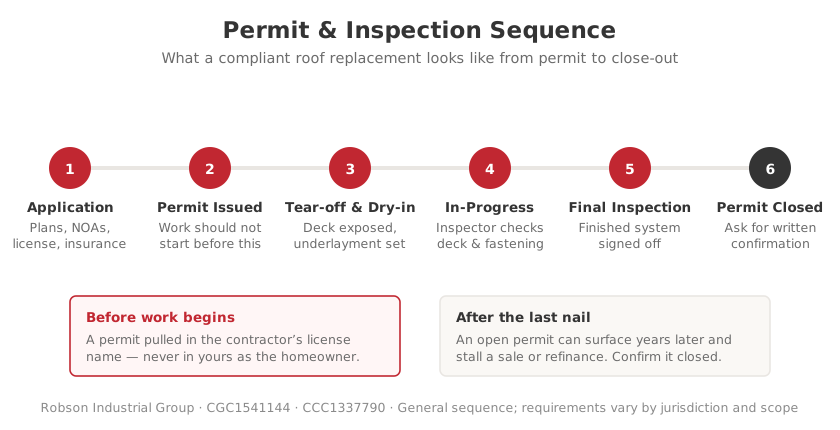
| Step | Action | Party Responsible | Typical Timeline | Key Documents Required |
|---|---|---|---|---|
| 1 | Pre-Permit Inquiry — Confirm requirements, fees, and any property-specific conditions before submission | Contractor (CGC1541144 / CCC1337790) | Day 1 | Property address; preliminary project scope |
| 2 | Application Submission — Submit permit application with scope of work, contractor license numbers, and COI | Contractor (CGC1541144 / CCC1337790) | Days 1–2 | Completed application; COI naming City as additional insured; license numbers CGC1541144 and CCC1337790 |
| 3 | Plan Review — Building Dept reviews specifications; HVHZ product approval (Miami-Dade NOA or HVHZ-listed FL PA) required for all roofing products | City of Lighthouse Point Building Dept | 5–10 business days | NOA / HVHZ approval documentation for every roofing product |
| 4 | Permit Issuance and Fee Payment — Permit issued upon plan review approval; contractor pays permit fee; placard issued for on-site display | Building Dept and Contractor | 1–2 business days after approval | Permit placard must be displayed on-site throughout project |
| 5 | Work Commences — Roofing project begins; permit placard on-site; NOA / HVHZ approval documentation accessible | Contractor crew | Per project schedule after permit issuance | Permit placard; NOA / HVHZ approval documentation; fastener and underlayment spec sheets |
| 6 | Inspection — City inspector verifies HVHZ product approval, fastener schedule, underlayment type, and workmanship | City Building Inspector | Day of or within 1 business day of inspection request | All NOA / HVHZ approval docs; fastener schedule; underlayment spec sheet |
| 7 | Final Permit Closeout — Permit closed on passed final inspection; record permanently added to property's permit history | City Building Dept | Same day as passed final inspection | Final inspection certificate; homeowner retains copy for insurance and resale files |
Why Permits Matter on High-Value Lighthouse Point Homes
Pulling a permit is a legal requirement, not a formality. For a Lighthouse Point property valued at $1 million or more, unpermitted roofing work creates compounding downstream problems:
- Real estate disclosure: Florida law requires disclosure of unpermitted work at sale. Buyers and lenders frequently require remediation — re-doing work under permit — or use unpermitted work to negotiate price reductions.
- Insurance claim exposure: Citizens Insurance and private insurers can and do deny storm damage claims traced to unpermitted roofing work. A claim denied on a $60,000 roof damage event far exceeds any savings from skipping a permit.
- HOA and deed restriction compliance: Some Lighthouse Point neighborhoods carry deed restrictions on roof material, color, or profile enforced through the permit process. Robson Industrial Group (CGC1541144 · CCC1337790) reviews deed restrictions before specifying a system — before the permit is submitted, not after rejection.
- Post-storm documentation: A closed building permit with a passed final inspection is auditable evidence of compliant installation. In a post-storm insurance claim, a complete permit trail supports approval; its absence invites denial.
Robson Industrial Group (CGC1541144 · CCC1337790) manages the City of Lighthouse Point permit process from application submission through final inspection closeout as a standard, integrated part of every roofing project. Lighthouse Point homeowners are never required to navigate permitting on their own.
Contractor License Verification for Lighthouse Point Homeowners
Lighthouse Point's combination of affluent demographics, high property values, and seasonal storm activity makes it a target for unlicensed roofing operators. Following any named tropical system or hurricane, unlicensed contractors — sometimes called "storm chasers" — canvas coastal Broward neighborhoods offering rapid bids at prices that appear competitive. The risks of hiring an unlicensed operator on a Lighthouse Point home are substantial: no permit, no proper specification, no insurance coverage, no manufacturer warranty, and no recourse if the roof fails or the contractor disappears after payment.
How to Verify CGC1541144 and CCC1337790 at myfloridalicense.com
All Florida-licensed contractors are listed on the Florida Department of Business and Professional Regulation (DBPR) public license portal at myfloridalicense.com. To verify Robson Industrial Group:
- Navigate to myfloridalicense.com and select "Verify a License."
- Enter license number CGC1541144 (Certified General Contractor) or CCC1337790 (Certified Roofing Contractor) in the license number search field.
- Confirm the license status shows Active, the licensee name matches Robson Industrial Group LLC (qualifier: Francisco Rijo), and the expiration date is current.
- Ask for a current Certificate of Insurance (COI) showing General Liability and Workers' Compensation coverage naming your property address as the project location.
Any contractor unwilling to provide a verifiable Florida license number or a current COI should not receive a roofing contract on a Lighthouse Point property, regardless of the bid amount. An unlicensed roofer working on a $1.5 million Lighthouse Point home is not a bargain. It is a liability the homeowner absorbs in full.
Questions to Ask Before Signing Any Lighthouse Point Roofing Contract
- What is your Florida Certified Roofing Contractor license number? — Robson Industrial Group: CCC1337790
- What is your Florida Certified General Contractor license number? — Robson Industrial Group: CGC1541144
- Can you provide a current Certificate of Insurance for General Liability and Workers' Compensation?
- Are you pulling the permit with the City of Lighthouse Point Building Department? (If the answer is "you can pull it yourself" or "permits aren't required" — walk away.)
- What Miami-Dade NOA or HVHZ-listed Florida Product Approval applies to each roofing material you're specifying? (Lighthouse Point is in the HVHZ.)
- Is this home pre-1978? If yes: what is your EPA RRP Firm Certification number?
- Are you a GAF Certified Residential Roofing contractor? Can you issue a GAF System Plus Limited Warranty? (Only GAF Certified Residential Roofing contractors can — Robson Industrial Group holds GAF ID 1164276.)
GAF Certified™ Status: The Additional Credential Layer for Lighthouse Point Homeowners
Florida contractor licensing establishes legal authorization. GAF Certified™ Residential Roofing Contractor status, held by Robson Industrial Group under GAF ID 1164276, is an additional manufacturer-issued credential that requires verified state licensing, current insurance, and documented industry standing. For Lighthouse Point homeowners whose homes represent seven-figure investments, the full credential stack of CGC1541144 (FL Certified GC) + CCC1337790 (FL Certified Roofing Contractor) + GAF Certified™ status (GAF ID 1164276) represents the complete verification picture: state-licensed, insured, and manufacturer-vetted as qualified to register the GAF System Plus Limited Warranty. That combination is not available from the majority of roofing contractors operating in Broward County, and it is certainly not available from unlicensed operators bidding storm-damaged coastal homes at discounted prices.
Frequently Asked Questions: Lighthouse Point Roofing
Yes. Lighthouse Point sits right on the Intracoastal with ocean access through the Hillsboro Inlet, and it is a Broward County city, and the Florida Building Code puts all of Broward County in the High Velocity Hurricane Zone alongside Miami-Dade, inland and waterfront alike. What that means for your roof: every product must be approved for HVHZ use, a Miami-Dade NOA or a Florida Product Approval whose evaluation specifically covers the HVHZ, and we build to HVHZ design wind speeds, roughly 170 mph and up (ASCE 7 Risk Category II; the exact figure for your parcel comes from the FBC wind-speed map). A plain statewide FL approval with no HVHZ listing does not pass plan review. Robson Industrial Group (CGC1541144 · CCC1337790) submits the NOA or HVHZ-listed approval paperwork on every permitted roof we build in the City of Lighthouse Point.
Standing seam metal and good concrete or clay tile, and it is not close. Metal with a Kynar fluoropolymer finish and stainless or heavy-galvanized hardware will run 50+ years out here and scores the highest on wind-mitigation inspections. Tile holds up almost as well when we install it with marine-grade synthetic underlayment, copper or stainless flashing at every penetration, and fasteners that will not corrode. Shingles are the one we steer people away from this close to the water: salt air strips the granules and breaks down the mat faster than it would further inland, so you are looking at 15–20 years instead of the 25–30 you would get away from the coast. On every Lighthouse Point job, whatever system you pick, Robson Industrial Group (CGC1541144 · CCC1337790, GAF ID 1164276) specs the coastal-grade version of it.
It depends on your current roof age, construction, roof shape, and what wind-mitigation credits you already have. We see Lighthouse Point homeowners on Citizens Insurance with coastal exposure commonly paying $8,000–$20,000 or more a year just on the wind portion. Put in a compliant new roof installed by licensed contractor Robson Industrial Group (CGC1541144 · CCC1337790), get a fresh OIR-B1-1802 wind-mitigation inspection, and the credits across roof covering, deck attachment, and secondary water resistance can bring that wind premium down 20–40% in many cases. If your house has a hip roof, common in Lighthouse Point's 1960s–1970s housing stock, that geometry credit alone is significant. The actual savings only get confirmed once a licensed Florida wind-mitigation inspector performs the inspection after the work is done.
Yes, no way around it. Homes built before 1978 can have lead-based paint, and any roofing or renovation work that disturbs painted surfaces legally requires the contractor to hold EPA Renovation, Repair and Painting (RRP) Firm Certification under Section 402 of TSCA. Robson Industrial Group holds that certification, #NAT-F338229-1, through 6/23/2031. This is not a nice-to-have, it is federal law, and a contractor working your pre-1978 Lighthouse Point home without active RRP Firm Certification puts both of you, contractor and homeowner, in legal and financial exposure. Ask every contractor bidding a pre-1978 property for their EPA RRP Firm Certification number and expiration date before you sign anything. Robson Industrial Group (CGC1541144 · CCC1337790) hands that documentation over with every estimate on a pre-1978 Lighthouse Point home.
It covers the GAF materials in the system, with longer non-prorated coverage than a standard shingle warranty, and it is important to be precise about that. Install a qualifying complete GAF system, the shingles, underlayment, ventilation products, and leak barrier all working together, and GAF System Plus gives you enhanced coverage against manufacturing defects in those components, including wind coverage up to the system's rated speed. It does not cover workmanship. On a Lighthouse Point home, where getting back up on the roof to fix an installation problem is not cheap, that is why we also put Robson's own written workmanship warranty, with its term, in every contract. Because Robson Industrial Group (CGC1541144 · CCC1337790) holds GAF Certified™ Residential Roofing Contractor status under GAF ID 1164276, your Lighthouse Point home is eligible for this enhanced warranty, a level of protection non-certified contractors are not authorized to register no matter which GAF products they install.