Homestead sits at the southern tip of Miami-Dade County. Hurricane Andrew's ground zero in 1992. The storm that rebuilt this city also gave it some of the most stringent roofing codes in the nation. Today, every Homestead roof replacement must meet High-Velocity Hurricane Zone (HVHZ) standards: Miami-Dade Notice of Acceptance (NOA) materials, a 6-nail fastener pattern, SBS-modified underlayment, and ring-shank deck nails.
That complexity is exactly what unlicensed and out-of-state contractors exploit after every storm. This guide gives you a plain-English framework for verifying a contractor's license through the Florida DBPR, understanding what HVHZ compliance means for your specific project, and protecting yourself from the scams that have targeted Homestead homeowners since Andrew.
Who This Guide Is For
- Homestead and Florida City homeowners planning a roof replacement or repair
- Property owners in unincorporated South Miami-Dade (Leisure City, Princeton, Naranja, Goulds)
- Anyone who recently received a storm-damage claim and is vetting contractors
- HOA members and property managers sourcing bids for multi-unit roofing projects
Homestead Neighborhoods We Serve
South Miami-Dade is not uniform ground for a roofing crew. A century-old bungalow near Flagler Avenue in Historic Downtown Homestead presents a completely different scope than a post-Andrew townhome in Keys Gate or a large-span roof on a Redland grove property. Knowing the neighborhood tells you what to expect before the ladder goes up.
Historic Downtown Homestead
The Flagler Avenue and Krome Avenue corridor is the original townsite laid out around Henry Flagler's Florida East Coast Railway terminus in the early 1900s. Decades before Hurricane Andrew. This area has the highest concentration of true pre-1978 structures in the city, alongside buildings rebuilt or heavily retrofitted after 1992. A roofing contractor working downtown needs to identify, house by house, whether they're dealing with original early-20th-century framing (which may need significant deck upgrades to meet current HVHZ fastening) or a post-Andrew rebuild that's already largely code-compliant.
Keys Gate
Keys Gate is a master-planned community built starting in the mid-1990s, entirely after Hurricane Andrew and entirely under the current HVHZ code. Homes here typically already have hip roofs, NOA-rated materials from original construction, and ring-shank deck attachment: a re-roof is usually a straightforward like-for-like material swap rather than a full structural assessment. The Keys Gate Community Association governs exterior approvals, including roofing material and color, for most parcels.
Redland
The Redland agricultural district borders Homestead to the west and is known for large-lot estate and farm properties rather than dense subdivisions. Roofing here often means larger, more exposed roof spans on primary residences plus outbuildings (packing sheds, barns, equipment structures) that may fall under different permitting and NOA requirements than a standard residential reroof. The open agricultural terrain also means less windbreak from surrounding structures, a factor addressed below.
Why Homestead's Open, Agricultural-Edge Terrain Adds Wind Exposure
Homestead sits at the edge of a vast, flat agricultural plain that stretches west toward the Everglades. One of the most open, low-obstruction landscapes in Miami-Dade County. Unlike dense urban Miami, where surrounding buildings create some wind-shadowing effect, a Homestead roof on the western and southern edges of the city faces largely unobstructed wind fetch across miles of low-lying farmland during a hurricane. That open terrain was a documented factor in the severity of damage during Hurricane Andrew, and it's one more reason HVHZ code enforcement in Homestead isn't treated as a formality: the same storm that produces moderate damage in a tree-lined, tightly built Miami neighborhood can hit a Redland-edge property with less resistance in its path. Agricultural operations nearby also mean post-storm debris fields can include displaced greenhouse panels, irrigation structures, and grove debris in addition to standard residential wind-borne debris: a detail your contractor's post-storm inspection should account for.
Florida Roofing License Types — What They Mean
Before you accept a single bid, confirm the contractor holds a valid Florida roofing or general contractor license. There are three license categories that allow roofing work in Homestead:
| License Type | Prefix | Scope | Works in Homestead? |
|---|---|---|---|
| FL Certified Roofing Contractor | CCC | Roofing work statewide — unlimited scope | Yes ✓ |
| FL Certified General Contractor | CGC | All trades including roofing, statewide | Yes ✓ |
| Registered Contractor | RC / CC | Limited to specific municipality or county | Depends on registration jurisdiction |
Robson Industrial Group LLC holds both CGC1541144 (FL Certified General Contractor) and CCC1337790 (FL Certified Roofing Contractor). Both licenses are verified active at myfloridalicense.com.
Never hire based on a verbal claim or a photocopy of a license card. Fraudulent contractors routinely use expired licenses, borrowed license numbers, or the credentials of another company. The 7-step verification below closes that door.
How to Verify a Roofing License — 7 Steps
- Go to myfloridalicense.com and click Verify a License in the top navigation.
- Select the profession. Choose "Roofing Contractor" for a CCC license or "General Contractor" for a CGC.
- Enter the license number exactly as given — prefix and digits (e.g., CCC1337790 or CGC1541144).
- Confirm the licensee name matches the person or company you are contracting with. An exact match is required — a different name is a red flag.
- Check license status. Must read Current, Active. Expired, Delinquent, or Suspended means no legal authority to work.
- Confirm the expiration date is in the future and covers the period of your project.
- Request a Certificate of Insurance listing your name as additional insured — confirms active general liability and workers' compensation coverage for your project dates.
DBPR license verification: CGC1541144 (verify here | CCC1337790) verify here.
HVHZ Requirements for Homestead Roofing
All of Miami-Dade County, including every address in Homestead and Florida City, falls within the High-Velocity Hurricane Zone. The HVHZ code was adopted in direct response to Hurricane Andrew, which destroyed approximately 63,000 homes in South Miami-Dade in August 1992. A contractor who does not know these requirements has no business working on a Homestead roof.
| HVHZ Requirement | What It Means for Your Roof | Why It Matters |
|---|---|---|
| Miami-Dade Notice of Acceptance (NOA) | All materials — shingles, tiles, metal panels, underlayment — must carry a valid NOA from Miami-Dade Product Control | Proves the product was tested to withstand 130+ mph sustained winds under actual assembly conditions |
| 6-nail fastener pattern | Each shingle receives 6 roofing nails; eave rows receive additional fasteners at closer spacing | Directly addresses the nail-pattern failures that caused mass shingle loss during Andrew |
| SBS-modified underlayment | Polymer-modified bitumen underlayment required — standard 15 lb. felt alone is prohibited under the HVHZ | Secondary water barrier that performs if the primary surface is damaged during a storm |
| 19/32-inch minimum deck | OSB or plywood roof deck must be at least 19/32 inch thick | Provides enough material for ring-shank nails to grip and resist pull-through under wind uplift |
| Ring-shank deck nails at 6/12 spacing | Ring-shank (annular ring) nails spaced 6 inches at panel edges, 12 inches in field | Ring-shank profile dramatically increases pull-out resistance vs. smooth-shank nails; required per TAS 105/106 |
| NOA assembly-specific compliance | Each installation must follow the exact fastening and installation specs of the specific NOA number — not the manufacturer's generic instructions | NOA approval is assembly-specific; deviating from the approved assembly voids the approval and your permit |
Homestead / Andrew Context: Why These Codes Exist
Hurricane Andrew made landfall near Homestead on August 24, 1992 with 165 mph sustained winds: the most destructive hurricane in U.S. history at the time. Post-storm forensic analysis by the South Florida Building Code Committee found that most roof failures were not caused by winds exceeding design limits, but by improper installation: wrong nail counts, wrong nail types, insufficient deck thickness, and materials that had never been tested to the wind speeds the region actually experiences. The HVHZ code is a direct legislative response. Every requirement has a specific failure mode it was designed to prevent.
The Permit Process for a Homestead Roof Replacement
Florida Statute §553.79 requires a permit for any roof replacement in Florida. In Homestead, permit jurisdiction depends on your exact address:
- City of Homestead addresses: Permit from the City of Homestead Building Department (790 N. Homestead Blvd., Room 103)
- City of Florida City addresses: Permit from Florida City Building Department (404 W. Palm Dr.)
- Unincorporated South Miami-Dade (Leisure City, Princeton, Naranja, Goulds, Redland): Miami-Dade County Building Department — South District office
Whichever jurisdiction applies, plan on a Notice of Commencement (NOC) recorded for any project over $2,500 per Florida Statute §713.13, and budget permit fees calculated from declared project valuation. Typically several hundred dollars for a standard single-family reroof, more for larger multi-family or agricultural structures out in the Redland. Both the City of Homestead and Miami-Dade County now accept permit applications and inspection scheduling online, which can shave days off the process during peak post-storm demand.
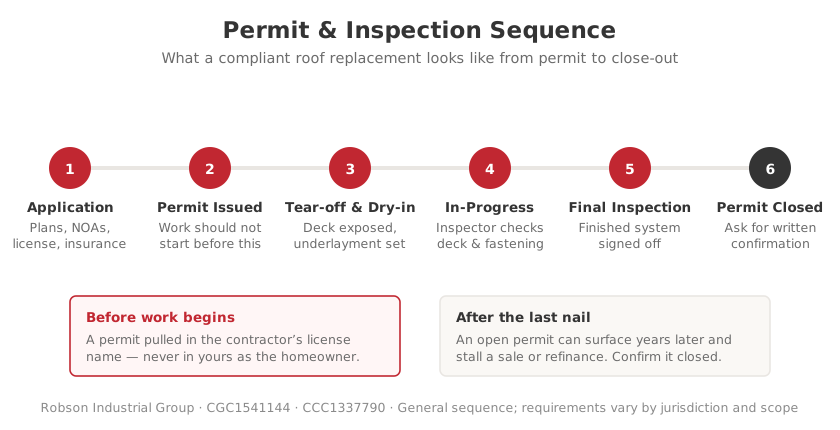
Regardless of jurisdiction, the sequence is the same:
- Contractor pulls the permit before any work begins. The permit application includes the NOA number for each material, the installation method, and deck specification. An owner-builder permit is possible but rare for a full replacement.
- Decking inspection after existing material is removed and new deck boards are attached but before underlayment is applied. Inspector confirms deck thickness, ring-shank nail type, and nail pattern.
- Underlayment inspection (some jurisdictions) before the primary roofing material is installed. Confirms SBS specification and installation method.
- Final inspection after all work is complete. Inspector verifies material NOA compliance, fastener counts, and installation per the approved plans. A passed final inspection generates a Certificate of Completion — request a copy and keep it with your home records.
Never Let a Contractor Skip the Permit
Unpermitted roofing work in Homestead creates serious downstream problems: insurance companies can deny wind or water claims on an unpermitted roof, mortgage lenders can demand remediation, and the permit obligation does not disappear: a future buyer's inspector or their title company will find the open or missing permit, often killing the sale or requiring full re-roofing at the seller's expense. The permit cost (typically $250–$800 depending on project scope and jurisdiction) is always worth it.
9 Types of Contractor Fraud Targeting Homestead Homeowners
Homestead's hurricane history makes it a recurring target for storm-chaser contractors: out-of-state operators who arrive after every named storm, solicit work door-to-door or through insurance adjusters, and disappear before inspections or warranty claims. Here are the nine fraud types to know:
| Fraud Type | How It Works | Protection |
|---|---|---|
| Storm chaser | Out-of-state contractors arrive immediately post-storm with unmarked trucks, no local license, and lowball quotes | Verify license at myfloridalicense.com before any discussion |
| License number borrowing | Unlicensed contractor uses someone else's license number on paperwork | Confirm the licensee name matches who you're contracting with |
| Insurance assignment fraud (AOB) | Contractor asks you to sign an Assignment of Benefits, then submits inflated claims to your insurer | Never sign an AOB — Florida largely eliminated this practice but some still attempt it |
| Permit-less work | Contractor avoids permit to speed up project and cut costs, leaving you with unpermitted work | Verify permit number at your local building department before work starts |
| Material substitution | Quote lists NOA-approved materials; installation uses cheaper non-NOA substitutes | Get material spec sheet with NOA numbers in writing; inspect delivery before installation |
| Disappearing-deposit scam | Collects 40–50% deposit, never returns, or returns weeks later and does poor work | Standard draw: 10–15% at contract signing, milestone payments, 10% retention at final inspection |
| Fake GAF or manufacturer certification | Claims to be a GAF Certified Residential Roofing Contractor or manufacturer-authorized installer without actual certification | Verify GAF Certified status at gaf.com/roofers; ask for installer ID number |
| Nail gun speed work | Uses nail gun at wrong angle or pressure, resulting in under-driven or over-driven nails that fail NOA pattern requirements | Request inspector report showing passed decking inspection; be present if possible |
| Phantom permit | Tells you they pulled a permit; no permit actually exists — discovered only at sale or insurance claim | Verify permit number yourself at the building department's public permit portal |
Proposal Checklist — What Every Homestead Bid Must Include
A legitimate roofing proposal for a Homestead project includes every item below. Missing items are not minor oversights: they are signals of either incompetence or intentional ambiguity to cut corners later.
| Proposal Item | What to Look For |
|---|---|
| Contractor license numbers | Both CGC and/or CCC numbers printed on the proposal — not just "licensed & insured" |
| Material specification with NOA numbers | Specific manufacturer, product name, and Miami-Dade NOA number for shingles/tiles, underlayment, and any accessory products |
| Deck specification | 19/32-inch minimum deck thickness confirmed; ring-shank nail type and 6/12 spacing explicitly stated |
| Fastener count | 6-nail pattern confirmed for field shingles; starter course and eave rows specified |
| Underlayment type | SBS-modified bitumen specified — not "standard underlayment" or "15 lb. felt" |
| Permit responsibility | States contractor is responsible for pulling the permit and scheduling all inspections |
| Payment schedule | 10–15% at signing, milestone payments, 10% final retention — never more than 10% at signing for a new project |
| Warranty terms | Manufacturer warranty (product) and contractor warranty (workmanship) both specified with duration and exclusions |
| Insurance certificates | General liability ($1M+ per occurrence) and workers' comp — COI naming you as additional insured |
| Clean-up and debris disposal | Specifically addresses removal of old roofing material from the property and disposal method |
Wind Mitigation — What a New Homestead Roof Saves You
South Miami-Dade homeowners pay some of the highest property insurance premiums in Florida. A properly documented HVHZ-compliant roof is one of the most effective ways to reduce that cost.
After your new roof is installed and passes final inspection, hire a licensed wind mitigation inspector to complete the OIR-B1-1802 Wind Mitigation Verification form. This form documents your roof shape, deck attachment, secondary water resistance (SBS underlayment), and opening protection. Submit it to your insurance carrier for a rate review.
Typical Homestead homeowner wind mitigation discounts:
- Hip roof shape: The single largest discount factor — a fully hip roof qualifies for the maximum shape credit. Many Homestead post-Andrew construction homes already have hip roofs.
- Deck attachment (ring-shank nails, 6/12 pattern): Earns the highest nail pattern credit — worth 10–20% alone
- SBS underlayment: Qualifies for secondary water resistance credit
- Total combined savings: 15–35% off your annual windstorm premium
On a South Miami-Dade premium of $5,000–$8,000 per year (not unusual in this zip code range), a 25% wind-mit credit saves $1,250–$2,000 annually. Over a 20-year roof lifespan, that's $25,000–$40,000 in cumulative insurance savings. Often exceeding the cost of the roof itself.
GAF Certified™ Residential Roofing Contractor — What It Means
Robson Industrial Group is a GAF Certified™ Residential Roofing Contractor (GAF ID: 1164276). GAF certification is earned, not purchased, and requires a demonstrated track record of proper installation and customer service.
The certification unlocks access to GAF's System Plus Limited Warranty, an enhanced warranty on the GAF materials in qualifying installations; workmanship is covered separately by Robson's own written warranty, with the term stated in your contract. Standard roofing warranties only cover manufacturing defects in the material. The System Plus warranty extends protection to the full roofing system when all components are GAF-approved and the installation is performed by a GAF Certified Residential Roofing Contractor.
Verify GAF Certified status at gaf.com/roofers using contractor name or ZIP code.
Financing
Financing may be available through third-party providers, subject to their approval and terms. Ask us for details.
What a Robson Estimate for a Homestead Home Includes
A written estimate from Robson Industrial Group for a Homestead roofing project is never a single price line. Every estimate includes:
- On-site roof, attic, and deck inspection — deck thickness, fascia/soffit condition, and framing age assessed before any number is finalized
- NOA material specification — exact manufacturer, product line, and Miami-Dade Notice of Acceptance number for your specific roof assembly
- Deck repair allowance — a stated per-sheet price for bringing decking up to the 19/32-inch HVHZ minimum, so you know the number before tear-off uncovers it
- Fastener and underlayment spec — 6-nail pattern, ring-shank gauge, and SBS-modified underlayment written out, not assumed
- Permit responsibility and jurisdiction — City of Homestead, Florida City, or Miami-Dade County permit pulled in Robson's name, with all inspections scheduled by us
- EPA RRP compliance check — flagged automatically for any pre-1978 property (see below)
- Wind mitigation inspection referral — scheduled after your Certificate of Completion so your insurance discount filing doesn't sit idle
- Written manufacturer and workmanship warranty terms — years and coverage spelled out in the contract
If a competing Homestead estimate skips the NOA number, the deck allowance, or the EPA RRP question on an older property, ask why before you sign.
EPA RRP Lead-Safe Certification: A Checklist for Pre-1978 Homestead Properties
Homestead's building stock spans nearly a century. From early-1900s Flagler-era construction downtown to homes built the week before Hurricane Andrew in 1992, right up to post-Andrew HVHZ-code construction in communities like Keys Gate. If your property was built before 1978, federal law requires more than a licensed roofer: it requires a contractor certified under the EPA's Renovation, Repair, and Painting (RRP) Rule before they can legally disturb painted fascia, soffits, or trim during your roofing project. Demolition of these components on an older home can release lead dust, which is a documented health risk especially for young children and pregnant women. Use this checklist before you sign:
- Confirm your build date. Miami-Dade County Property Appraiser records show the year built for any Homestead, Florida City, or unincorporated South Miami-Dade parcel.
- Ask for the contractor's RRP certification number directly — not a verbal “yes, we're certified.”
- Confirm the certification is current. EPA RRP firm certifications expire and must be renewed.
- Ask what containment practices they use around painted trim, fascia, and soffits during tear-off — plastic sheeting, HEPA vacuum cleanup, and proper disposal are standard practice under the rule.
- Get it in writing as a line item in your contract, not just a verbal assurance.
Robson Industrial Group LLC holds EPA RRP Certification #NAT-F338229-1 (expires 6/23/2031), certified only for purposes of Section 402 of the Toxic Substances Control Act (TSCA). Ask to see it before we start work on any pre-1978 Homestead or Florida City property.
Red Flags That Should Stop a Homestead Hire Immediately
| Red Flag | What It Signals |
|---|---|
| Cannot provide a license number on the spot | Possibly unlicensed or using borrowed credentials |
| Does not mention HVHZ or NOA requirements | Unfamiliar with Miami-Dade code — will produce non-compliant work |
| Requests more than 15% upfront payment | Florida law (F.S. 489.126) does not cap deposits, but over 10% up front obliges the contractor to apply for the permit within 30 days and start within 90 days of permit issuance |
| Offers to handle your insurance claim for you | Potential Assignment of Benefits (AOB) or public adjuster fraud setup |
| Cash-only pricing with no written contract | No paper trail = no recourse when work is defective |
| Arrived unsolicited after a storm | Storm chasers statistically have 3–4× higher rates of complaints and licensing violations |
| Will not provide proof of workers' comp | You may be liable for injuries on your property if contractor has no coverage |
| Quote is dramatically lower than all others | Skimping on materials, labor, or compliance — HVHZ work has real cost floors |
Why Homestead Homeowners Choose Robson Industrial Group
Robson Industrial Group LLC is a Miami-Dade licensed general and roofing contractor, CGC1541144 and CCC1337790, serving Homestead, Florida City, and surrounding South Miami-Dade communities. We hold both Florida Certified licenses, carry full general liability and workers' compensation, and are a GAF Certified™ Residential Roofing Contractor (GAF ID: 1164276).
We are local, based in Miami-Dade County, not storm chasers. Every project we execute meets HVHZ code and passes Miami-Dade or City of Homestead inspection. We pull every permit and handle every inspection, and we provide the Certificate of Completion and wind mitigation documentation you need to file for your insurance discount.
What You Get When You Call Robson
- Verified Florida licenses: CGC1541144 & CCC1337790
- GAF Certified™ installation (GAF ID 1164276) — qualifies for System Plus warranty
- Full HVHZ compliance: NOA materials, 6-nail pattern, SBS underlayment, ring-shank deck nails
- We pull every permit and coordinate every inspection
- Wind mitigation documentation for insurance discount filing
- Written warranty covering both product and workmanship
Frequently Asked Questions
What licenses must a roofing contractor have to work in Homestead, FL?
Any contractor doing roofing work in Homestead (Miami-Dade County) must hold either a Florida Certified Roofing Contractor license (CCC prefix) issued by the DBPR, or a Florida Certified General Contractor license (CGC prefix). Locally-registered contractors can also work within their registered municipality. Verify the exact license number at myfloridalicense.com before signing any contract. Robson Industrial Group holds both CGC1541144 and CCC1337790.
Does Homestead fall inside the High-Velocity Hurricane Zone (HVHZ)?
Yes. Homestead is entirely within Miami-Dade County, which is fully designated as a High-Velocity Hurricane Zone (HVHZ). Every roofing project must use materials and methods that carry a valid Miami-Dade Notice of Acceptance (NOA), require a 6-nail fastener pattern at field and eaves, SBS-modified underlayment (no standalone felt), and 19/32-inch minimum deck with ring-shank nails at 6/12 spacing. These are the same code requirements adopted after Hurricane Andrew devastated Homestead in 1992.
Do I need a permit for a roof replacement in Homestead?
Yes. Florida Statute §553.79 requires a permit for any roof replacement in Homestead, whether the work is done in the City of Homestead, the City of Florida City, or unincorporated Miami-Dade County surrounding the area. Your contractor must pull the permit before work begins and schedule all required inspections, decking, underlayment, and final. Never allow a contractor to proceed without a permit; unpermitted roofs can trigger insurance cancellation and cause major complications when you sell.
How do I verify a roofing contractor's license in Florida?
Go to myfloridalicense.com, select "Verify a License," choose the appropriate profession (Roofing Contractor for CCC, or General Contractor for CGC), and enter the license number exactly as provided. Confirm the licensee name matches who you're contracting with, the license status shows "Current, Active," and the expiration date is in the future. Also verify the contractor carries general liability insurance and workers' compensation by requesting a Certificate of Insurance naming you as an additional insured.
What insurance discount can I get for a new HVHZ-compliant roof in Homestead?
Homestead homeowners with a properly installed, HVHZ-compliant roof can qualify for a wind mitigation credit of 15–35% off their annual homeowners insurance premium via the OIR-B1-1802 wind mitigation inspection form. The discount is based on roof shape, deck attachment, underlayment type, and opening protection. A hip roof with ring-shank deck nails, SBS underlayment, and impact-rated openings earns the maximum credit. On a $4,000–$8,000 annual premium typical in South Miami-Dade, this represents $600–$2,800 in savings per year.
Does historic downtown Homestead have special roofing considerations?
Yes. Much of Historic Downtown Homestead near Flagler and Krome Avenues predates Hurricane Andrew and, in some structures, predates 1978. These properties need individual assessment to determine whether original framing and decking meet current HVHZ fastening requirements, and older structures may also trigger EPA RRP lead-safe work practice requirements. A post-Andrew rebuild a few blocks away may need none of that extra scope.
Is a re-roof in Keys Gate different from an older Homestead neighborhood?
Generally simpler. Keys Gate was built entirely after 1992 under the current HVHZ code, so homes typically already have hip roofs, NOA-rated materials, and correct deck attachment from original construction. A re-roof there is usually a like-for-like material swap rather than the structural upgrades often required on pre-Andrew homes elsewhere in Homestead. Keys Gate Community Association approval for material and color is still required before permitting.
How much does a full roof replacement cost in Homestead?
HVHZ-compliant roof replacements in Homestead typically run higher than non-HVHZ areas of Broward or northern Miami-Dade, given the NOA material requirements, 6-nail fastener pattern, and SBS underlayment mandated code-wide. Expect a range of roughly $10,000–$35,000+ depending on square footage, material (asphalt shingle at the low end, tile at the high end), and whether deck replacement is needed. Get an itemized written estimate: see the checklist above for exactly what should be broken out.
Get a Free Roofing Estimate in Homestead
Licensed, HVHZ-compliant, GAF Certified™, serving Homestead, Florida City, and South Miami-Dade. Lic. CGC1541144 · CCC1337790.
Request a Free Estimate