Why a Fort Lauderdale Roof Is Not a Miami Roof
The first thing to get straight about roofing in Fort Lauderdale is that it is not Miami. You are in Broward County, which the Florida Building Code puts inside the High-Velocity Hurricane Zone along with Miami-Dade, both in their entirety. Same HVHZ code, different permit desk. Contractors who work both counties still mix up the paperwork regularly, and you are the one who pays for it when the permit bounces.
The second thing is that this city is not one market. A 1930s masonry cottage in Flagler Heights and a waterfront estate in Las Olas Isles are two different jobs with two different approval paths, and a Harbor Beach condo is a third. Add Victoria Park, Progresso Village, Tarpon River and Croissant Park and you have most of the building vintages Florida has produced since 1925, sometimes on the same street.
Then there is the salt. Between the Atlantic, the Intracoastal Waterway and the New River, a very large share of this city sits inside a mile of salt water, and salt air eats fasteners. This is the most common thing we get called out to look at on a roof that is only eight or ten years old: the covering is fine, the fasteners are rusted through, and tiles are lifting or the panel is loose. Inside that mile you want hot-dipped galvanized or stainless steel fasteners, and you want them named on the proposal before you agree to it.
Anything built before 1978 brings a third layer. Much of Victoria Park, Colee Hammock, Rio Vista and the older parts of Tarpon River predates the lead-paint ban, and a roof job disturbs fascia, soffit and trim. That puts the work under the federal EPA Renovation, Repair and Painting rule. We hold EPA RRP Certification #NAT-F338229-1 (expires 6/23/2031) under Section 402 of TSCA, which is what lets us do that work legally rather than quietly.
We are Robson Industrial Group LLC, licensed CCC1337790 (Certified Roofing Contractor, our roofing license of record) and CGC1541144 (Certified General Contractor, for the general scope around the roof), both current and active, and a GAF Certified™ Residential Roofing Contractor (GAF ID 1164276). This guide is the same thing we would tell you standing in your driveway.
Broward vs. Miami-Dade: Same HVHZ Code, Different Permit Office
Both counties are the High-Velocity Hurricane Zone. What changes at the county line is who reviews your permit, not the wind standard your roof has to meet. Contractors who work both counties still mix up the paperwork, so here is what is identical and what actually differs:
| Category | Broward County — Fort Lauderdale | Miami-Dade County |
|---|---|---|
| In the HVHZ? | YES — entire county, entire city | YES — entire county |
| Product Approval Type | HVHZ approval required: Miami-Dade NOA, or an FL Product Approval whose evaluation covers the HVHZ | HVHZ approval required: Miami-Dade NOA is the standard reference |
| Wind Design Speed | HVHZ design speeds, roughly 170 mph and up (ASCE 7 Risk Category II); exact figure per parcel from the FBC wind-speed map | HVHZ design speeds, roughly 170 mph and up (ASCE 7 Risk Category II); exact figure per parcel from the FBC wind-speed map |
| Fastener Specification | Per the HVHZ product approval; marine-grade required near coast | Per the HVHZ product approval (NOA); marine-grade required near coast |
| Underlayment and Deck Nailing | Per the NOA or HVHZ-listed FL approval installation schedule, verified at the deck and underlayment inspections | Per the NOA installation schedule, verified at inspection |
| Permit Jurisdiction | City of Fort Lauderdale Building Services Division 700 NW 19th Ave · (954) 828-5150; Broward Board of Rules and Appeals (BORA) for code interpretations |
Miami-Dade County or the municipal building department |
| Insurance Impact | Wind-mit inspection (OIR-B1-1802) can reduce premiums 15–35% | Same form; credits may differ by insurer |
So: a plain statewide FL number with no HVHZ listing on a Fort Lauderdale permit application is the wrong application. The city and Broward's Board of Rules and Appeals enforce the HVHZ provisions of the Florida Building Code, and the correction notice comes back and costs you two weeks. It is a small detail that tells you a lot about who you are dealing with.
City of Fort Lauderdale Permit Process
Every reroof and every significant repair in Fort Lauderdale needs a permit from the City of Fort Lauderdale Building Services Division, 700 NW 19th Ave, Fort Lauderdale, FL 33311, (954) 828-5150. It is the biggest city in Broward and the queue reflects that. Build the wait into your plan instead of being surprised by it.
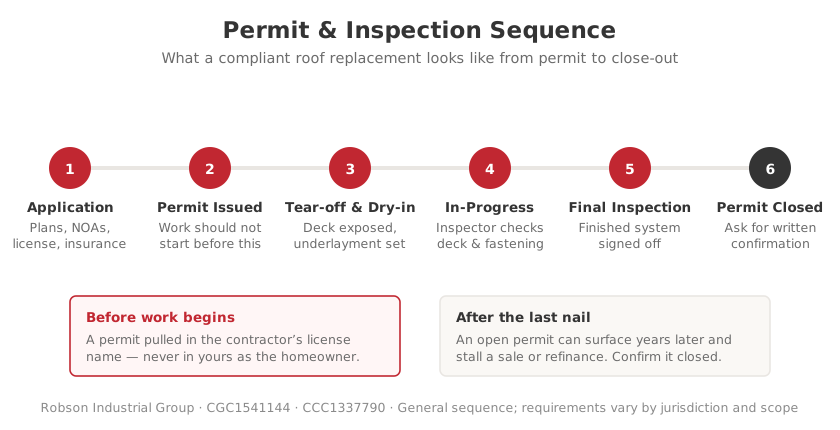
Typical Permit Timeline: 3–5 Weeks
- The contractor files. Not you. The licensed contractor of record files it, with the address, the scope, the HVHZ product approvals (NOA or HVHZ-listed FL#) for the system going on, his licence numbers and proof of insurance.
- Plan review. A straightforward residential reroof can go over the counter. A complex structure or a historic-district property takes longer, and Colee Hammock takes longer still.
- Corrections, if the filing was sloppy. A missing HVHZ approval, the wrong licence class, a vague scope. Every correction round resets the clock, which is the real reason permits drag.
- Permit issues and gets posted. It goes up at the job site. Nobody touches the roof before that, including for a "quick start" on the tear-off.
- Tear-off and inspections. The city inspector comes out for the deck nailing, again for the underlayment, and again at the end. We schedule those and we meet them; you should not be the one on the phone with the city.
- Close-out. Final passes, the permit closes, and you get the paperwork. Keep it. Your insurer will ask, and so will your buyer's inspector.
If you have an HOA or a condo board, get Architectural Review Committee approval before the city permit goes in. People do it the other way round all the time, and then the ARC comes back and requires a different tile than the one on the permit. Now you are re-permitting a job you already paid to permit. The order is ARC, then city permit, then installation.
We do the permit end to end: the application, the product approval paperwork, the inspection scheduling and the close-out. If you find yourself chasing your own permit, something has gone wrong with your contractor, not with the city.
HOA & Neighborhood Architectural Review in Fort Lauderdale
Some Fort Lauderdale streets have a formal HOA. Some have a civic association with real teeth and no HOA at all. Some sit in a city historic district, which is a separate review board on top of everything else. Knowing which one you are in, and in what order to approach them, saves more time on a roof job here than anything that happens on the roof itself.
| Neighborhood | ARC / Review Process | Typical Timeline | Common Restrictions | Common Approved Materials |
|---|---|---|---|---|
| Las Olas Isles | Mandatory ARC submission for all exterior changes; some sub-associations have separate review boards | 15–30 days | Color must match neighborhood palette; material must maintain waterfront character; some prohibit asphalt shingle on waterfront-facing slopes | Concrete tile (earth tones), metal standing seam (muted colors), clay tile |
| Victoria Park | Victoria Park Civic Association plus City of Fort Lauderdale historic overlay for some blocks; ARC and neighborhood association review | 20–35 days | Architectural compatibility with 1930s–1950s stock; limitations on visible rooftop equipment; period-appropriate materials preferred | Flat/modified bitumen (ranch styles), asphalt shingle (approved colors), metal (select styles) |
| Harbor Beach | Harbor Beach Property Owners Association; mandatory ARC for roofing; strict enforcement | 15–25 days | Coastal character preservation; marine-grade fasteners required (association-level rule, not just code); color approval required | Concrete tile, clay tile, standing seam metal (silver/charcoal) |
| Rio Vista | Rio Vista Civic Association; review via association board; not all blocks are HOA-mandated but many have deed restrictions | 10–20 days | Deed restrictions may limit material types; waterfront lots have additional review considerations | Concrete tile, standing seam metal, asphalt shingle (approved colors) |
| Colee Hammock | City of Fort Lauderdale Historic District designation; Architectural Review Board (city level) required for exterior changes | 30–45 days (historic review) | Must preserve historic character; modern materials may require justification; alteration of roofline shape generally not permitted | Standing seam metal (on appropriate historic styles), flat/modified bitumen (concealed), slate-profile tile |
Waterfront Condo Considerations
On the Intracoastal and beach corridors you are usually dealing with a condo board, not an HOA, and a major roof often means a special assessment vote before anyone signs anything. In practice a property manager runs the process and reports to the board. Expect your contractor to sit in that meeting, present the proposal himself, and answer questions about product approvals and fastener specs in front of the owners. If he will not do that, he is not ready for condo work.
Non-HOA Neighborhoods: Flagler Heights, Progresso Village, Tarpon River, Croissant Park
No mandatory HOA on most of these streets, but the building code still applies in full, and the housing here is largely pre-1978. That makes lead-safe work practices federal law rather than a courtesy: disturb more than six square feet of painted surface on a pre-1978 house and the work has to be done by a certified RRP firm. We hold that certification, #NAT-F338229-1.
Roofing Materials for Fort Lauderdale's Coastal Climate
Four things decide the material here, and only one of them is taste: the wind design speed, how close you are to salt water, what your HOA will actually approve, and how long you intend to own the house. A Las Olas Isles waterfront estate and a Tarpon River bungalow are not the same problem and should not get the same recommendation.
| Material | Lifespan (FL Coast) | Coastal Performance | HOA Acceptance | Typical Cost Range (installed, per sq) |
|---|---|---|---|---|
| Asphalt Shingle (Architectural / Impact) |
15–25 years (coastal environment shortens lifespan vs. inland) | Moderate — algae and UV degradation accelerate in coastal humidity; requires marine-grade fasteners near water; impact-rated class required for FBC compliance | Restricted — many Fort Lauderdale HOAs (esp. Las Olas, Harbor Beach) prohibit or restrict shingle; accepted in non-HOA neighborhoods and Victoria Park (approved colors) | $350–$550/sq |
| Concrete Tile (Flat or S-profile) |
40–50+ years | Excellent — inherently wind-resistant at correct fastening; requires stainless or hot-dipped galvanized fasteners in coastal zones; excellent fire rating; does not corrode | Widely accepted — dominant material in HOA communities; Las Olas, Harbor Beach, Rio Vista all accept concrete tile; color must match ARC palette | $500–$800/sq |
| Metal — Standing Seam (Aluminum or Galvalume) |
40–60 years | Best-in-class — aluminum is inherently corrosion-proof; Galvalume steel also rated for coastal; no exposed fasteners eliminates corrosion entry points; superior hurricane wind uplift | Growing acceptance — Las Olas, Harbor Beach, Rio Vista accept metal in architectural colors; Colee Hammock historic district requires style review; increasingly preferred by Intracoastal condo boards | $750–$1,200/sq |
| Flat — TPO / Modified Bitumen (Low-slope applications) |
20–30 years (TPO); 15–25 years (mod-bit) | Good — proper slope, drainage, and seam quality are critical; TPO membranes perform well in UV environments; ponding water is a failure driver; fastener and base sheet must carry HVHZ product approval (NOA or HVHZ-listed FL#) | Generally accepted — flat roofs are not visually conspicuous; most HOAs do not restrict flat-roof membrane materials; common in Victoria Park, Tarpon River, Croissant Park older homes | $350–$650/sq |
The Coastal Fastener Rule: No Exceptions
Inside roughly a mile of salt water, which covers most of this city, you need hot-dipped galvanized or stainless fasteners. This is not a nicety. It is written into the installation requirements of the HVHZ product approvals for coastal exposure, and the harbor and waterfront associations enforce it on their own account as well.
Here is what happens when it is ignored. Standard zinc-plated or electro-galvanized fasteners give you 5 to 10 years in this air. Then the shank corrodes, the head pulls through, and the tile starts walking or the membrane starts lifting at the seams, from the ground the roof still looks new. That is the job we get called to after the second owner's inspector finds it.
So read the proposal. If it does not name the fastener type, the grade and the standard, the person who wrote it has not thought about salt. We put ours in writing on every coastal job.
On eligible GAF shingle systems we can register the GAF System Plus Limited Warranty, which covers the GAF materials in the system. Workmanship is covered separately by Robson's own written warranty, with the term stated in your contract. The System Plus warranty is only available through GAF Certified™ contractors, which we are (GAF ID 1164276).
Florida Contractor License Verification: A 7-Step Process
Florida's DBPR runs a free public licence lookup and it takes about ninety seconds. Do it before you commit to anything, including with us. A licence number on a business card or a website is a claim; the state database is the fact. We would rather you check.
| License Type | Abbreviation | Authorized Scope | Valid for HVHZ Work? | Valid for Fort Lauderdale (Broward)? |
|---|---|---|---|---|
| Certified Roofing Contractor | CCC (e.g., CCC1337790) | All roofing systems on any structure; unlimited dollar amount; statewide; the license that authorizes roofing work and pulls the roofing permit | Yes | Yes — full roofing scope |
| Certified General Contractor | CGC (e.g., CGC1541144) | General construction (structural deck repair, rooftop structures, full-building projects); unlimited dollar amount; statewide; without a roofing license it must subcontract the roof to a licensed roofer (F.S. 489.113(3)) | General scope only | Yes for general scope; roofing itself needs a CCC |
| Registered General Contractor | RG | Similar scope to CGC but limited to one or more specific counties; registered (not certified) with DBPR | Depends on county registration | Only if registered for Broward County |
| Registered Roofing Contractor | RC | Roofing only; county-limited registration; must be registered in Broward for Fort Lauderdale work | Generally No | Only if registered for Broward County |
| Unlicensed / Handyman | N/A | No authority for roofing work in Florida. Illegal to contract roofing without a license regardless of project size. | No | No — illegal |
The 7-Step DBPR License Verification Process
- Go to myfloridalicense.com and click "Verify a License."
- Select "Contractor" as the license type from the dropdown menu.
- Enter the license number exactly as provided (e.g., CCC1337790 or CGC1541144).
- Confirm the name on the license matches the company or individual you are hiring. Mismatches indicate a potential issue — the license may belong to someone else.
- Verify the status reads "Current, Active." Expired, suspended, or revoked licenses are immediately disqualifying.
- Check the license type — confirm the roofing is covered by a Certified Roofing Contractor (CCC) license; a company holding only a CGC must subcontract the roof, so ask who the roofer of record is.
- Review disciplinary history — any complaints, fines, or license actions are visible on the DBPR record. One or two resolved minor complaints may be normal for a high-volume contractor; multiple unresolved complaints or license suspensions are red flags.
Robson Industrial Group LLC — License Verification
- CCC1337790 — Certified Roofing Contractor, Florida DBPR. Status: Current, Active. Our roofing license of record: covers all roofing systems, statewide, unlimited dollar amount.
- CGC1541144 — Certified General Contractor, Florida DBPR. Status: Current, Active. Covers the general-contracting scope around the roof (structural deck repair, rooftop structures), statewide, unlimited dollar amount.
- GAF Certified™ Residential Roofing Contractor — GAF ID 1164276. Eligible to register the GAF System Plus Limited Warranty (GAF materials) on qualifying shingle systems.
- EPA RRP Certification #NAT-F338229-1 — Expires 6/23/2031. Certified for purposes of Section 402 of TSCA. Required for renovation work in pre-1978 housing.
Verify CCC1337790 and CGC1541144 directly at myfloridalicense.com. GAF certification verifiable at gaf.com/certified.
9 Red Flags: Warning Signs in the Fort Lauderdale Roofing Market
Storm seasons, old housing stock and insurance-driven replacements keep this market busy, and a busy market attracts people who should not be on your roof. These are the nine things that would make us walk away if we were the homeowner.
- Cannot provide a verifiable Florida license number, or cannot show an active CCC. Roofing is a licensed trade: a Certified Roofing Contractor (CCC) license is what authorizes the roof and pulls the roofing permit. A company holding only a general contractor (CGC) license must subcontract the roof, so ask who the roofer of record is. Ask for the number and the licensee's legal name, then check it yourself at myfloridalicense.com. It takes ninety seconds and it is the single highest-value thing you will do in this whole process.
- Tells you Fort Lauderdale is “not HVHZ” or that plain FL Product Approval is enough. Broward County is in the High-Velocity Hurricane Zone in its entirety. Roofing products here need HVHZ approval: a Miami-Dade NOA or an FL Product Approval with HVHZ listing. A contractor who says a plain statewide FL# will do either doesn't understand the code or is hoping you don't.
- Cannot specify marine-grade fasteners for coastal work. Any contractor proposing standard zinc-plated fasteners within a mile of salt water is setting you up for premature roof failure. Ask him what fastener he is using, by grade. If the answer is vague, that is your answer.
- Offers to "handle" HOA approval for you without involving you in the process. ARC submissions require homeowner participation — your signature, your property details, your commitment to the association. A contractor who claims they'll just "take care of it" and then starts work without documented ARC approval is exposing you to HOA fines and potential forced re-roofing.
- Proposes to begin work before the city permit is issued. Work without a permit in Fort Lauderdale can result in stop-work orders, fines, mandatory tear-off and reinstallation (at your expense), and complications with homeowner's insurance claims. Never allow work to begin before the permit is posted at the job site.
- Provides a proposal with no HVHZ product approvals listed. Any Fort Lauderdale roofing proposal should reference the specific NOA or HVHZ-listed FL# for the roofing system being installed. The absence of product-approval references suggests the contractor is not familiar with Broward's HVHZ compliance requirements.
- Storm-chaser soliciting immediately after a hurricane, with out-of-state plates and no local address. Legitimate Fort Lauderdale roofing contractors are licensed in Florida, have a verifiable local presence, and are active before hurricane season — not just after it. Out-of-state contractors soliciting door-to-door after a storm event often cannot pull a Florida permit.
- Requests large upfront payment (more than 10–15% deposit). Florida law governs contractor deposit requirements. A request for 50% or more upfront before materials are ordered is a red flag. Standard practice is a materials deposit upon permit approval, with progress payments tied to inspection milestones.
- Cannot produce certificates of insurance for general liability and workers' compensation. Uninsured roofing work on your property makes you the insurer of last resort for worker injuries. Ask for current certificates with your address listed as the certificate holder, sent from the insurer rather than forwarded as a PDF.
Pre-1978 Homes & EPA RRP Compliance in Fort Lauderdale
Most of Flagler Heights, Progresso Village, Tarpon River, Colee Hammock and Victoria Park, plus parts of Rio Vista and Croissant Park, was built before 1978. Those houses can have lead paint on the fascia, soffits, eaves and window trim, which is exactly what a tear-off crew disturbs.
Under the EPA Renovation, Repair, and Painting (RRP) Rule (40 CFR Part 745), any renovation that disturbs more than six square feet of painted surface in a pre-1978 housing unit must be performed by an EPA-certified renovation firm using a certified renovator. This is federal law, and it applies to roofing contractors who disturb painted exterior components during installation.
Certified for purposes of Section 402 of the Toxic Substances Control Act (TSCA).
We use EPA-compliant containment, work practices, and cleaning verification on all pre-1978 projects in Fort Lauderdale. Homeowners receive RRP compliance documentation at project close — an important record for insurance and resale.
What RRP Compliance Requires on a Roofing Job
- Performing a lead test of painted surfaces to be disturbed (or treating as if lead-positive)
- Posting RRP warning signs at the work area
- Containing work area and covering ground surfaces to prevent lead dust and chip dispersal
- Prohibiting food, drink, and smoking in the work area
- Cleaning with HEPA vacuum and wet wipe methods
- Performing a cleaning verification test before removal of containment
- Providing the homeowner with the EPA pamphlet "Renovate Right" and obtaining a pre-renovation disclosure acknowledgment
If your house is pre-1978 and the roofer standing in your yard has not brought up lead once, he either does not know the rule or is planning to ignore it. Neither is a good sign, and the liability does not stay with him.
Wind-Mit Inspection & Insurance Savings for Fort Lauderdale Homeowners
A wind mitigation inspection is a state form, the OIR-B1-1802, that records how your house is built to resist wind. In this insurance market a good one can cut the wind portion of your premium by 15–35%, though the actual number is your insurer's call, not ours. We do not perform these inspections; you hire a licensed inspector independently, which is the point of them.
What Wind-Mit Inspectors Evaluate
- Roof covering — HVHZ product approval compliance; impact-resistance rating
- Roof deck attachment — nail size and spacing (6d vs. 8d ring-shank; 6" vs. 4" grid)
- Roof-to-wall connection — clips, single wraps, double wraps, structural
- Roof shape — hip roof provides the best credit vs. gable end
- Opening protection — impact-rated windows/doors or shutters
- Secondary water resistance — self-adhering underlayment layer (SWR)
We build for those credits on purpose: 8d ring-shank nails at 6"×6" minimum spacing, tighter on request, HVHZ-approved underlayment, and systems that qualify for the secondary water resistance credit. Book your inspector within about 30 days of permit close-out, while the paperwork is fresh and the deck photos are still on someone's phone.
Insurance Coordination
Over 5 to 7 years those savings pay back part of the roof. Worth knowing: some carriers here now want a current wind-mit report before they will keep writing an older roof at all, so this is increasingly about staying insured rather than just paying less. We hand you the full permit file to give your carrier.
Why Us, Specifically
There are hundreds of roofers in South Florida and most of them are licensed. The honest answer to "why you" is narrower than a sales pitch: we hold both the roofing and the general contractor licence, we are GAF certified, we are EPA RRP certified for the pre-1978 houses that make up much of this city, and we work Broward's HVHZ product approvals often enough to get the paperwork right the first time. Whether that is worth more than the next bid is your call to make with the two proposals side by side.
Robson Industrial Group LLC — At a Glance
- CCC1337790 — Florida Certified Roofing Contractor (roofing license of record) · Current, Active · Statewide · Unlimited dollar amount
- CGC1541144 — Florida Certified General Contractor (general scope around the roof) · Current, Active · Statewide · Unlimited dollar amount
- GAF Certified™ Residential Roofing Contractor · GAF ID 1164276 — Eligible to register the GAF System Plus Limited Warranty, which covers GAF materials. Workmanship is covered separately by Robson's own written warranty, stated in your contract.
- EPA RRP Certification #NAT-F338229-1 — Expires 6/23/2031 · Certified for purposes of Section 402 of TSCA · Required for pre-1978 housing
- Terms, eligibility and cost depend on the program and your property; ask us and we will walk you through it before you commit to anything.
GAF System Plus Limited Warranty
Two separate warranties apply to a shingle job, and it pays to know which one covers what. The GAF System Plus Limited Warranty covers the GAF materials in the system. It is only available through GAF Certified™ contractors. Workmanship is covered separately by Robson's own written warranty, with the term stated in your contract, which matters because most failures are installation failures. Read the actual warranty documents before you weigh them against another bid; we will hand them to you rather than describe them.
Why Licenses CCC1337790 + CGC1541144 Together Matter
Here is where holding both licences actually shows up. You tear off an old Fort Lauderdale roof and you find things: rotted decking, fascia that crumbles when you touch it, framing that would not pass today. A roofing-only contractor has to stop, and either sub it out or send you to find a GC while your house sits open under a tarp. We carry the general contractor licence too, so we keep working. That is the whole practical difference, and it usually shows up on day two.
Proposal Checklist: What Every Fort Lauderdale Roofing Proposal Must Include
Put the proposals you have collected next to this list. A complete one covers all ten. Anything missing is not a formatting oversight; it is a question nobody has answered yet, and it will come back as a change order.
| # | Required Item | Why It Matters | Robson Standard |
|---|---|---|---|
| 1 | Contractor license number(s) — CCC (roofing) and, for any general scope, CGC, with licensee legal name | Verifiable at myfloridalicense.com; a CGC-only company must subcontract the roof; unlicensed work voids homeowner's insurance and creates liability | CCC1337790 & CGC1541144 on every document |
| 2 | HVHZ product approval (NOA or HVHZ-listed FL#) for each roofing system component — underlayment, shingle/tile/membrane, ridge cap | Required on all City of Fort Lauderdale permit applications; a plain statewide FL# without HVHZ listing causes permit rejection | System-specific NOA or HVHZ-listed FL# referenced for each component |
| 3 | Fastener specification — type, material grade (hot-dipped galvanized or stainless for coastal), size, and pattern | Coastal Fort Lauderdale properties require marine-grade fasteners; standard steel fails in salt-air environments | Marine-grade fastener spec stated in writing for all coastal projects |
| 4 | Permit responsibility — confirms contractor will pull all permits with City of Fort Lauderdale Building Services Division | Homeowner-pulled permits (or no permits) leave the homeowner without licensed contractor protections | Full permit administration included; CCC1337790 (roofing) / CGC1541144 (general scope) as contractor of record |
| 5 | HOA/ARC coordination — states whether ARC submission assistance is included; confirms sequence (ARC before permit) | Incorrect sequence (permit before ARC) is a common, expensive mistake in HOA communities | HOA sequencing confirmed; ARC package preparation included on request |
| 6 | Certificates of insurance — general liability AND workers' compensation, with property as certificate holder | Uninsured contractor = you become the insurer for job-site injuries; required by most HOA communities | Certificate issued after the contract is signed, at the permit and HOA-document stage, before work starts |
| 7 | Warranty terms — manufacturer warranty (materials) AND workmanship warranty (labor); duration, coverage, transferability | Material-only warranties do not cover installation defects; GAF System Plus covers GAF materials, so workmanship must be covered separately in writing | GAF System Plus Limited Warranty (GAF materials) available (GAF ID 1164276) on qualifying systems; Robson's own written workmanship warranty, term stated in the contract |
| 8 | EPA RRP disclosure (if pre-1978 property) — RRP cert number, lead-safe work practice plan, homeowner disclosure acknowledgment | Federal requirement; non-compliance fines up to $37,500 per day per violation under TSCA | EPA RRP Cert #NAT-F338229-1; compliant work plan provided for all pre-1978 properties |
| 9 | Scope of work detail — decking repair allowances, flashings, drip edge, ice-and-water details, equipment penetrations, cleaning and disposal | Vague "reroof" scopes become disputes at invoice time; every material and process should be named | Itemized scope with materials, processes, and exclusions clearly stated |
| 10 | Payment schedule tied to milestones — permit issuance, material delivery, inspection milestones, final inspection pass | Front-loaded payment schedules favor unscrupulous contractors who may disappear mid-job; milestone payments protect you | Progress payments tied to permit, delivery, and inspection milestones; no excessive deposits |
Frequently Asked Questions: Fort Lauderdale Roofing
1. Is Fort Lauderdale in the High-Velocity Hurricane Zone, and what product approval does my roof need?
Yes, Fort Lauderdale is in the HVHZ. The Florida Building Code defines the High-Velocity Hurricane Zone as Miami-Dade County and Broward County, both in their entirety, so crossing the county line changes your permit office, not your wind code. Every roofing product must be approved for HVHZ use: a Miami-Dade Notice of Acceptance (NOA), or a Florida Product Approval whose evaluation specifically covers the HVHZ. A plain statewide FL number with no HVHZ listing does not pass plan review. Every permit filed with the City of Fort Lauderdale Building Services Division (700 NW 19th Ave, (954) 828-5150) has to carry those HVHZ approvals. If a contractor tells you Fort Lauderdale is not HVHZ or that ordinary FL approval is enough, he is quoting the wrong code at you, and that same habit is what puts a correction notice on your permit.
2. How long does a roofing permit take in Fort Lauderdale?
Budget 3–5 weeks from filing to issuance at the City of Fort Lauderdale Building Services Division (700 NW 19th Ave, Fort Lauderdale, FL 33311, (954) 828-5150). This is the biggest city in Broward and the volume shows. What actually blows the timeline is not the city, it is a sloppy filing: a missing HVHZ product approval, the wrong licence class, no insurance certificate. Each correction round starts the clock again. Add another 15–30 days if you need ARC approval first, and plan on roughly 6–10 weeks from signing to the first day on the roof.
3. Do I need HOA approval before getting a new roof in Fort Lauderdale?
In most managed communities, yes, and the order matters. If you are in Las Olas Isles, Victoria Park, Harbor Beach, Rio Vista or any condo association, get Architectural Review Committee approval before the city permit is filed. Do it backwards and you can end up with an approved permit for a tile your board will not accept, which means re-permitting a job you already paid to permit. Historic properties in Colee Hammock and parts of Victoria Park and Las Olas add a city Architectural Review Board on top of that, and it is slower. We prepare the ARC package and we sequence it in that order.
4. What roofing materials hold up best near Fort Lauderdale's waterfront?
Standing-seam metal, aluminum or Galvalume, and concrete tile set on marine-grade fasteners. Aluminum does not rust, which is the whole argument for it this close to the Atlantic and the Intracoastal. Concrete tile holds up well too and most Fort Lauderdale boards already accept it. Whatever goes on, inside about a mile of salt water you need hot-dipped galvanized or stainless fasteners. Standard zinc-plated fasteners give you 5–10 years here, and when they let go the covering is usually still fine, which is why nobody catches it from the ground. Get the fastener grade written on the proposal.
5. How do I verify a roofing contractor's license in Florida?
Go to myfloridalicense.com, click Verify a License, choose Contractor, and enter the number. Then check four things: the name on the licence matches the company you are hiring, the status reads Current and Active, the class is Certified rather than Registered, and the disciplinary history is clean. For the roof itself you want to see a Certified Roofing Contractor (CCC) license: roofing is its own licensed trade, and a general contractor (CGC) without a roofing license must subcontract the roof to a licensed roofer (F.S. 489.113(3)), so ask who the roofer of record is. A resolved complaint or two on a busy contractor is normal; a pattern of unresolved ones is not. Ours are CCC1337790 (roofing) and CGC1541144 (general scope), and our GAF certification (ID 1164276) is checkable at gaf.com/certified. Check them. Anyone who is annoyed that you asked has told you something.
Ready for a Fort Lauderdale Roofing Estimate?
We work Fort Lauderdale, the rest of Broward, and Miami-Dade. We pull the permits, sit with your HOA or condo board, and stay on it through the signed-off final inspection. If you want to talk to somebody who has actually been on a roof in your neighborhood, call the number below.
Call (954) 546-4161Robson Industrial Group LLC · CGC1541144 · CCC1337790 · GAF Certified™ ID 1164276 · 7290 NW 7th St, Unit 105, Miami, FL 33126